Learn free · topic 2
What is an Entity?
In the world of data and databases, the term entity is foundational yet often misunderstood. To build reliable data systems, it is essential to understand what an entity is and how it is structured. This chapter explores the concept of an entity and breaks it down into its three core components: Entity Type, Entity Attributed and Entity Instance.
Let’s decode it.
What Is an Entity?
An entity is anything that can be uniquely identified and described. In data modelling, an entity typically refers to a real-world object, person, concept, or event that holds relevance within a system, such as a student, a book, or a transaction.
Entities are the fundamental building blocks of structured data models. To model and manage them effectively, we categorize entities into two levels:
- Entity Type: the blueprint or template
- Entity Attribute: the properties
- Entity Instance: the real-world, data-filled object
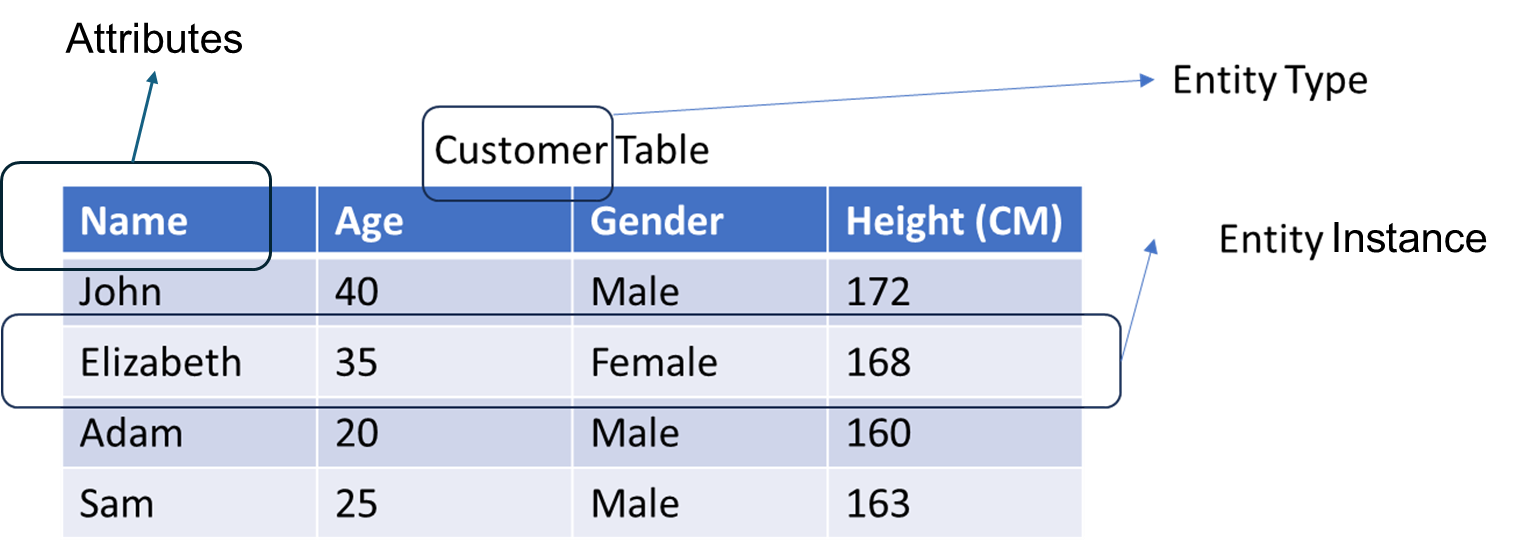
1. Entity Type – The Blueprint
An Entity Type is a template or schema that defines the structure of a category of entities. It specifies which attributes (data fields) each entity of that type will have, but it contains no actual data.
Key Characteristics of an Entity Type:
- Represents a general class or category
- Defines attributes such as Name, ID, or Price
- Used during the data modelling or design phase
- Maps directly to a table in a relational database
Example:
Consider the Book entity type in a library system:
- Attributes: Title, Author, ISBN, Publication Year
- This structure applies to all books managed in the system
2. Entity Attribute – The Properties
An Entity Attribute is a property, characteristic, or field that describes an entity. Attributes capture the details that differentiate one entity instance from another and form the actual data elements within a system. Without attributes, entities would remain abstract blueprints without descriptive power.
Key Characteristics of an Entity Attribute
- Defines a specific property of an entity type (e.g., Name, Age, Price)
- Holds actual values for each entity instance
- Provides granularity that enables searching, filtering, and reporting
- Maps to a column/field in a relational database table
Example
Using the Book entity type in a library system, attributes may include:
- Title (text)
- Author (text)
- ISBN (unique identifier)
- Publication Year (integer)
For the specific book I Am Data!:
- Title: I Am Data!
- Author: Mustafa Qizilbash
- ISBN: 978-1-23456-789-0
- Publication Year: 2023
Each of these fields represents an Entity Attribute.
Attribute Types
Attributes can be further classified into different types depending on their nature:
- Simple vs. Composite
- Simple: indivisible, like Age.
- Composite: can be broken down into sub-attributes, like Full Name (First Name, Last Name).
- Single-valued vs. multi-valued
- Single-valued: one value per entity, e.g., Date of Birth.
- Multi-valued: multiple values per entity, e.g., Phone Numbers.
- Derived Attributes
- Attributes calculated from other data, e.g., Age derived from Date of Birth.
- Key Attributes
- Uniquely identify an entity instance, such as ISBN for books or Employee ID for staff.
3. Entity Instance – The Real Thing
An Entity Instance is a specific, individual realization of an entity type. It represents real data, where values are assigned to the attributes defined by the corresponding entity type.
Key Characteristics of an Entity Instance:
- A single object or record derived from the entity type
- Has unique values for its attributes
- Represents actual data stored in the system
- Maps to a row in a database table
Example:
From the Book entity type, one entity instance could be:
- Title: I Am Data!
- Author: Mustafa Qizilbash
- ISBN: 978-1-23456-789-0
- Publication Year: 2023
This is a single, specific book, an entity instance of the Book entity type.
Closing Note
Understanding the distinction between Entity Type and Entity Instance is essential for designing structured data models, normalizing databases, and building scalable systems.
Think of it like this:
- Entity Type is the blueprint.
- Entity Instance is the real-world record built from that blueprint.
This clarity ensures consistent communication, efficient schema design, and more reliable data systems.
Finished reading? Test yourself with 10 questions on this topic.
Go to the questions →From I Am Datapedia! by Mustafa Qizilbash, published here free by the author. Nothing about your reading is stored.