Learn free · topic 48
5NF – Fifth Normal Form
(Projection–Join Normal Form)
Fifth Normal Form (5NF), also known as Projection–Join Normal Form (PJNF), eliminates redundancy that appears only when a table is decomposed into smaller projections and then re-joined. Unlike earlier normal forms, which focus on functional or multi-valued dependencies, 5NF addresses join dependencies, situations where a table can be reconstructed from multiple smaller tables, yet still contains hidden redundancy.
A table is in 5NF if it is already in Fourth Normal Form and every join dependency in the table is implied by the candidate keys alone. If a table can be decomposed into smaller tables in such a way that the original data can be perfectly reconstructed by joining them, without introducing spurious rows, then the decomposition should be performed.
To understand this more intuitively, consider an expanded loan example. Suppose we create a table that records relationships between Loan, Guarantor, and CollateralType together in one structure:
LoanGuarantorCollateral (LoanID, GuarantorID, CollateralType)
Now imagine that the relationships between Loan and Guarantor, Loan and CollateralType, and Guarantor and CollateralType are all independent but valid in combination. In some cases, the full three-column table may simply represent combinations that can be derived from three smaller binary relationships:
LoanGuarantor (LoanID, GuarantorID)
LoanCollateral (LoanID, CollateralType)
GuarantorCollateral (GuarantorID, CollateralType)
If the original three-column table contains no additional information beyond what can be derived by joining these three smaller tables, then storing the large table directly may introduce redundancy. Any update to one part of the relationship would require multiple row updates.
Fifth Normal Form ensures that such redundancy is removed. If a table’s information equals the natural join of two or more of its projections, and that dependency is not enforced by keys alone, the table should be decomposed into those projections. The decomposition must satisfy two conditions: when the smaller tables are joined, they recreate the original facts exactly, and no smaller table contains redundant data internally.
The key difference between 4NF and 5NF lies in the complexity of dependency. Fourth Normal Form handles independent multi-valued facts about the same key. Fifth Normal Form handles cases where redundancy emerges only through complex join patterns involving three or more attributes.
In practice, Fifth Normal Form is rarely required in everyday transactional systems. Most real-world schemas stabilize at 3NF or BCNF, and sometimes 4NF. However, 5NF becomes relevant in highly structured domains involving complex many-to-many-to-many relationships, especially where associations are fully independent.
Conceptually, 5NF ensures that a table contains only irreducible relationships, relationships that cannot be further decomposed without losing information. It refines relational purity to a high degree, preventing subtle redundancy that only becomes visible when examining join behavior.
With 5NF achieved, the model eliminates even advanced structural duplication. The remaining forms move toward extreme decomposition and theoretical completeness, beginning with Sixth Normal Form.
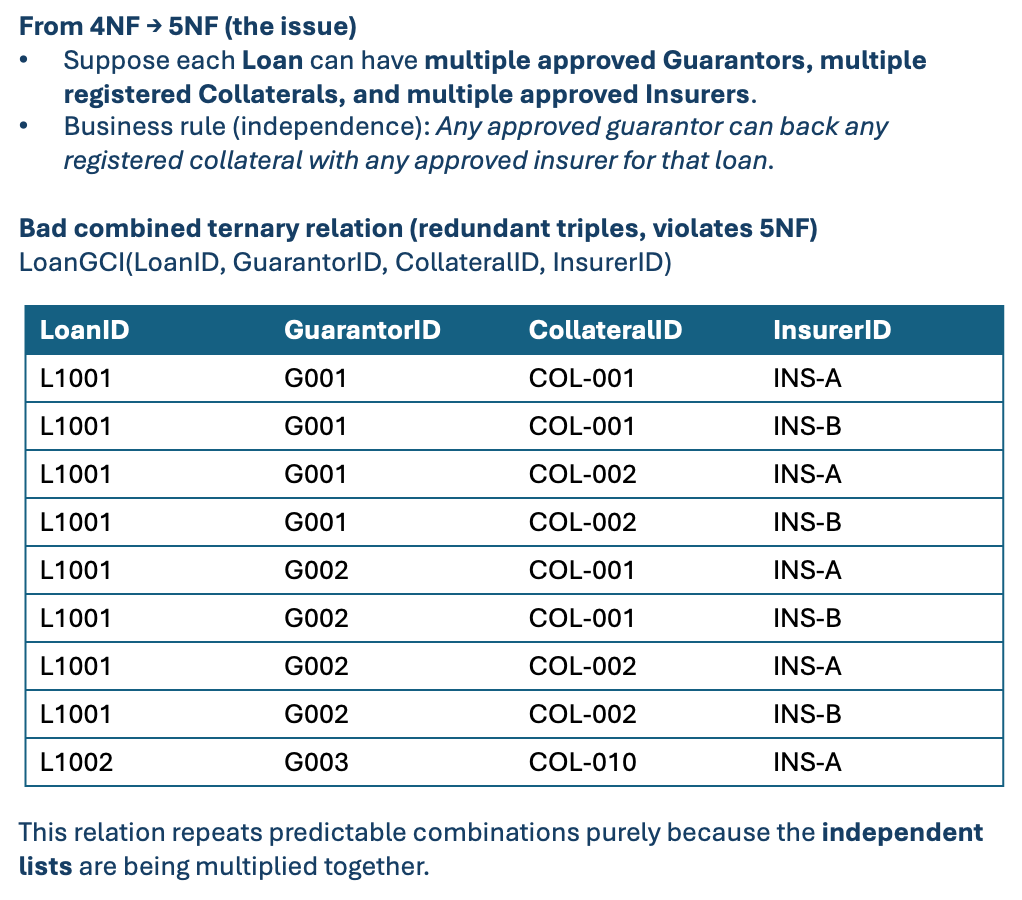
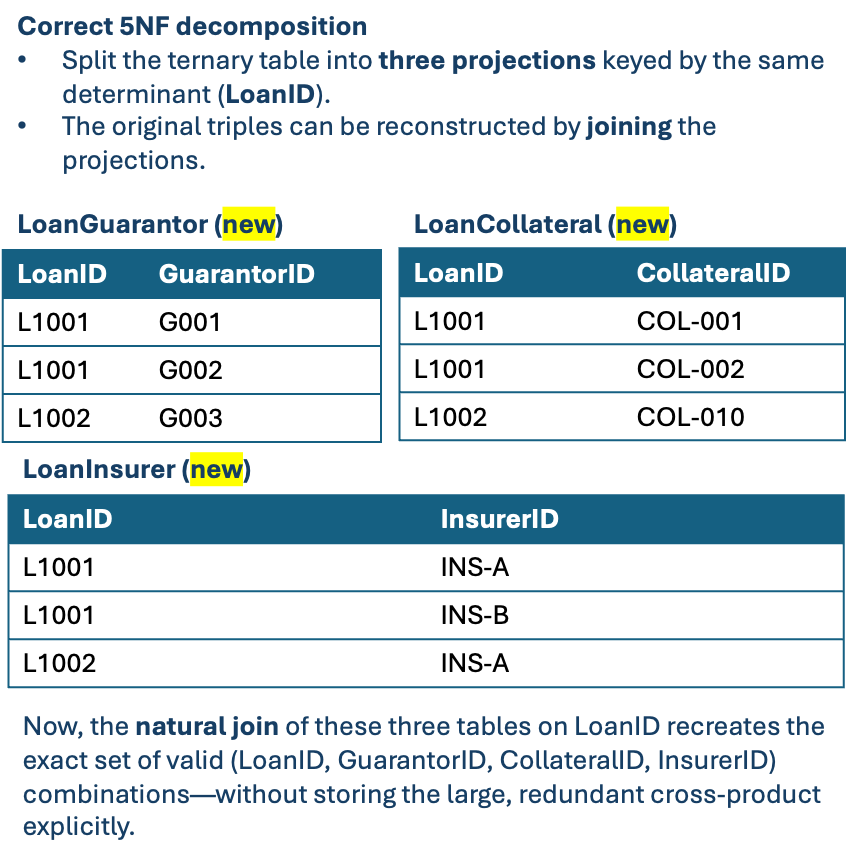
Correct 5NF decomposition
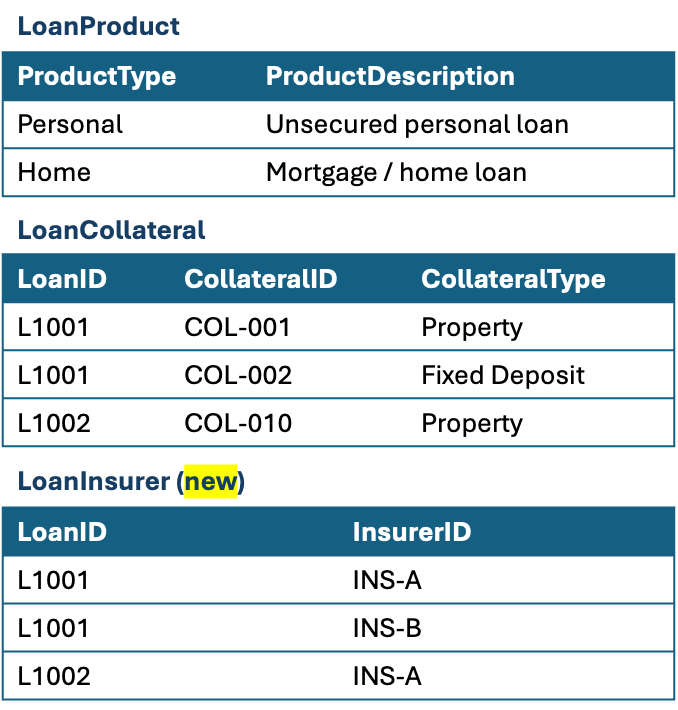
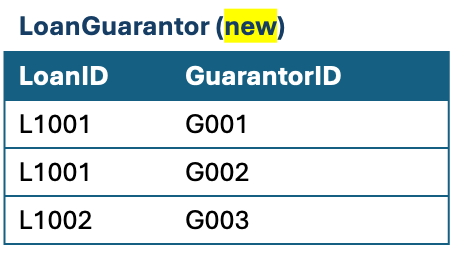
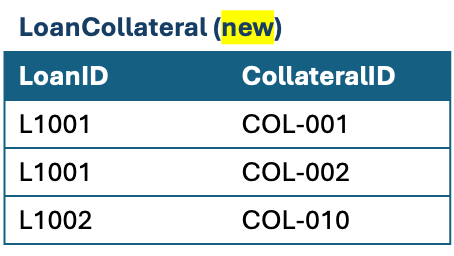
- Split the ternary table into three projections keyed by the same determinant (LoanID).
- The original triples can be reconstructed by joining the projections.
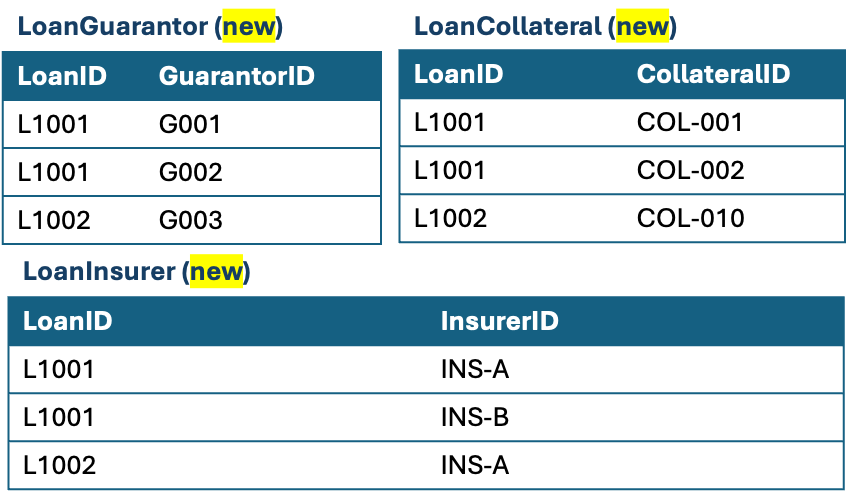
Now, the natural join of these three tables on LoanID recreates the exact set of valid (LoanID, GuarantorID, CollateralID, InsurerID) combinations, without storing the large, redundant cross-product explicitly.
What it adds
- Removes redundancy that only shows up in combined relations.
- Makes each independent list maintain-once, while preserving the ability to derive all valid combinations via joins.
- Prevents update anomalies in big “cross-product” tables.
When to stop
- Use 5NF when your fact table is essentially a cross-product of independent lists per key.
- If business rules constrain combinations (e.g., Guarantor G001 may not back Collateral COL-002), you’ll need an extra association table (e.g., LoanGuarantorCollateral) to model that constraint; in that case, don’t decompose to pure cross-product because the relationship is not fully independent.
⚠️ “5NF is the ‘why are we storing the cross-product?’ moment. If a loan’s approved guarantors, collaterals, and insurers are truly independent choices, the giant table of all triples is just repetition. Split them into three small relations keyed by the loan and join them when needed. But, if business rules block some combinations, you’ll need explicit association tables instead of pretending independence.”

Finished reading? Test yourself with 10 questions on this topic.
Go to the questions →From I Am Datapedia! by Mustafa Qizilbash, published here free by the author. Nothing about your reading is stored.