Learn free · topic 30
Taxonomy Modelling
Taxonomy Modelling is the practice of organizing concepts into hierarchical categories, typically arranged in parent–child structures. Its purpose is to classify terms in a structured and consistent way so that they are easier to understand, navigate, and manage.
The main goal of Taxonomy Modelling is to provide a clear and simple classification framework. By grouping related concepts under broader categories, organizations can standardize terminology, improve search and navigation, and ensure that everyone uses the same structure when referring to business terms.
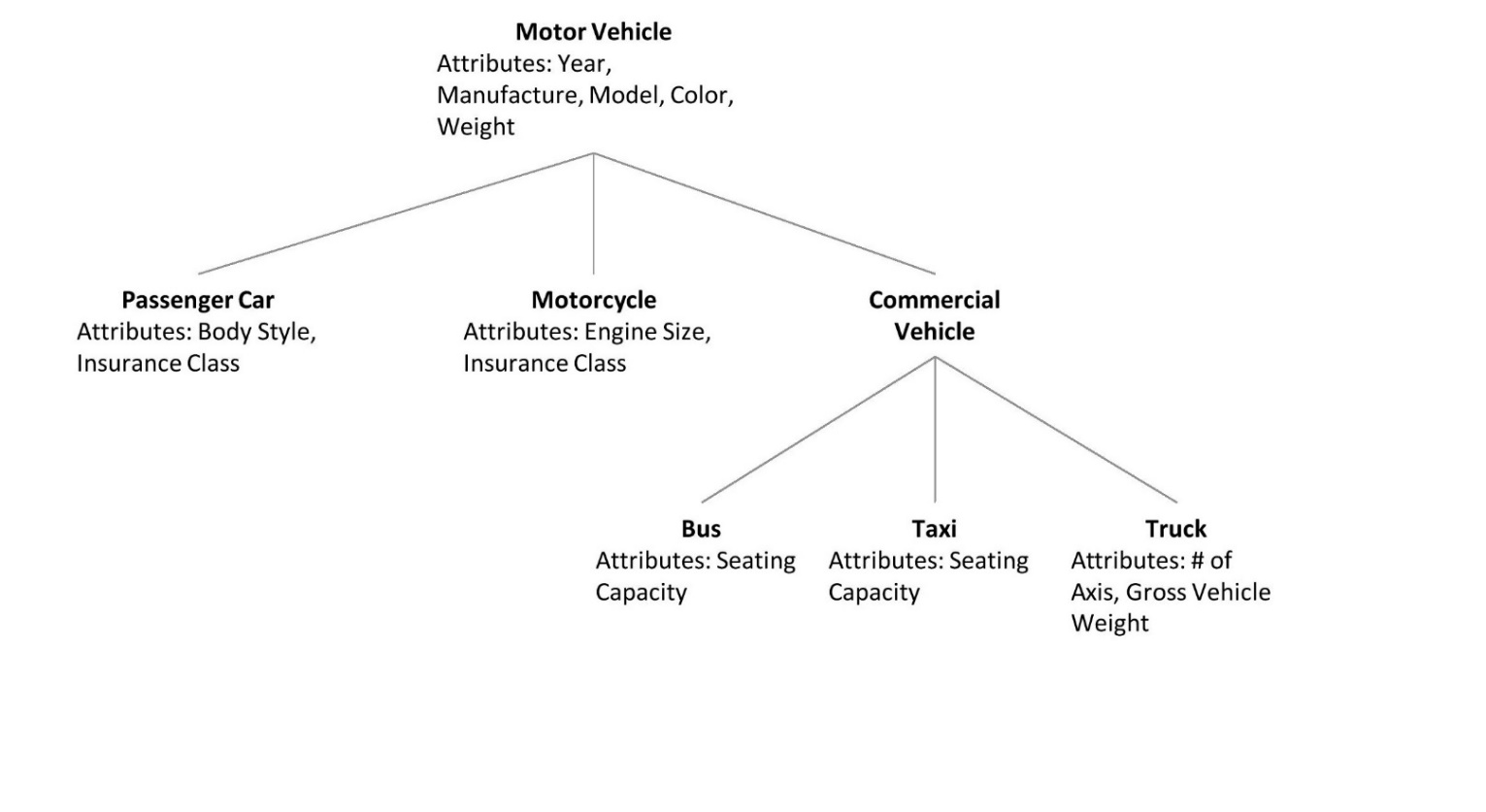
A taxonomy focuses purely on classification. It arranges concepts into levels of abstraction, moving from general to specific. For example, in healthcare, one might classify Diseases at a high level, then Infectious Diseases beneath that, followed by Viral Infections, and then specific conditions such as COVID-19. Each level refines the previous one. The structure is hierarchical and orderly, but it does not attempt to capture complex rules or reasoning.
To understand this more simply, consider a school library. Books may first be grouped into broad categories such as Science, Literature, and History. Under Science, there may be subcategories such as Physics, Chemistry, and Biology. Under Biology, there may be topics such as Human Biology or Environmental Science. This hierarchical arrangement makes it easy to locate and organize knowledge without requiring detailed logical rules.
In a banking context, Taxonomy Modelling can be used to classify loan products. At a high level, there may be a category called Loan Products. Under that category, there may be Personal Loans, Home Loans, Auto Loans, and SME Loans. These can be further subdivided. For example, Personal Loans may be classified as Secured or Unsecured. Home Loans may be classified as Fixed Rate or Variable Rate. This structure helps organize products clearly and consistently.
Taxonomies are also very useful in analytics and reporting. Because categories are clearly defined, metrics can be grouped and compared by classification. An organization may calculate the average loan amount by product type, compare approval rates for secured versus unsecured loans, or measure default ratios across different loan categories. The hierarchical structure ensures that reporting is consistent and understandable.
It is important to distinguish taxonomy from ontology. While both involve organizing concepts, taxonomy focuses only on classification and hierarchy. It does not define detailed relationships, constraints, or reasoning rules. Ontologies are more complex and expressive, allowing systems to infer new knowledge. Taxonomies are simpler and lighter, making them easier to maintain and apply across large organizations.
The nature of Taxonomy Modelling is therefore hierarchical and classification-focused. It is technology-independent and widely used in areas such as metadata management, knowledge organization, retail catalogues, digital libraries, and content management systems. Because it is simpler than ontology modelling, it often serves as a starting point for building more advanced knowledge frameworks.
In summary, Taxonomy Modelling provides a structured way to organize business terms into agreed categories and hierarchies. It simplifies communication, improves navigation and reporting, and lays the groundwork for more advanced semantic modelling. By clearly defining how concepts are grouped, it brings order and clarity to enterprise knowledge without introducing unnecessary complexity.
Finished reading? Test yourself with 10 questions on this topic.
Go to the questions →From I Am Datapedia! by Mustafa Qizilbash, published here free by the author. Nothing about your reading is stored.