Learn free · topic 34
Canonical Data Modelling
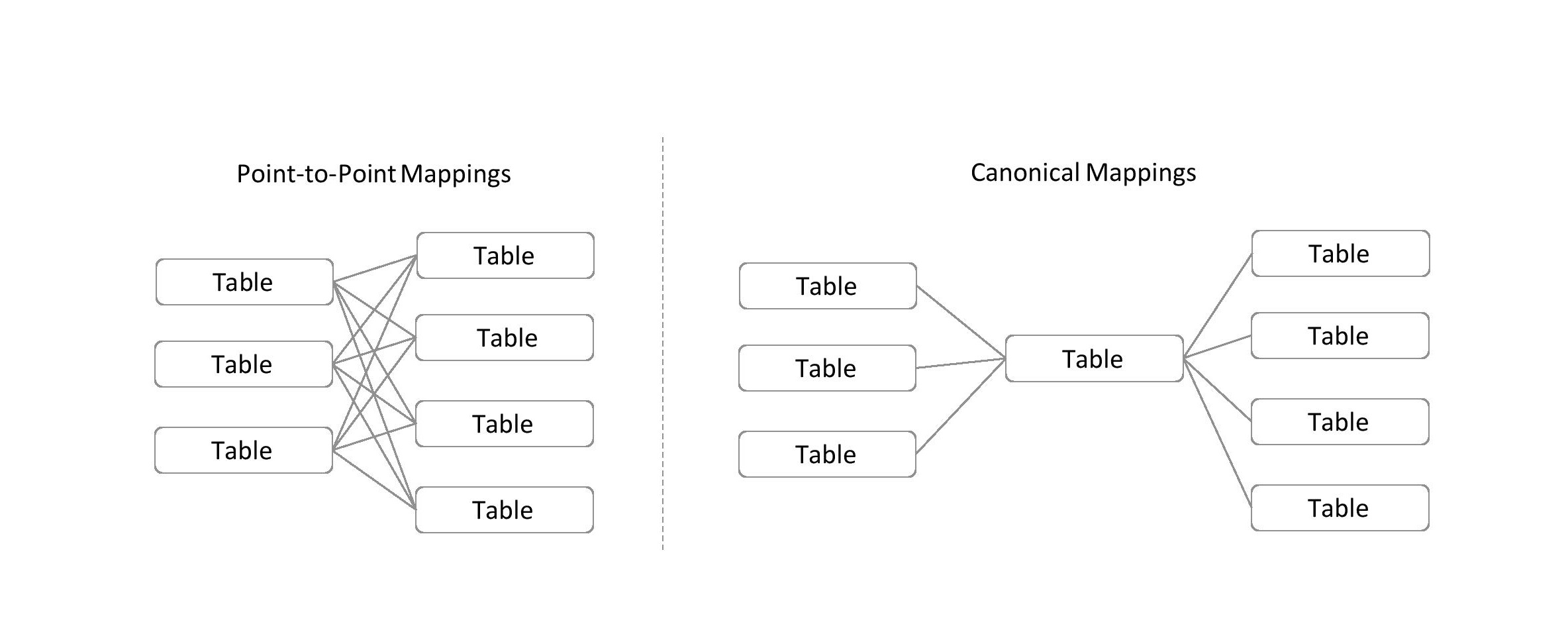
In many organizations, integration evolves through point-to-point connections. In a point-to-point model, each system directly maps its data format to every other system it communicates with. While this may work in small environments, it becomes increasingly complex as more systems are added. If five systems need to exchange information, each system may require multiple custom mappings. As the enterprise grows, the number of integrations expands rapidly, creating tight coupling, duplicated transformation logic, and high maintenance overhead. Any change to one system, such as an upgrade or replacement, can require modifications in many connected systems. Over time, the integration landscape becomes fragile and difficult to manage.
Canonical Data Modelling introduces a more controlled approach. Instead of every system translating to every other system, each system translates only to and from the canonical structure. In this model, systems do not communicate directly with one another’s proprietary formats. They communicate through the shared canonical representation. For example, if an ERP system is integrated with twenty other applications and later needs to be replaced, only the ERP-to-canonical mapping must be updated. The other applications continue communicating with the canonical structure unchanged. This significantly reduces integration complexity, lowers maintenance effort, and minimizes operational risk.
In a loan-processing environment, Canonical Data Modelling ensures that a Loan Application is represented in the same structure regardless of which system produces or consumes it. A canonical representation may include standardized elements such as Customer Identifier, Application Identifier, Application Date, Loan Amount, and Approval Decision. The Loan Origination System, Risk Engine, and Collections system may each have different internal schemas, but when exchanging information, they translate their data into this agreed canonical format. Each system performs a transformation from its internal model to the canonical model when sending data and from the canonical model back to its internal structure when receiving data. This allows internal autonomy while preserving enterprise-level consistency.
Canonical Data Modelling also simplifies analytics. When data from multiple operational systems is consolidated into a data warehouse or lakehouse, consistent canonical structures reduce reconciliation effort. Analysts do not need to adjust queries to account for structural differences between source systems. Measures such as counting loan applications by approval decision, calculating average loan amounts, or analyzing portfolio performance can be performed reliably because the exchanged data follows a unified representation.
It is important to distinguish Canonical Data Modelling from semantic or ontology modelling. While ontology modelling focuses on meaning, classification, and reasoning, canonical modelling focuses on practical interoperability. Its objective is not to enable inference, but to ensure that heterogeneous systems can exchange structured information in a predictable and standardized way. Canonical models are typically implemented at integration layers such as APIs, service buses, integration hubs, or event-driven architectures.
Canonical Data Modelling is therefore cross-system and enterprise-wide in nature. It is technology-agnostic in principle and designed to reduce integration complexity by replacing fragile point-to-point mappings with a structured, maintainable exchange model. While earlier modelling techniques focused on meaning, connectivity, and contextual richness, Canonical Data Modelling addresses a different architectural challenge: scalable, reliable, and consistent data exchange across heterogeneous systems.
Integration Approaches: Point-to-Point vs Canonical
Approach | How it works | Loan Example Impact |
Point-to-Point | Every system translates directly to every other system (n × (n-1) mappings). | Loan Processing → Risk Engine → Core Banking → Collections → Data Warehouse → each has custom mapping |
Canonical Modelling | Each system maps once into a shared canonical format. | All systems exchange Loan Application in the same structure (CustomerID, ApplicationID, Decision…) |
“Without Canonical: every system maps to every other→spaghetti (Point-to-Point).” “With Canonical: every system maps once into a shared hub.”
Canonical Modelling replaces many-to-many integrations with one-to-many, a massive reduction in complexity.
Finished reading? Test yourself with 10 questions on this topic.
Go to the questions →From I Am Datapedia! by Mustafa Qizilbash, published here free by the author. Nothing about your reading is stored.