Learn free · topic 314
Supertype and Subtype
In data modelling, particularly in the context of relational databases, the terms "supertype" and "subtype" are used to describe the relationships between entities.
Let's explore these concepts:
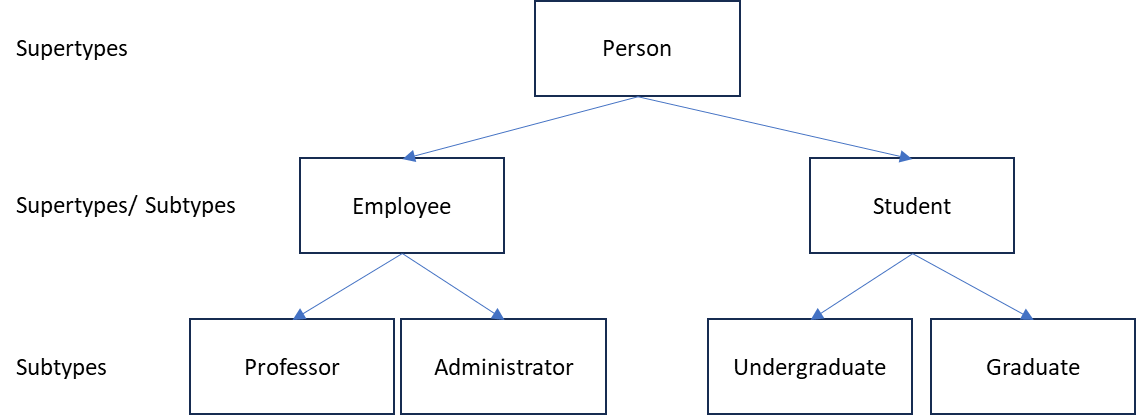
Supertype: A supertype is a generalization that represents a higher-level entity. It encompasses common characteristics shared by multiple lower-level entities.
- It contains attributes common to multiple related entities.
- It represents the generalization of several entities.
- For example, consider a supertype "Vehicle" that includes common attributes like "Manufacturer," "Model," and "Year." Cars, motorcycles, and trucks could be subtypes of this supertype, inheriting these common attributes.
- Subtype: A subtype is a specialization of a supertype, representing a more specific entity with additional attributes or characteristics.
- It inherits attributes from the supertype and may have additional attributes.
- It represents a more specific category within the generalization.
- For example, using the "Vehicle" example, "Car" is a subtype that inherits attributes from the "Vehicle" supertype but may have additional attributes specific to cars, such as "Number of Doors" or "Body Type."
Key Concepts:
- Inheritance: Subtypes inherit attributes from their supertype, promoting reusability and reducing redundancy.
- Generalization and Specialization: Supertypes represent general concepts, and subtypes represent more specific variations or specializations of those concepts.
- Completeness: Subtypes can be categorized as either "total" (covering all instances of the supertype) or "partial" (covering only some instances).
Another example, consider a scenario where you have a supertype "Employee" with common attributes like "Name" and "EmployeeID." Subtypes could include "Manager" and "Technician," each having additional attributes like "Department" or "Skills."
In summary, supertypes and subtypes are used in data modelling to represent general and specific entities, facilitating the organization of data in a way that captures both commonalities and differences among related entities.
Finished reading? Test yourself with 10 questions on this topic.
Go to the questions →From I Am Datapedia! by Mustafa Qizilbash, published here free by the author. Nothing about your reading is stored.