Learn free · topic 29
FCO-IM Modelling
Fully Communication Oriented Information Modelling, commonly referred to as FCO-IM, is a modern fact-oriented information modelling method that focuses on capturing information exactly as it is communicated in natural language. Developed from the 2000s onward, FCO-IM addresses a long-standing problem in modelling: the loss of meaning that often occurs when business statements are translated into technical models.
The primary goal of FCO-IM is to eliminate the gap between business communication and technical design. Instead of forcing business facts to fit immediately into predefined structures such as entities and attributes, FCO-IM records facts in their original verbal form. These verbalized facts are then systematically transformed into formal models, ensuring that nothing is lost or reinterpreted along the way.
Unlike earlier modelling approaches, FCO-IM treats communication itself as the object of modelling. It recognises that business knowledge is first expressed through spoken or written sentences. These sentences carry nuances, timing, responsibility, and intent that are often weakened or removed when models jump too quickly into abstraction. FCO-IM preserves this richness by treating each sentence as a first-class modelling artefact.
A simple example helps illustrate this idea. A stakeholder might say, “Order 123 is placed by Customer John on 1 January 2025.” Instead of immediately breaking this into tables or attributes, FCO-IM records the sentence exactly as communicated. From this sentence, formal fact types can later be derived, such as “Customer places Order” and “Order has Order Date.” Because the original sentence is retained, the model always remains traceable back to the original business communication.
In an operational business context such as loan processing, FCO-IM begins by collecting sentences directly from stakeholders. Examples include statements like “Customer 123 submits Loan Application 456 on 12 August,” “Loan Application 456 has approval decision Approved,” or “Loan Application 456 is linked to Repayment Schedule R1.” These sentences are not rewritten or simplified at first; they are captured as they are spoken or written.
From these sentences, fact types are extracted in a controlled and transparent way. For example, “Customer submits Loan Application,” “Loan Application has Approval Decision,” and “Loan Application is linked to Repayment Schedule” become formalized facts. Roles and constraints are then defined explicitly. A customer may submit one or more loan applications. Each loan application must have exactly one approval decision. Each loan application may be linked to one or more repayment schedules. Every rule in the model can be traced back to one or more original sentences.
One of the most important characteristics of FCO-IM is traceability. Every fact, rule, and constraint remains linked to the original business communication that justified it. This ensures that the model always reflects how the business actually talks about its operations, rather than how a modeller assumes it should work. When questions arise, teams can always return to the original sentences to validate or refine the model.
FCO-IM also supports analytical use cases without redefining meaning. Measures such as loan approval rate or delinquency ratio are derived directly from the same fact sentences used in operational modelling. Because analytics reuse the same verbalized facts and constraints, reports and key performance indicators remain consistent across the organization.
Another key strength of FCO-IM is its ability to support automatic transformation. Once facts are captured and structured, they can be transformed into many technical representations, including entity-relationship diagrams, UML models, XML schemas, semantic web models, and even executable systems. This allows FCO-IM to act as a true bridge between business understanding and technical implementation.
In terms of its nature, FCO-IM is communication-driven, fact-oriented, and highly precise. It sits between conceptual understanding and logical data modelling, ensuring that meaning is preserved before structural decisions are made. Rather than replacing other modelling techniques, it strengthens them by providing a semantically sound foundation.
In summary, FCO-IM represents the most mature evolution of fact-based information modelling. It captures business facts as they are communicated, preserves their meaning through traceability, and enables consistent transformation into technical models. This makes it a powerful bridge between business language, system design, and analytics, ensuring that information remains accurate, testable, and reusable across the entire enterprise.
🡪 Below is by Marco Wobben
Fact Oriented Modelling is based on decades of research, and by now knows three dialects. Nijssen Information Analysis Method (NIAM), Object Role Modelling (ORM), and Fully Communication Oriented Information Modelling (FCO-IM).
In this topic, we will focus on Fully Communication Oriented Information Modelling (FCO-IM).
It all started around NIAM which focused on language to capture business knowledge and build data models with them. ORM was the successor which worked out how to model using first order predicate logic. Whereas FCO-IM serves the communication of the business about data itself.
Fact-Oriented Modelling (FOM) remains a relevant approach, though some of its dialects, NIAM (Nijssen Information Analysis Method) and ORM (Object-Role Modelling), are less commonly used in mainstream practice today. However, they are not entirely obsolete. Below is a summary of their history and current status:
NIAM (Nijssen Information Analysis Method) – 1970s
- Developed by G.M. Nijssen, NIAM was one of the earliest fact-based Modelling methodologies.
- It focused on representing business facts in a structured manner.
- Over time, its concepts were refined and incorporated into ORM, making NIAM largely obsolete as a standalone method.
- NIAM served as the foundation for later fact-oriented approaches.
- ORM (Object-Role Modelling) – 1980s
- ORM evolved from NIAM, with refinements introduced by Terry Halpin and others.
- It enhanced fact-based Modelling with role-based constraints, conceptual schema representation, and improved tool support (later refined in ORM 2).
- ORM, particularly its second-generation version (ORM 2), is still used in specialized fields, including academic research and conceptual data Modelling.
- Some tools, such as Microsoft Visio (via the NORMA plugin), continue to support ORM.
- However, modern database Modelling approaches, such as entity-relationship Modelling (ER), NoSQL schema design, and knowledge graph-based methodologies, are more commonly adopted in real-world applications.
- FCO-IM (Fully Communication-Oriented Information Modelling) – 1990s
- FCO-IM evolved from NIAM, placing greater emphasis on capturing information exactly as it is communicated in real-world contexts.
- It remains in use, particularly in Europe (especially Dutch-speaking regions), where it helps with regulatory compliance and knowledge structuring.
- Evolution Path
NIAM (1970s) → ORM (1980s, refining NIAM) → FCO-IM (1990s, with a focus on real-world communication).
While these fact-oriented approaches may not dominate industry practice, the underlying principles of verbalization, constraint enforcement, and rule-based Modelling continue to influence modern data methodologies.
FCO-IM focuses on how domain experts communicate about their data, instead of the structure and dependency of the data itself. This is a fundamental difference and yet so subtle, it is hard for many professionals to grasp the advantages.
Any data model is hard to build, and even harder to verify. Various technologies structure that data in different ways to optimize for their own purpose. Yet, the authentic story of the business experts, on what they do, and how they communicate amongst each other to do the work the best they can, is lost from the start.
Reality is, data is not a reflection of reality, it reflects how people communicate. Modelling data therefor falls short of the need to communicate. Building IT products based on abstract data structures may serve the purpose of a single communication pipeline but rarely serves the experts or the organization as a whole and is almost never a holistic approach.
Natural Language
Capturing the actual expert communication about data, in the natural language of the experts, complete with definitions, concrete examples, to find the label types (value types) and the object types (the things that reflect something in the business domain), is there for crucial.
It all starts with atomic fact expressions such as:
- Marco Wobben speaks in Episode 37 of 'Lets talk about data'.
- 'Lets talk about data' is hosted by Mustafa Qizilbash.
In Episode 37 of 'Lets talk about data' the topic 'FCO-IM Data Modelling' is discussed.
Information Grammar
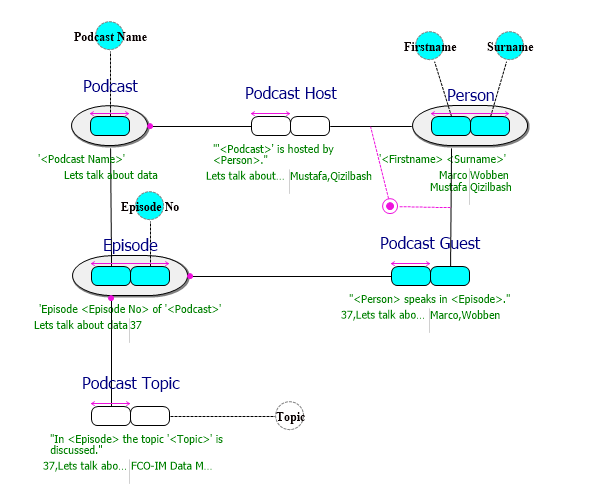
After having interviewed domain experts for the fact expressions, their knowledge is needed to further analyze the parts of it, and to name those. From such analysis the following information grammar may arise:
After having classified and qualified all the above stated facts, we can visualize the information model as shown below. The highlighted parts correspond to the elements from the first fact expression to show its grammar in context.
UML Class Diagram
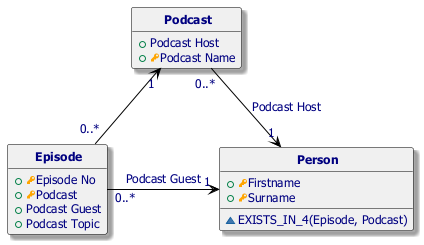
Through automation FCO-IM tools (such as CaseTalk) transform the information model into data modal. The above model is represented in UML as such:
Relational Diagram
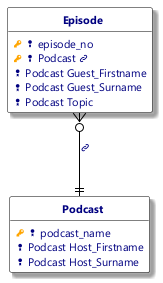
Similarly, tools can represent it as a relational diagram.
This instantly shows the different outcomes when comparing a UML diagram with a relational model. Normalized databases traditionally have less tables to store the data optimally. It demonstrates at the same time why a relational models are harder to verify.
Relational Diagram ++
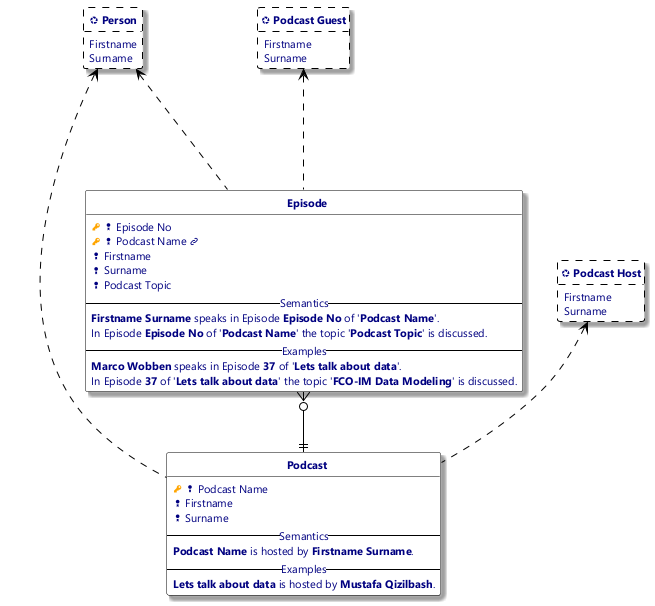
For that reason, database views and documentation are added into the diagram:
This is a brief overview of the method of FCO-IM. There’s a lot more to the story which is not told in these few pages.
To learn more about that visit the modeled podcast. To learn more, order the book called “Just the Facts” by Marco Wobben which exclusively explains the method, the bridging of Business and IT, and the wide range of artifacts CaseTalk can generate.
The favorite FCO-IM tool is called CaseTalk, which handles enterprise scale information models, supporting versioning, model lineage, data governance, temporal data, DataVault, and also artifacts such as column stores, JSON, XML and semantic web (OWL), Graph, Linked Data, Code Generators, Database Generators, and even allow navigating live data from your databases. Visit www.casetalk.com for free downloads.
Comparison
Aspect | NIAM | ORM | FCO-IM |
Era | 1970s | 1990s | 1990s → Today |
Approach | Facts as simple natural-language sentences | Objects play roles in facts, with richer constraints | Facts captured exactly as communicated in natural language |
Strength | Easy for business users to validate | Expressive: adds uniqueness, cardinality, constraints | Ensures traceability and automatic transformations to data models |
Limitation | Too simplistic for complex business rules | Powerful but complex; harder for business users | More formal, still requires discipline to apply |
Loan Approval Example | “Customer submits Loan Application” | Customer (object) applies for (role) Loan (object) | Sentence: “Customer 123 submits Loan Application 456 on 12-Aug” → Fact Type: Customer submits Loan Application |
Practical Relevance Today | Historical (rarely used) | Mostly academic / niche | Modern best practice, used in real projects |
Key Takeaway
- NIAM = Origin (simple, natural-language facts).
- ORM = Expansion (adds roles, rules, and constraints).
- FCO-IM = Modern best practice (retains natural communication + traceability → technical models).
This comparison slide cements the story of evolution.
Finished reading? Test yourself with 10 questions on this topic.
Go to the questions →From I Am Datapedia! by Mustafa Qizilbash, published here free by the author. Nothing about your reading is stored.