Learn free · topic 75
SECURITY & ACCESS CONTROL MODELLING
Security & Access Control Modelling is the practice of defining structured rules and frameworks that determine who can access what data, under which conditions, and in what manner. It formalizes data protection through roles, permissions, entitlements, and policies aligned with organizational security requirements and regulatory obligations.
The primary goal of this modelling approach is to ensure that sensitive information is accessible only to authorized users while still enabling legitimate business access. It balances protection and productivity by translating business security rules into enforceable system controls.
At its core, Security & Access Control Modelling defines entities such as:
- Users (individual identities)
- Roles (grouped responsibilities or job functions)
- Permissions (allowed actions, such as read, write, approve)
- Policies (conditional rules governing access)
Typically, users are assigned to roles, roles carry permissions, and policies define constraints such as time of access, geographic location, or device type.
In data environments, access modelling extends beyond simple table-level permissions. It may include:
- Row-Level Security (RLS) – restricting access to specific rows based on attributes (e.g., branch assignment).
- Column-Level Security (CLS) – masking or hiding sensitive fields such as Salary or LoanAmount.
- Attribute-Based Access Control (ABAC) – enforcing rules based on user attributes, data attributes, and environmental conditions.
Unlike purely technical configurations within databases or applications, security modelling provides the enterprise blueprint that connects business requirements with enforcement mechanisms. For example, a business rule such as “Only Risk Officers can view defaulted loan details” is formalized through structured roles, permissions, and policies.
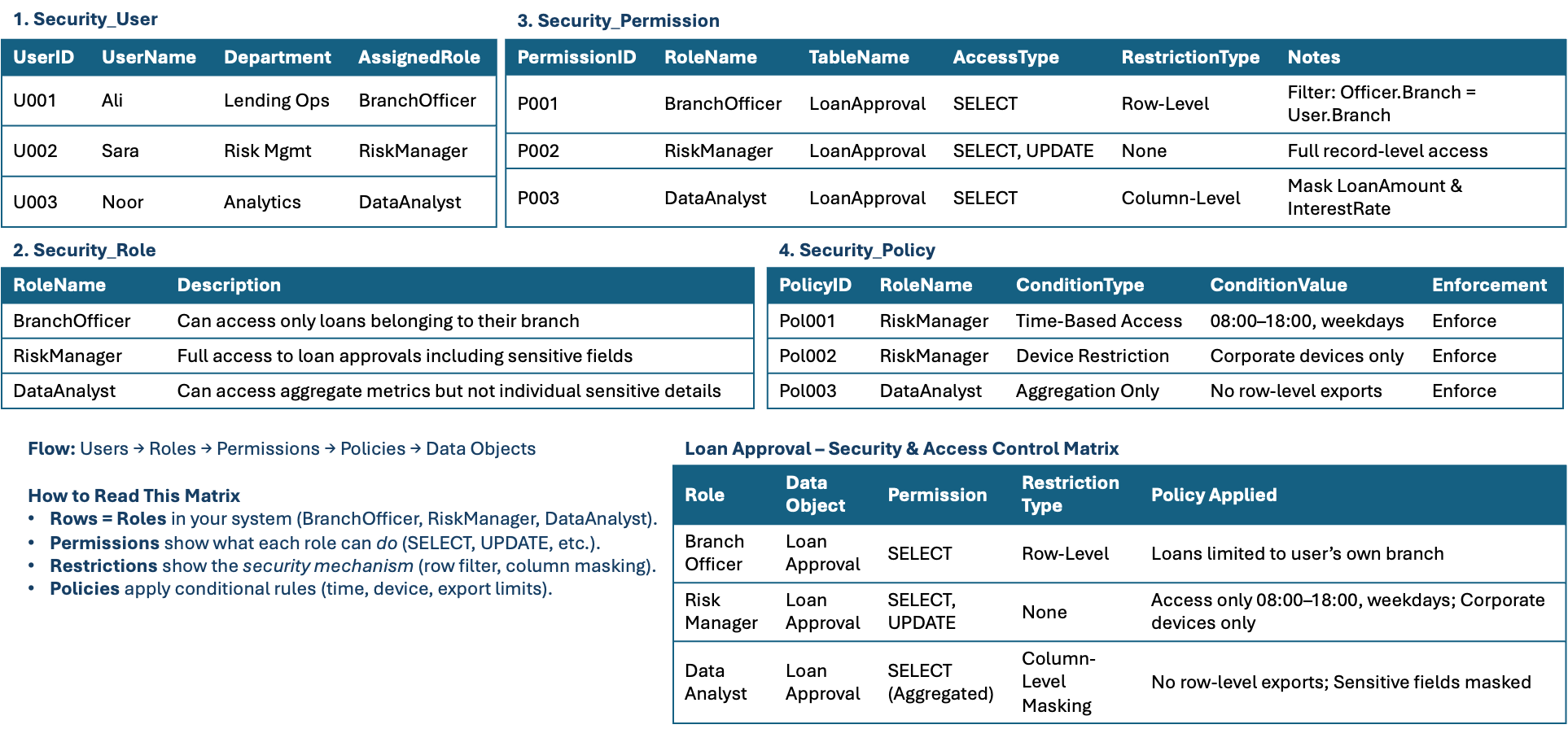
Consider a loan approval system within a bank. Certain fields such as LoanAmount and InterestRate are marked as sensitive. A well-designed security model may enforce:
- Branch Officers can only view loans assigned to their own branch (row-level control).
- Analysts can access aggregated loan statistics but cannot view individual customer names (column masking).
- Risk Managers have full access but only during office hours and from corporate-managed devices (policy-based access control).
The strengths of Security & Access Control Modelling include structured protection of sensitive data, reduced risk of breaches, and alignment between business policies and technical enforcement. It supports fine-grained controls and provides traceability for audits and compliance reporting.
However, the approach introduces complexity. Large organizations may face “role explosion,” where too many narrowly defined roles become difficult to manage. Without disciplined governance and change management, access creep can occur, where users accumulate permissions over time. Highly granular controls may also affect system performance if not implemented carefully.
From a modelling perspective, Security & Access Control Modelling is governance- and compliance-driven. It is cross-cutting in nature, applying across applications, data warehouses, data lakes, BI platforms, and APIs. It does not replace other modelling techniques but overlays them with structured protection and accountability.
In summary, Security & Access Control Modelling translates business access requirements into enforceable structures and policies. By defining users, roles, permissions, and conditional controls, it ensures confidentiality, integrity, accountability, and trust across enterprise data environments.
How this reads (Hook logic in one line)
- Ali (Branch Officer) can only view loans assigned to his branch.
- Sara (Risk Manager) can see all loan data, but only during business hours and from corporate devices.
- Noor (Data Analyst) can query aggregates for trends, but sensitive fields like LoanAmount are masked.
Security & Access Control models bridge business policy and technical enforcement. They ensure analysts, managers, and officers see exactly what they should, and nothing more.
Finished reading? Test yourself with 10 questions on this topic.
Go to the questions →From I Am Datapedia! by Mustafa Qizilbash, published here free by the author. Nothing about your reading is stored.