Learn free · topic 350
Reference Architecture
Reference Architecture is foundational to designing any complex system or solution. It provides a high-level diagram that represents the structural pattern of the solution, establishing a consistent framework that guides the design and implementation of similar projects across an organization. Unlike solution architecture, which is customized for each project, reference architecture offers a generalized template that aligns with established best practices, making it broadly applicable and easily understandable for both technical and non-technical stakeholders.
Purpose and Benefits
The main objective of a reference architecture is to set a standardized approach for designing solutions within an organization. This ensures consistency, reduces redundancy, and accelerates solution delivery by offering a clear blueprint. With this architecture, teams can quickly understand the fundamental elements of the solution, enabling efficient alignment with organizational goals. Additionally, reference architectures aid in risk management by promoting tried-and-tested design patterns and technologies, minimizing potential errors in execution.
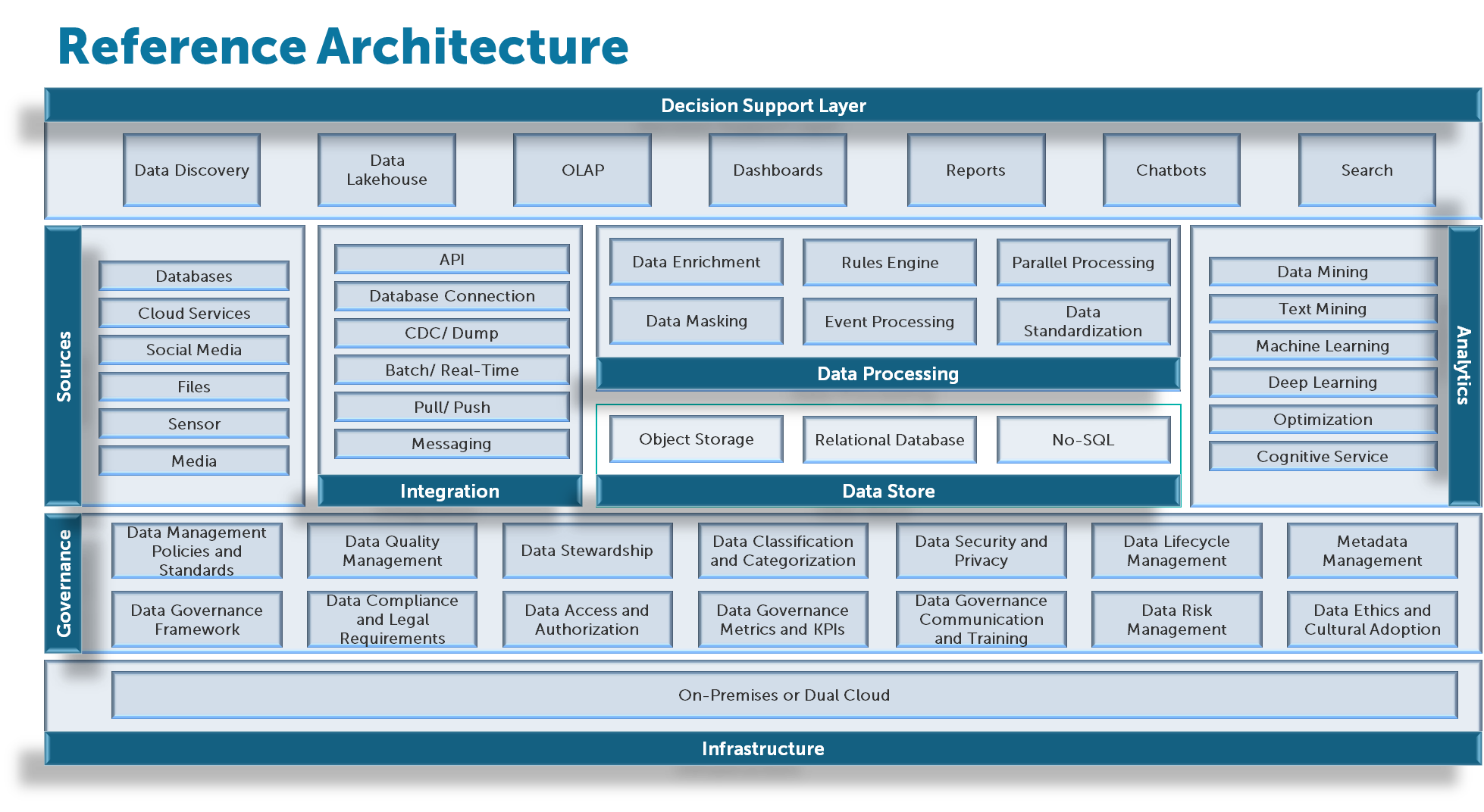
Components of Reference Architecture
In a data and AI cognitive (DAC) environment, a typical reference architecture shows how data flows through multiple stages, each with specific roles and purposes. This architecture provides a high-level outline of where each component fits into the broader ecosystem. Here are the key components of a DAC-oriented reference architecture:
- Data Sources: The starting point for data entry into the system, data sources can range from transactional databases, applications, IoT devices, external datasets, to cloud storage. Each source supplies raw data into the architecture.
- Landing Zone: This is a centralized area where raw data is ingested and stored temporarily. The landing zone acts as a buffer before the data moves to more structured layers, enabling secure and controlled intake from diverse sources while maintaining data integrity and traceability.
- Staging Area: After the data is ingested, it moves to the staging area. Here, data undergoes preliminary cleaning and transformation. This stage prepares the data for further processing, ensuring consistency and completeness before it advances through the pipeline.
- Transformation and Storage Layer: This is often where advanced data processing occurs. Within this layer, data is transformed, enriched, and stored in data warehouses or other storage solutions to support reporting, analytics, and advanced AI models. This stage may also involve a semantic layer, organizing data in ways that business users can easily query and understand.
- Virtualization Layer: In cases where direct access to data is needed without physically moving or duplicating it, the virtualization layer provides a logical view of the data. This approach helps optimize resource usage, facilitates quicker access, and supports diverse analytical queries without compromising performance.
- Analytics and Machine Learning Layer: This advanced layer houses analytics, machine learning, and artificial intelligence workloads. Here, data scientists, analysts, and AI specialists conduct experiments, build predictive models, and gain insights to support data-driven decision-making. It enables the application of advanced techniques like deep learning, natural language processing (NLP), and real-time analytics.
- Data Governance Layer: A crucial component in reference architectures, the data governance layer ensures that data usage adheres to regulations, standards, and policies. This layer incorporates data quality, metadata management, security controls, and audit logs, helping maintain compliance and trustworthiness across the data ecosystem.
- Presentation and Consumption Layer: The last stage of the architecture, this layer enables end-users and applications to access data for decision-making. It includes dashboards, reports, APIs, and other consumption interfaces that deliver curated insights to business units, product teams, and executives.
Building Blocks of Reference Architecture
Each component in the reference architecture integrates specific tools and technologies that align with the organization's technology stack. For example, in a cloud-centric architecture, tools like Azure Data Factory, Google BigQuery, or Amazon Redshift may be involved in data storage and transformation, while Tableau, Power BI, or custom web applications may populate the presentation layer. In an advanced DAC framework, there might also be additional layers or specialized tools for handling real-time data, data cataloguing, or federated data access.
In summary, reference architecture is the backbone of solution design, establishing a reusable, adaptable template that supports project efficiency, scalability, and coherence. By clearly defining each component and its role, it fosters alignment across teams and simplifies the complexities of modern data and AI ecosystems. Reference architecture acts as a bridge between the technical intricacies and strategic objectives of an organization, empowering everyone, from data engineers to business stakeholders, with a shared understanding of the solution landscape.
Finished reading? Test yourself with 10 questions on this topic.
Go to the questions →From I Am Datapedia! by Mustafa Qizilbash, published here free by the author. Nothing about your reading is stored.