Learn free · topic 153
Data Fabric
The concept of the Data Fabric is often confused with the Data Hub, but while the two share the goal of breaking down silos, they operate at different levels of abstraction. The Data Hub serves as the distribution and operationalization layer, enabling insights from analytical platforms to flow back into enterprise applications. The Data Fabric, by contrast, is a broader architectural paradigm that unifies data governance, integration, and orchestration across the entire enterprise ecosystem.
In the earlier discussion of the Data Hub, we established that enterprise systems are typically divided into three categories:
- Operational systems (OLTP): core business applications such as ERP, CRM, and core banking.
- Data Warehouses (DWH): supporting business intelligence through dashboards, reports, and data mining.
- Data Lakes: enabling advanced analytics, machine learning, and data science.
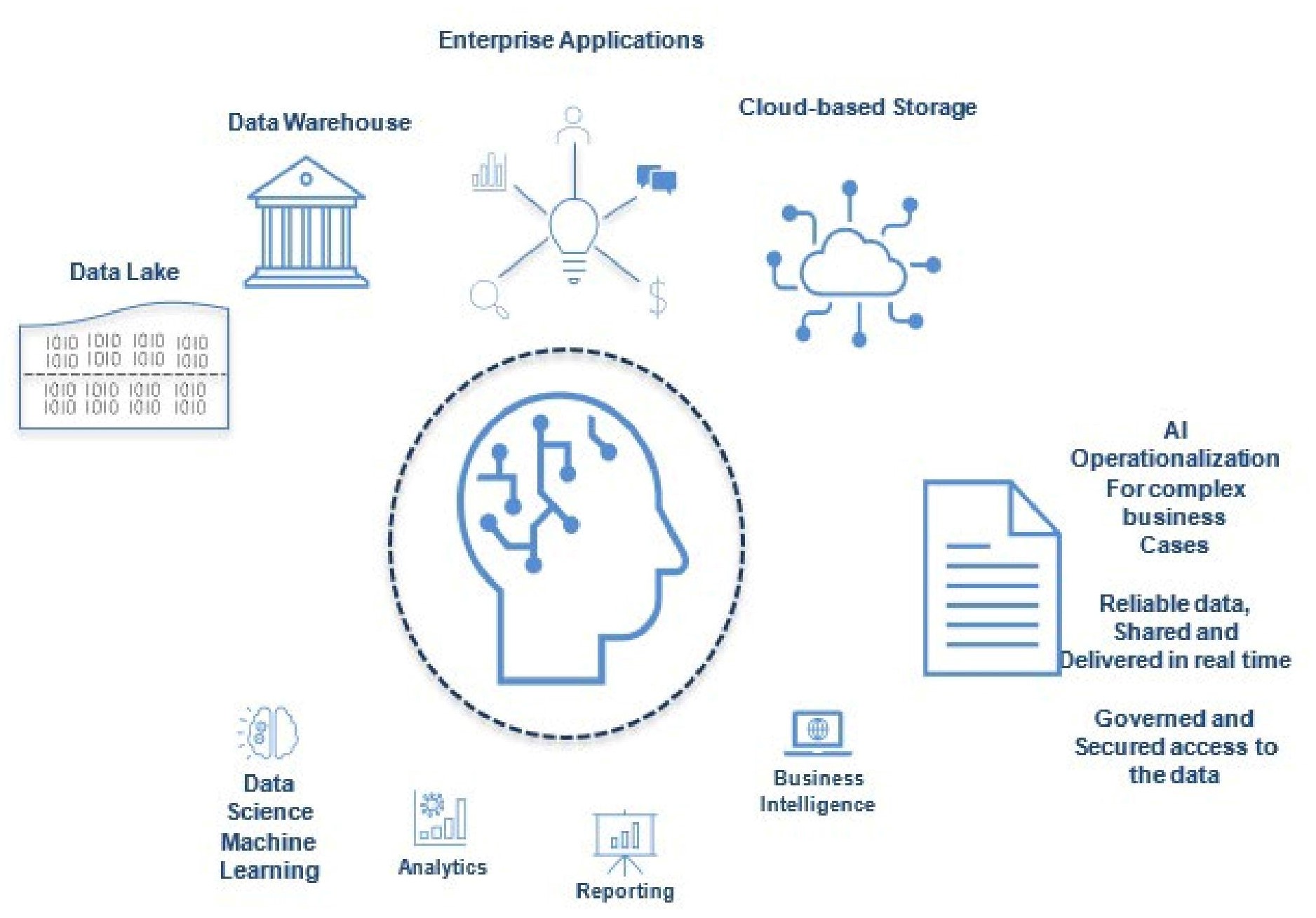
The Data Fabric takes this one step further. Instead of focusing only on integration between operational and analytical systems, the Fabric provides a unified layer of governance and control across all data assets, whether they reside in OLTP systems, Data Warehouses, Data Lakes, Lakehouses, or BI platforms. It coordinates the entire lifecycle of data: discovery, integration, governance, security, and consumption.
A useful metaphor is to think of the Data Fabric as the central nervous system of the enterprise. Just as each organ in the human body performs its own specialized function but is coordinated by the brain, each data platform performs its own tasks (transaction processing, reporting, advanced analytics), but the Fabric ensures that they work together seamlessly, under consistent policies and instructions.
What makes the Data Fabric particularly relevant today is the hybrid and multi-cloud reality of most organizations. Data no longer resides in a single environment; it is distributed across on-premises systems, private clouds, and multiple public clouds. Without a unifying architecture, this distribution quickly becomes unmanageable, creating integration gaps, inconsistent governance, and compliance risks. The Data Fabric fills this gap by providing:
- Centralized governance and policy enforcement across platforms.
- Metadata-driven intelligence to automate data discovery, lineage, and integration.
- Security and compliance controls applied consistently in all environments.
- Hybrid and multi-cloud integration to eliminate silos across diverse infrastructures.
- Self-service access for business and technical users to discover and consume governed data.
It is important to emphasize that the Data Fabric is not a single tool or product. Rather, it is a set of technologies and practices, often spanning data catalogs, metadata platforms, orchestration engines, API gateways, and governance frameworks, that together create a logical fabric woven across the enterprise.
In summary, the Data Fabric operates at a higher plane than the Data Hub. While the Hub focuses on the practical distribution of curated data and insights, the Fabric ensures that all systems, operational and analytical, on-premises and cloud, operate under a unified framework of governance, integration, and orchestration. It is this architectural shift that positions the Data Fabric as the “brain” of modern data ecosystems, coordinating activity across an increasingly distributed digital enterprise.
Finished reading? Test yourself with 10 questions on this topic.
Go to the questions →From I Am Datapedia! by Mustafa Qizilbash, published here free by the author. Nothing about your reading is stored.