Learn free · topic 251
MPP(Massive Parallel Process)
We all have heard about MPP (Massive Parallel Processing). In the current era, consumption and serving layer without MPP capability cannot survive.
MPP is mostly used to read and write (mostly insert) in parallel where more than 1 processor is involved.
In MPP, multiple processers are used to process queries in parallel which might be running in single node or across multiple nodes, in same location or multiple locations.
In a non-MPP mode when a query is executed its different pieces of code are executed one by one in a sequence. But in MPP mode when a query is executed its different pieces of code are executed in parallel on all the processors in one go. This increases the execution of queries 100 times faster than compared to one-by-one execution.
In the current era where data coming from social-media, audios, videos etc., are coming in such a velocity/ pace/ speed that without MPP, it will not be possible to write, process or read data in timely manner.
MPP was there since decodes. We all know Mainframe computers which run in MPP mode but as those were or are still so expensive that can’t be used in the mass community.
It became famous when Facebook, Google and a few other organizations started to make use of MPP to process its internal data. Google has the biggest MPP architecture in place. Then Hadoop came, which was installable and usable on community hardware. This was groundbreaking and everyone started using it even on their home laptops 😊. Now, Cloud computing has come where organizations are giving elastic computing services where end users can run a query which can then, if required, automatically spin 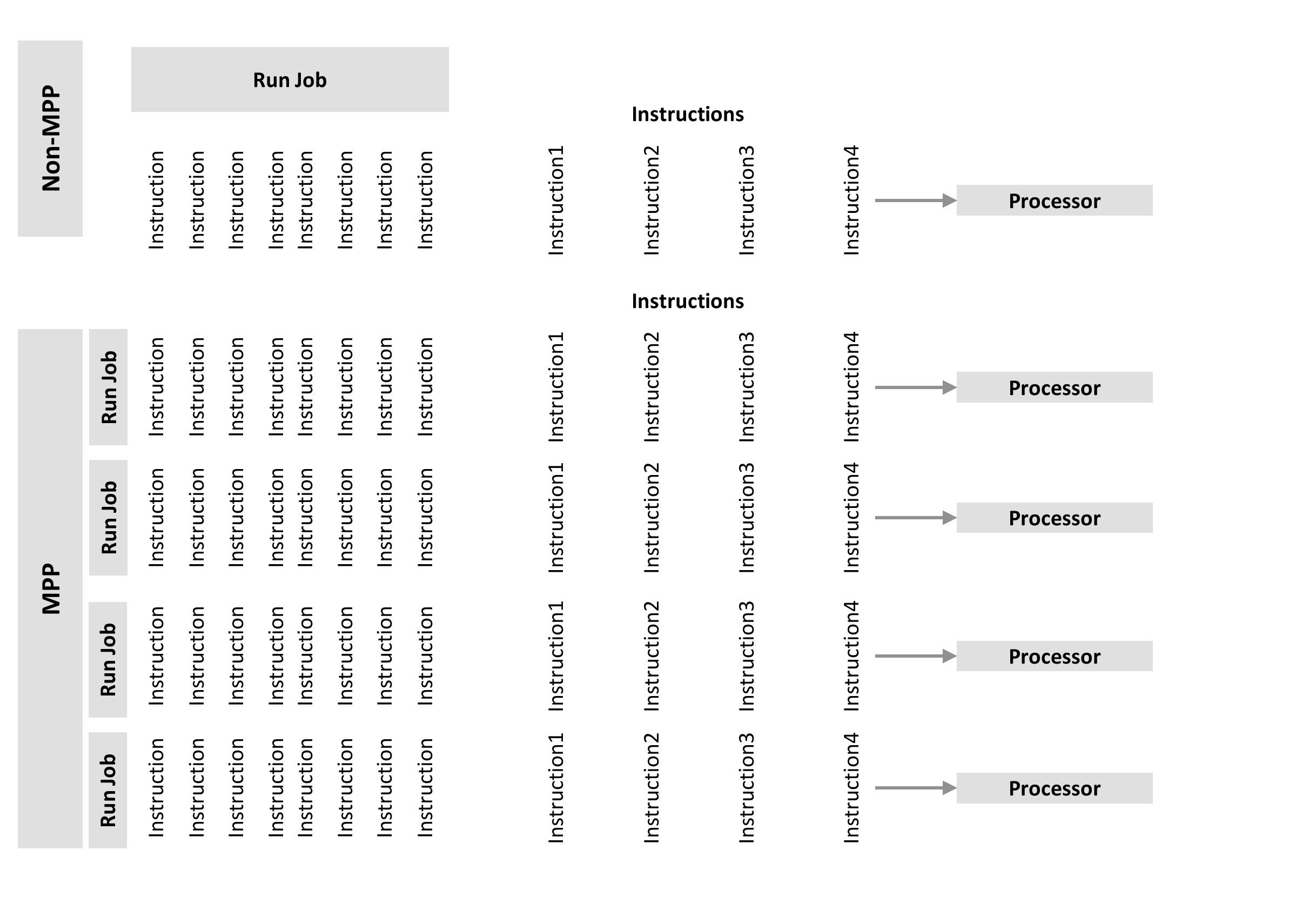
MPP is normally used by, even our daily used laptops, tablets and even mobiles. There was an era when BI reporting used to take hours and hours to produce reports, not anymore. We have seen queries taking days to complete 😊.
‘Any report or any dashboard taking more than 3-5 seconds is a NO NO in current era.’
Finished reading? Test yourself with 10 questions on this topic.
Go to the questions →From I Am Datapedia! by Mustafa Qizilbash, published here free by the author. Nothing about your reading is stored.