Knowledge Graph (KG)
From the book I Am Datapedia!, published here free by the author.
Just like Row is the physical content in a Relational Database, Knowledge Graph (KG) is the physical content in a Graph Database.
Knowledge Graph (KG) integrates closely with Graph Theory, MetaGraph, Taxonomies, and Ontologies, acting as a unifying framework that bridges these concepts.
Let’s decode…..
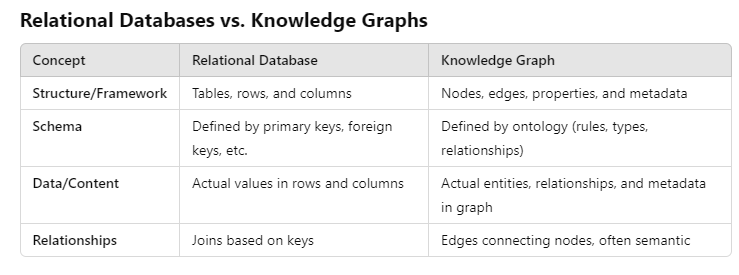
In a relational database, the schema (tables, columns, constraints) is empty until you populate it with rows (data). Similarly, the Knowledge Graph is the populated version of Graph Theory (structure), MetaGraph (metadata), Taxonomies (classification), and Ontologies (rules).
In Relational Database, Table Orders with columns OrderID, CustomerID, OrderDate having Rows with actual order records.
In Knowledge Graph, Nodes represent Customers and Orders; edges represent Purchases in this way i.e., (Customer: Alice) -[:Purchases {Date: '2023-12-12'}]-> (Order: #12345)
Examples:
- Graph Theory provides the mathematical structure for representing relationships as nodes and edges whereas Knowledge Graph adds data instances to this structure. Nodes represent real-world entities, and edges represent actual relationships between them e.g.,
- Graph Theory: Abstract representation of relationships.
- Knowledge Graph: (Person: Alice) -[:Knows]-> (Person: Bob)
- MetaGraph manages metadata about the graph structure, describing the data about the graph itself whereas Knowledge Graph includes metadata like source, provenance, lineage, or confidence scores for each node and edge, making it more robust and trustworthy e.g.,
- MetaGraph: The 'Knows' relationship has a confidence score of 0.95 and was last updated on 2024-12-15.
- Knowledge Graph: Embeds this metadata into the graph structure: (Person: Alice) -[:Knows {Confidence: 0.95, Updated: "2024-12-15"}]-> (Person: Bob)
- Taxonomy provides a hierarchical classification of entities and concepts whereas Knowledge Graph instantiates this classification by linking specific data entities to their respective categories e.g.,
- Taxonomy: A generic hierarchy: Electronics → Laptops → Gaming Laptops
- Knowledge Graph: Maps actual data to this taxonomy: (Product: Dell Gaming Laptop) -[:Belongs To]-> (Category: Gaming Laptops)
- Ontology defines the schema, rules, and semantics for entities and relationships whereas Knowledge Graph instantiates this schema with actual data, adhering to the rules and relationships defined in the ontology e.g.,
- Ontology: Specifies that:
- A "Person" can "Knows" another "Person."
- A "Product" must "Belong To" a "Category."
- Knowledge Graph: Represents actual data: (Person: Alice) -[:Knows]-> (Person: Bob) and (Product: iPhone) -[:Belongs To]-> (Category: Smartphones)
- Ontology: Specifies that:
Express your reaction
Your Take on This Insight?
Share how this content resonates with you.
0 reactionsSign in to react or comment
Comments (0)
No comments yet.
Free account
You can read every topic without one. A free account lets you react to this topic, comment under it and search the Knowledge Hub. Reacting and commenting need a confirmed e-mail address.