Learn free · topic 74
METADATA MODELLING
Metadata Modelling is the discipline of designing structured frameworks that describe data about data. It defines how business, technical, and operational descriptors are captured, organized, and related so that data assets can be understood, discovered, traced, and governed consistently across the enterprise.
The primary goal of metadata modelling is to establish a structured and standardized approach to cataloguing and managing metadata. By doing so, organizations can improve compliance, strengthen data governance, enhance data quality, and increase trust in analytical and operational systems.
Metadata modelling focuses on descriptors such as:
- Business definitions
- Data ownership and stewardship
- Lineage (upstream and downstream data flow)
- Data source systems
- Refresh frequency
- Sensitivity classification
- Quality rules and thresholds
- Storage location and format
Unlike ontologies, which emphasize semantic meaning and relationships between business concepts, metadata modelling emphasizes the management attributes of data assets. It does not primarily answer “What does a Loan mean?” but rather “Where does the Loan data come from?”, “Who owns it?”, “How often is it refreshed?”, and “Is it sensitive?”
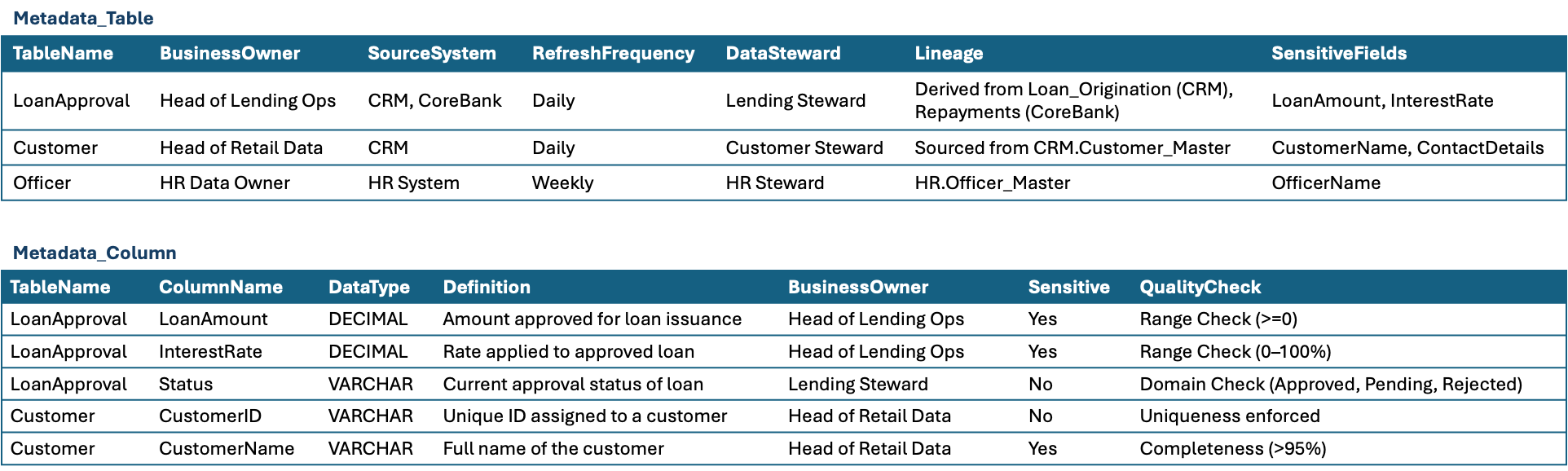
For example, consider a LoanApproval table in a bank’s data warehouse. A metadata model for this table may capture:
- The system in which it resides (Data Warehouse Layer)
- Source systems (CRM, Core Banking)
- Refresh frequency (Daily at 02:00 AM)
- Data steward (Lending Data Steward)
- Sensitivity classification (Confidential – Financial Data)
- Lineage mapping from upstream operational systems
- Applicable data quality checks
This structured metadata becomes the foundation for data catalogues, governance platforms, and compliance workflows. Analysts using the LoanApproval table can trace its origin, evaluate its reliability, and understand its governance status before making business decisions.
Metadata modelling plays a critical role in regulatory environments. In financial institutions, regulators often require clear lineage, ownership, and traceability. A well-designed metadata model ensures that data lineage from operational systems to reports can be documented and explained during audits.
The strengths of metadata modelling include enhanced traceability, improved discoverability of data assets, clear accountability through stewardship assignments, and stronger support for compliance and audit requirements. It enables organizations to manage complex data landscapes with transparency and control.
However, metadata modelling does not directly define business meaning, that responsibility lies with ontologies and semantic models. Additionally, metadata repositories require ongoing maintenance to remain accurate. If governance becomes overly bureaucratic, the metadata system may lose usability and adoption.
From a modelling perspective, metadata modelling is governance- and management-focused. It complements conceptual, logical, dimensional, and semantic models by adding layers of operational context, ownership, and control.
In summary, metadata modelling structures the descriptors that make data understandable and governable. While other modelling techniques define how data is structured or what it means, metadata modelling ensures that data assets are discoverable, traceable, accountable, and trusted across the enterprise.
How this reads (Hook logic in one line)
- The LoanApproval Table is refreshed daily, owned by the Lending team, and traced back to both CRM and CoreBank systems.
- LoanAmount and InterestRate are flagged as sensitive with quality checks defined.
- Metadata makes it clear who owns the data, how often it refreshes, where it comes from, and what constraints apply.
Finished reading? Test yourself with 10 questions on this topic.
Go to the questions →From I Am Datapedia! by Mustafa Qizilbash, published here free by the author. Nothing about your reading is stored.