Learn free · topic 72
UNIFIED STAR SCHEMA (USS)
The Unified Star Schema (USS) is an advanced dimensional modelling approach that enhances traditional star schemas by introducing a central structure known as the Puppini Bridge. This bridge aligns facts and dimensions into a single, consistent analytical framework, making queries more reliable, intuitive, and resistant to common join errors.
The primary goal of USS is to provide a unified query entry point that eliminates ambiguity when working with multiple fact tables. It simplifies drill-across analysis and ensures business users receive consistent results without needing deep SQL expertise.
In a traditional dimensional warehouse, each business process, such as Loan Approvals, Repayments, or Customer Interactions, typically has its own fact table. While dimensions may be conformed across these stars, combining multiple fact tables in a single query can lead to common modelling pitfalls:
- Fan traps, where joins multiply rows incorrectly
- Chasm traps, where relationships between facts and dimensions are ambiguous or missing
USS addresses these issues by introducing the Puppini Bridge, which acts as a “superstar” table. The bridge is essentially a union of keys from all relevant facts and dimensions. Instead of starting queries directly from individual fact tables, analysts begin at the bridge and then left-join to any required fact or dimension. This controlled entry point prevents incorrect aggregations and unintended row multiplication.
In a loan approval environment, a bank may maintain separate fact tables for:
- Loan Approvals
- Loan Repayments
- Loan Defaults
- Customer Interactions
With a Puppini Bridge in place, analysts can safely generate combined reports such as:
- Approval-to-Repayment Conversion by Customer Segment
- Default Rates by Officer Branch and Product Type
- Customer Interaction Impact on Loan Performance
Without USS, such cross-fact analysis may require complex joins that are prone to error. With USS, the bridge guarantees consistent and predictable join paths.
One of the major strengths of USS is its support for self-service BI. Because queries always originate from a unified structure, business users can explore data across multiple processes without deep knowledge of warehouse internals. It also enables BI teams to add new fact tables later without breaking existing reports.
However, USS introduces trade-offs. The Puppini Bridge can become wide and sparse, as it may include many keys that are not populated for every row. Careful storage and indexing strategies are required. Strong governance over conformed dimensions and consistent keys is also essential. Additionally, in some implementations, certain measures may need to be embedded or restructured to align with the bridge approach, which can feel counterintuitive to modellers accustomed to strict fact-centric designs.
From a modelling family perspective, USS belongs primarily to the Dimensional Modelling domain but can be considered a dimensional–semantic hybrid. It focuses on analytical clarity rather than normalization theory. It is not driven by Normal Forms and does not aim to comply with relational normalization principles. Its objective is safe, accurate, and simplified analytics.
In summary, the Unified Star Schema retains traditional facts and dimensions but introduces a central Puppini Bridge to unify them into a single, controlled analytical entry point. It prioritizes query safety, usability, and cross-fact consistency, making it particularly valuable in complex BI environments with multiple interacting business processes.
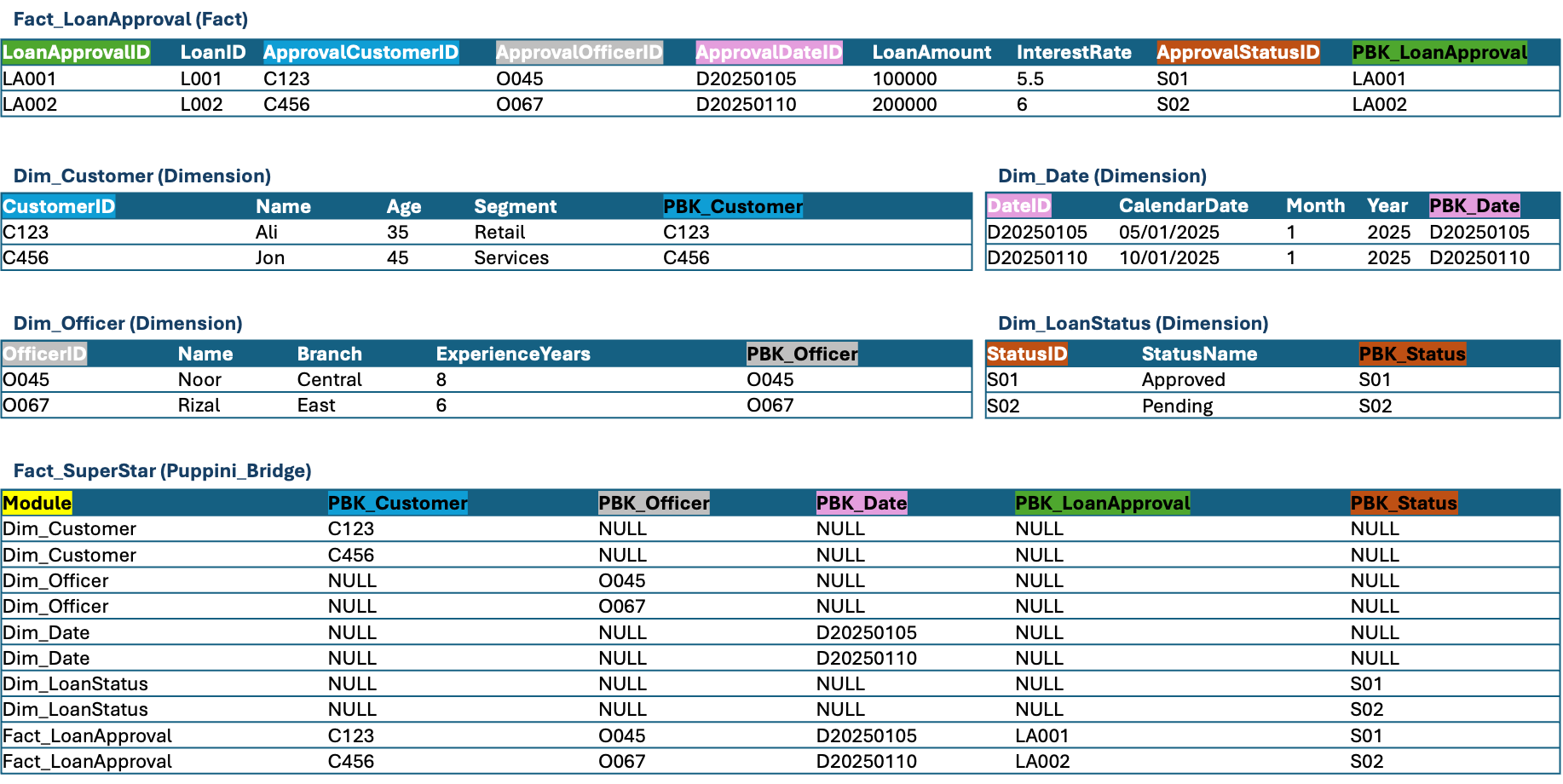
How It Reads: By starting from the Bridge_Puppini, you can pull in customer, officer, date, and status details in a consistent way. For example: “Loan LA001 was approved on 5-Jan-2025 for Customer C123 (Ali), handled by Officer O045 (Noor), with an amount of 100,000 at 5.5%.” Because the bridge is the single-entry point, this logic will remain valid even if new facts like Repayments or Collections are added later.
Finished reading? Test yourself with 10 questions on this topic.
Go to the questions →From I Am Datapedia! by Mustafa Qizilbash, published here free by the author. Nothing about your reading is stored.