Learn free · topic 46
BCNF – Boyce–Codd Normal Form
Boyce–Codd Normal Form (BCNF) is a stricter refinement of Third Normal Form. While 3NF eliminates transitive dependencies, it still allows certain edge cases where a non-key attribute (or a non-superkey determinant) can functionally determine other attributes. BCNF addresses these edge cases by strengthening the dependency rule.
Formally, a table is in BCNF if, for every functional dependency X → Y, the determinant X is a superkey of the relation. In simpler terms, whenever one attribute (or group of attributes) determines another, that determining attribute must uniquely identify rows in the table. If it does not, the design violates BCNF.
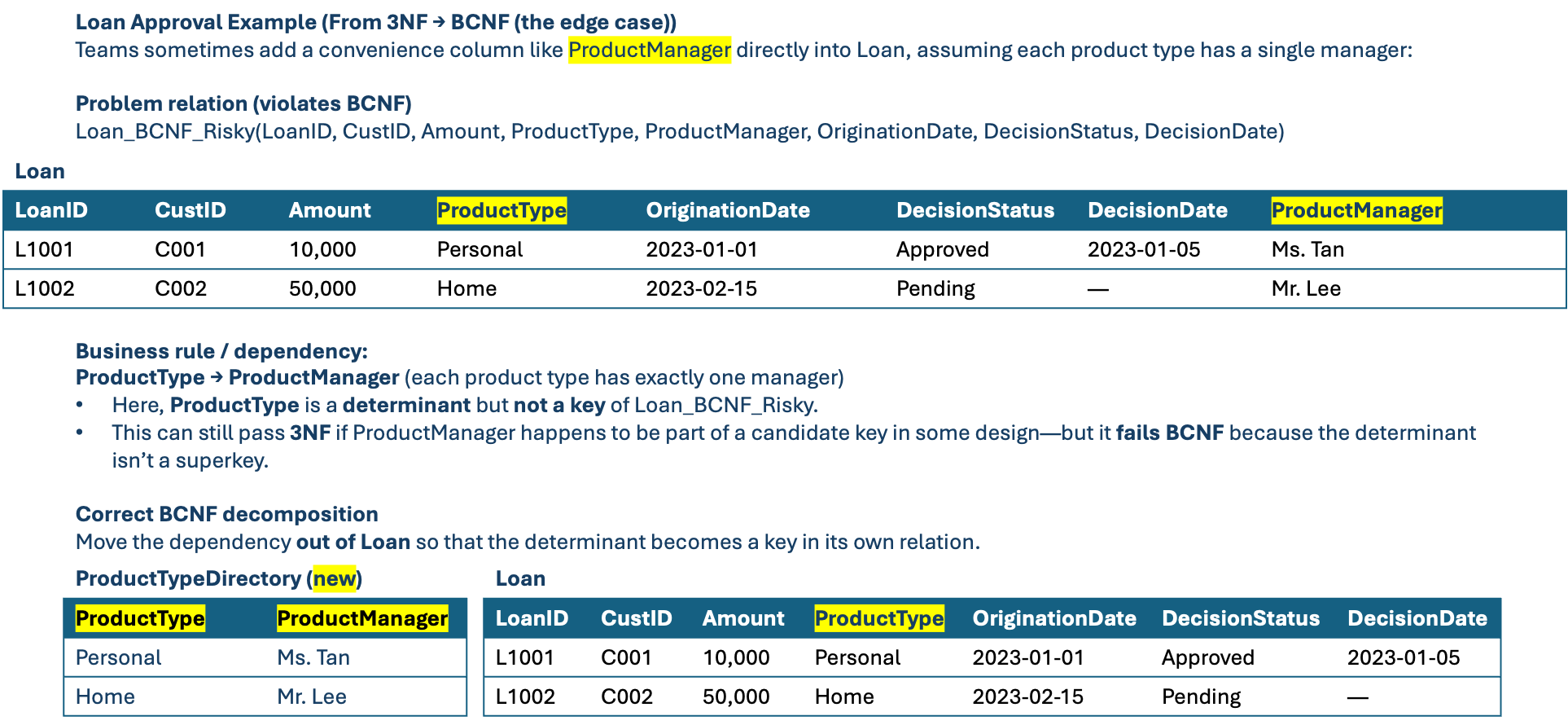
To understand the difference from 3NF, consider a scenario in the loan approval domain. Suppose a table stores LoanID, ProductType, and InterestRate. Assume that business rules state that each ProductType has exactly one InterestRate. This creates the functional dependency:
ProductType → InterestRate
Now imagine that the primary key of the table is LoanID. Each loan has a product type, and each product type determines its interest rate. This table may technically satisfy 3NF because there are no transitive dependencies through non-key attributes in the traditional sense. However, the determinant ProductType is not a superkey, it does not uniquely identify rows in the table. Multiple loans may share the same product type.
This creates redundancy. The same interest rate value will repeat across many loan rows for the same product type. If the interest rate changes, multiple rows must be updated. This is precisely the kind of anomaly BCNF prevents.
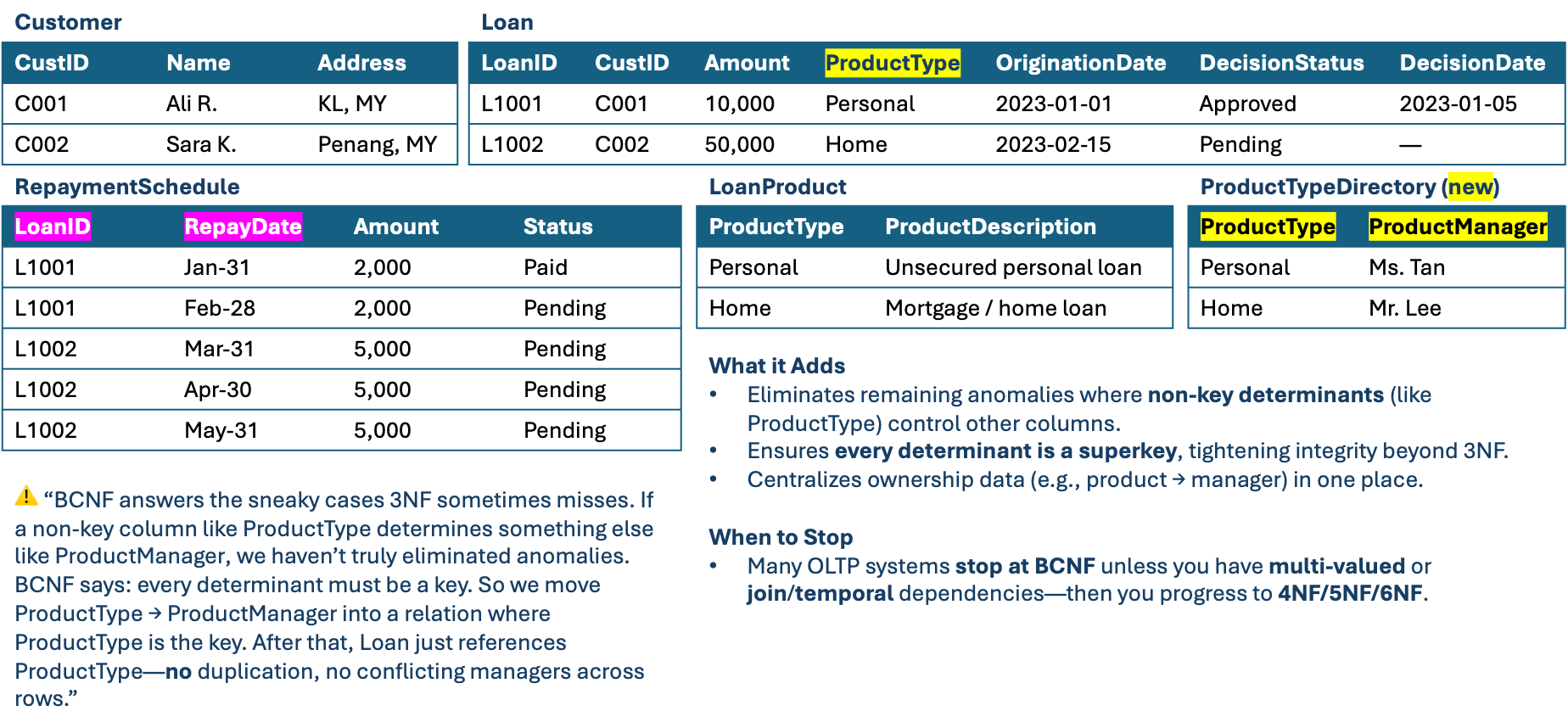
To satisfy BCNF, we must decompose the table. ProductType and InterestRate should move into a separate table where ProductType becomes the primary key. The Loan table should reference ProductType through a foreign key. After decomposition, every functional dependency has a determinant that is a superkey within its respective table.
The key difference between 3NF and BCNF is subtle but important. Third Normal Form allows certain dependencies where a non-superkey determines another attribute, as long as that determined attribute is part of a candidate key. BCNF removes that allowance entirely. It requires that every determinant be a superkey without exception.
In practice, most well-designed 3NF schemas already satisfy BCNF. However, in more complex schemas involving multiple candidate keys or overlapping dependencies, BCNF ensures stronger structural integrity.
BCNF represents the final stage of normalization commonly required for transactional systems. Beyond this point, the normal forms become increasingly specialized and theoretical, addressing multi-valued and join dependencies rather than basic redundancy.
With BCNF achieved, the relational structure is mathematically disciplined. Every determining attribute uniquely identifies rows, and structural anomalies are minimized even in edge cases.
Finished reading? Test yourself with 10 questions on this topic.
Go to the questions →From I Am Datapedia! by Mustafa Qizilbash, published here free by the author. Nothing about your reading is stored.