Learn free · topic 35
Semantic Data Modelling
Semantic Data Modelling is the practice of designing data structures that are enriched with explicit business meaning so that both humans and machines can interpret and use the data consistently. Unlike purely structural models that define tables, fields, and relationships without deeper context, semantic data models embed meaning directly into the design. They ensure that data is not only structured correctly, but also understood correctly across systems, domains, and even organizational boundaries.
The primary goal of Semantic Data Modelling is to create data models that are self-descriptive and semantically precise. In traditional modelling, a field such as CustomerID may simply be defined as a numeric identifier. In a semantic model, however, that identifier is linked to a formal definition stating that it represents a unique identifier for a person or organization holding an account within a specific business context. The model clarifies what the data means, not just how it is stored. This added semantic layer enables interoperability, governance, and machine-driven reasoning.
Semantic Data Modelling typically aligns closely with ontologies, taxonomies, and business glossaries. While ontologies define shared vocabularies and relationships, semantic data models apply those definitions directly within the data structure. As a result, data elements reference standardized concepts rather than existing as isolated fields. This creates consistency across applications and allows systems to interpret data using shared definitions.
In operational systems, semantic modelling can represent information using structured subject–predicate–object patterns, often referred to as triples. For example, instead of storing loan data only in relational tables, a semantic representation might express that Customer123 applies for LoanApplication456, that LoanApplication456 hasApprovalDecision Approved, and that LoanApplication456 hasRepaymentSchedule ScheduleR1. Each component in these statements references a shared ontology that defines what Customer, LoanApplication, ApprovalDecision, and RepaymentSchedule mean. This ensures that systems consuming the data interpret the relationships consistently.
The analytical advantages of Semantic Data Modelling become especially clear when integrating diverse data sources. Because entities and relationships are linked to shared vocabularies, queries can span multiple datasets seamlessly. For instance, an analyst could retrieve all loans where the customer works in an industry classified as high risk within a predefined taxonomy. Another query might retrieve delinquent loans along with their related guarantors across separate systems. Since the underlying data is semantically aligned, such cross-domain queries become possible without complex structural reconciliation.
Semantic models also support inference. If a loan application has an approval decision of Approved, and the ontology defines that an approved loan becomes an active loan, the system can automatically infer that the loan is active. This reasoning capability distinguishes semantic modelling from purely structural modelling. The system does not merely store and retrieve data; it understands relationships and can derive new knowledge from existing facts.
It is important to distinguish Semantic Data Modelling from Canonical Data Modelling. Canonical models standardize structure for exchange between systems. Semantic models go further by standardizing meaning, allowing machines to interpret and reason over data consistently. While canonical models reduce integration complexity, semantic models enable intelligent interoperability and advanced analytics.
The nature of Semantic Data Modelling is therefore meaning-driven and context-rich. It bridges traditional data modelling with semantic technologies such as knowledge graphs and ontology-based systems. By embedding business definitions directly into data structures, it enables governance, semantic search, linked data integration, and AI-driven reasoning.
In summary, Semantic Data Modelling represents the progression from standardized exchange to machine-readable meaning. It ensures that data carries explicit semantics, enabling systems not only to share information, but also to interpret, integrate, and reason over it across enterprise and domain boundaries.
Comparison
Technique | Focus | Loan Example Representation | What it adds |
Ontology | Define shared vocabulary and logical rules | Defines classes: LoanApplication, Customer, ApprovalDecision and their links | Provides agreement on what concepts mean, supports inference |
Knowledge Graph | Model entities and relationships as a graph | Customer → appliesFor → LoanApplication → hasDecision → Approval | Enables graph queries, traversals, relationship analytics (e.g., fraud rings) |
Metagraph | Extend graphs with attributes on relationships | appliesFor edge carries { Date=12-Aug, Channel=Online, Officer=123 } | Captures richer context, supports advanced queries on relationships |
Semantic Data Modelling | Encode data with machine-readable meaning | RDF triples: Customer123 → appliesFor → LoanApp456 | Enables interoperability, reasoning, and linked data across systems |
Taxonomy is a subset of ontology, classification hierarchies (e.g., Loan Products → {Personal, Home, SME}).
- Ontology = the dictionary and grammar behind those sentences
- Knowledge Graph = the network of sentences, linked together for queries
- Metagraph = sentences with full context on the links (who, how, when, under what conditions)
- Semantic Data Model = sentences written with meaning
From Business Concept to Database Table:
The Core Modelling Progression
At this point in the modelling journey, it becomes important to understand how business ideas are transformed into working systems. Regardless of the specific technique used, every data modelling approach ultimately participates in the same fundamental progression: business concepts must be translated into structures that software systems can store, manage, and process. This progression forms the backbone of Core Data Modelling.
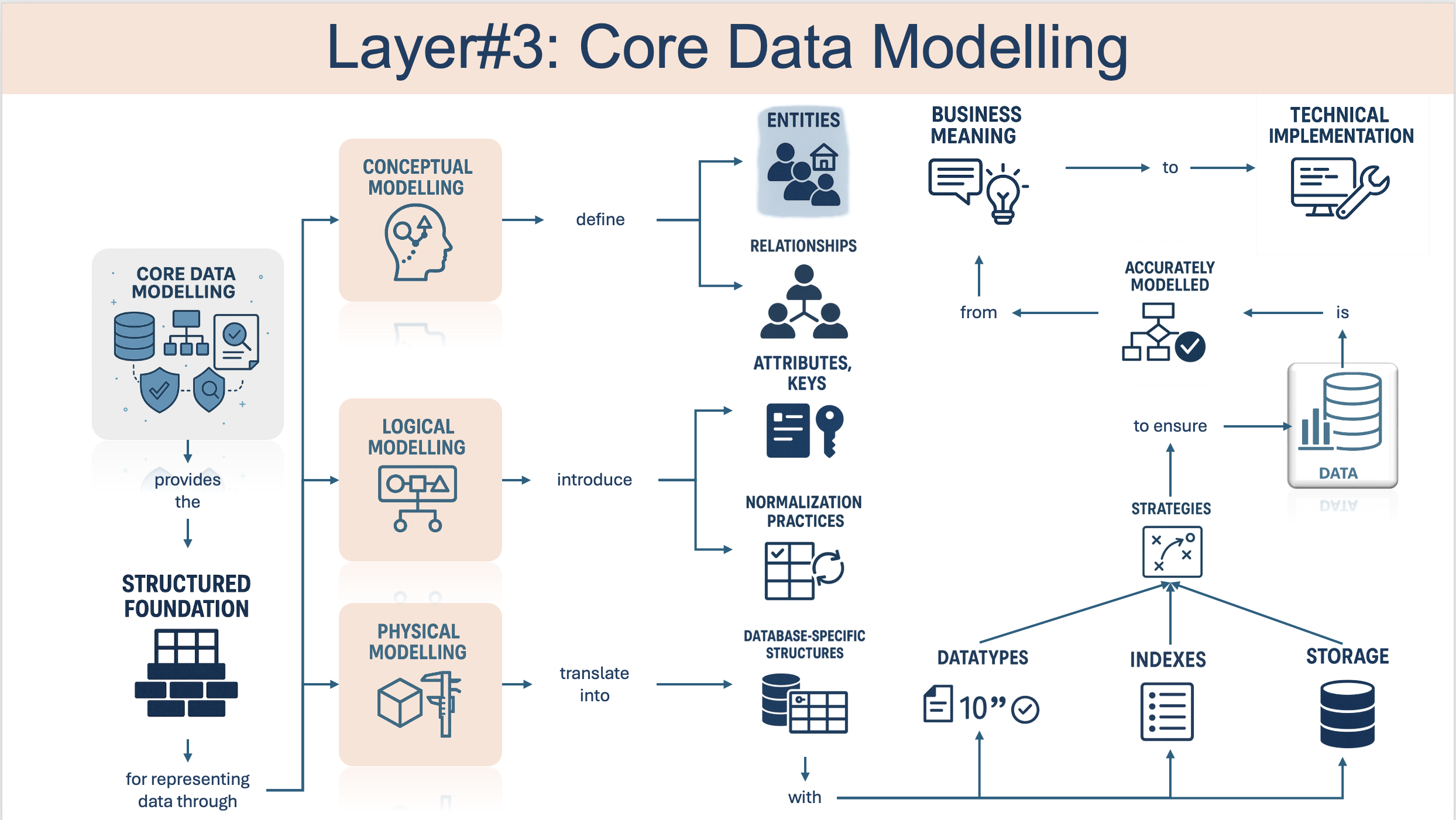
Core Data Modelling describes the path from conceptual understanding to physical implementation. It explains how a business concept such as Loan, Customer, or Approval Decision eventually becomes a database table, document structure, or persistent storage object inside a system. While the techniques discussed earlier focused on meaning, communication, semantics, and integration, this stage addresses how those ideas become operational reality.
There are two primary architectural journeys that modelling techniques typically follow.
In the first journey, concepts move directly from conceptual representation to physical design. In this path, a distinct logical modelling stage is either minimal or absent. The model transitions relatively quickly from business-level definitions to implementation structures. This approach is common in techniques such as hierarchical models, network models, event-driven architectures, JSON or XML schema design, and API or service modelling. The emphasis is on translating structure efficiently into executable or storage-ready formats.
In the second journey, concepts pass through a dedicated logical modelling layer before physical implementation. In this path, business concepts are refined through normalization, rule definition, constraint specification, and structural alignment. Logical modelling introduces discipline, ensuring consistency and integrity before physical optimization occurs. Techniques such as dimensional modelling, object-oriented modelling, NoSQL design strategies, Data Vault, Anchor Modelling, Focal Point Modelling, Hook structures, Unified Star Schema, and temporal modelling often follow this structured path. Here, the logical layer acts as a stabilizing bridge between business meaning and physical storage.
The key insight is that not all modelling techniques require a separate logical layer, but all modelling techniques must ultimately move from concept to implementation. Understanding these two journeys helps learners recognize why Conceptual Data Modelling (CDM), Logical Data Modelling (LDM), and Physical Data Modelling (PDM) form the core pillars of enterprise data architecture. Every other modelling method either explicitly or implicitly builds upon this progression.
This bridge marks the transition from “business ideas” to “system reality.” Whether the journey includes an explicit logical refinement stage or moves directly to physical design, the destination remains the same: a working data structure that faithfully represents business intent within a technological environment.
Finished reading? Test yourself with 10 questions on this topic.
Go to the questions →From I Am Datapedia! by Mustafa Qizilbash, published here free by the author. Nothing about your reading is stored.