Learn free · topic 42
UNF – Unnormalized Form
Unnormalized Form (UNF) represents the raw and unstructured state of data before any normalization rules are applied. It is the natural starting point of most data collections, whether they originate from spreadsheets, CSV extracts, operational exports, or loosely designed legacy systems. In UNF, structure exists, but discipline does not. Data is captured for convenience rather than integrity.
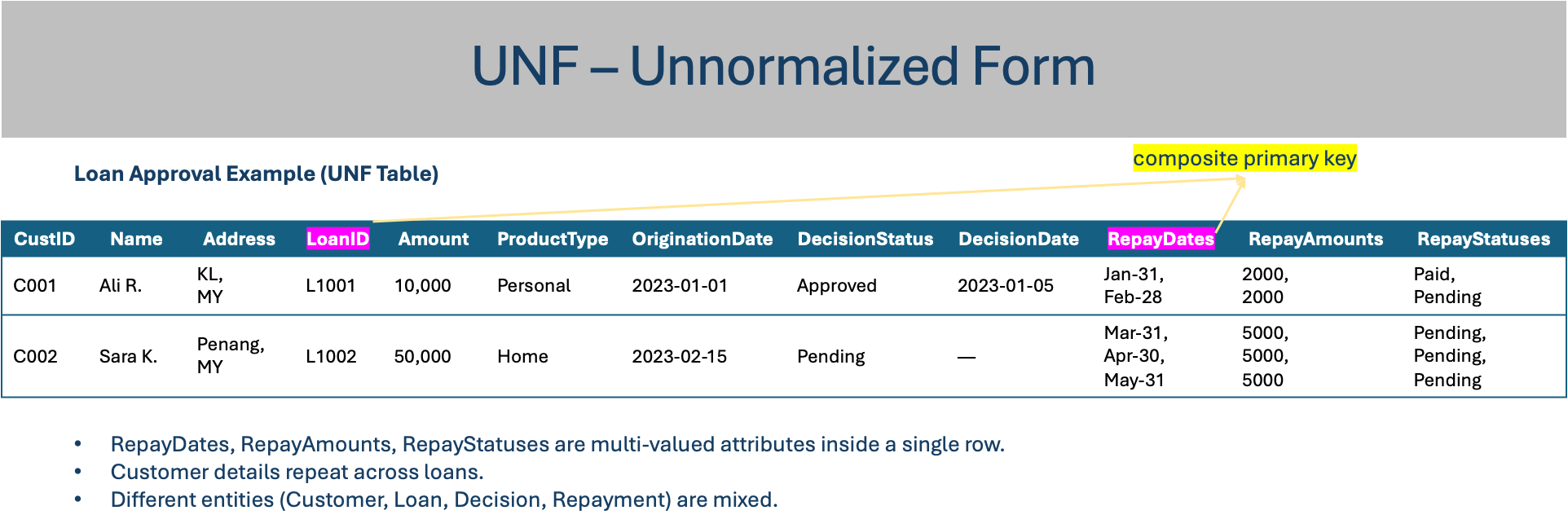
In this form, tables may contain repeating groups, multi-valued attributes, and mixed entities within a single row. For example, in the loan approval case, a single row may contain customer information, loan details, approval status, and multiple repayment dates, repayment amounts, and repayment statuses all embedded within the same record. Columns such as RepayDates, RepayAmounts, and RepayStatuses may store several values in one cell, separated by commas or line breaks. This violates relational principles because each column should hold a single, atomic value.
Another characteristic of UNF is entity mixing. Customer attributes, loan attributes, decision information, and repayment data coexist within the same structure. This blending of distinct entities increases redundancy and creates structural confusion. Customer details may repeat across multiple loan records. If a customer changes their address, every related row must be updated manually. This creates update anomalies and opens the door to inconsistencies.
UNF does not enforce structural rules. There are no guarantees of atomicity, dependency integrity, or clean key relationships. Composite keys may appear implicitly, but without formal constraint enforcement. Data is stored in a way that reflects how it was collected, not how it should be logically structured.
Despite its weaknesses, UNF serves an important purpose. It allows rapid data capture without upfront modelling discipline. Many real-world systems begin in this state because capturing information quickly is often prioritized over designing it correctly. In practice, spreadsheets and raw data dumps frequently resemble UNF structures.
However, UNF should never be the stopping point. It is only the starting mess from which normalization begins. The entire purpose of normalization is to transform this raw structure into a clean, consistent, and logically organized design. Each subsequent normal form refines the structure further, progressively eliminating repeating groups, partial dependencies, transitive dependencies, and other structural flaws.
UNF therefore marks the beginning of the normalization journey. It shows us what happens when data is captured without relational discipline. From this state, we will proceed step by step, restructuring the loan approval example until each fact is stored properly, dependencies are clear, and integrity is enforced.
Finished reading? Test yourself with 10 questions on this topic.
Go to the questions →From I Am Datapedia! by Mustafa Qizilbash, published here free by the author. Nothing about your reading is stored.