Learn free · topic 151
Data Lakehouse
The concept of the Data Lakehouse emerged around 2020 as an architectural response to the limitations of both Data Warehouses and Data Lakes. In simple terms:
Data Warehouse + Data Lake = Data Lakehouse.
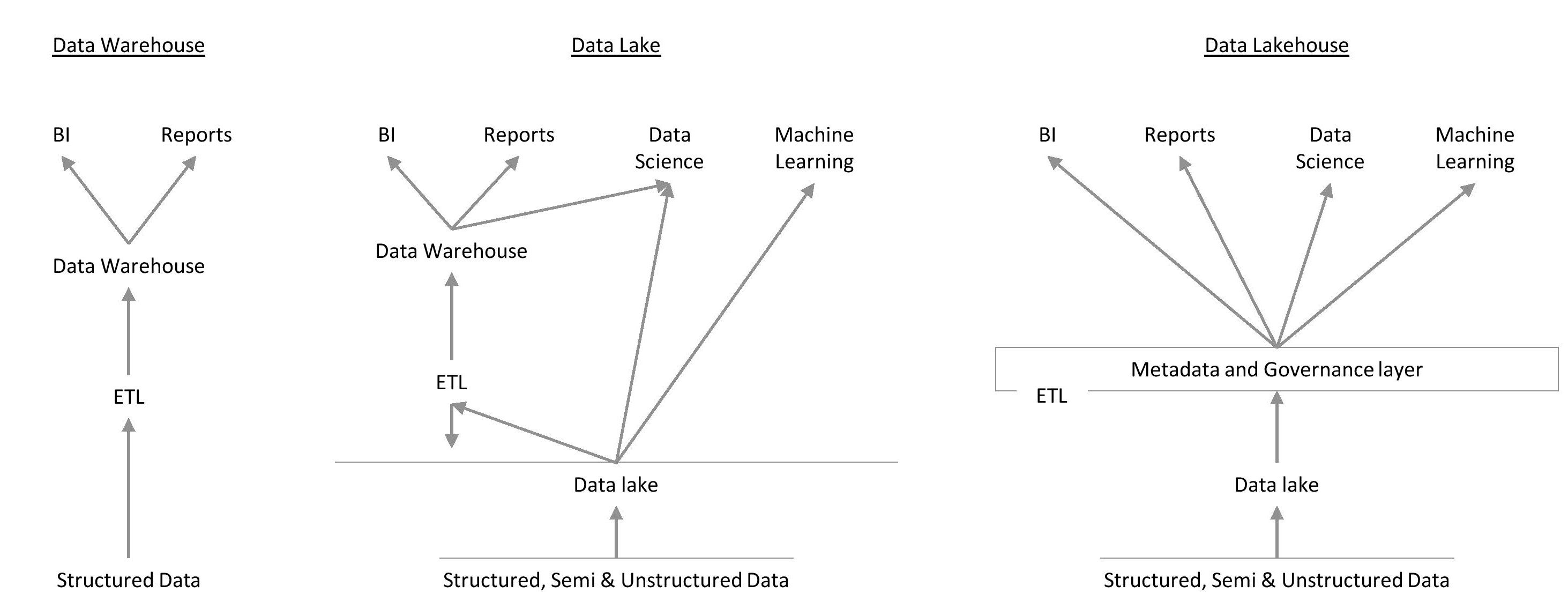
At its core, the Data Lakehouse addresses two long-standing challenges. Traditional Data Lakes allowed organizations to store vast amounts of raw data but lacked strong transactional guarantees, often leading to inconsistent or unreliable datasets. Data Warehouses, by contrast, provided consistency and governance but were limited in their ability to handle semi-structured and unstructured data at scale. The Lakehouse resolves this by offering:
- ACID transactions: ensuring reliability and data consistency.
- Upsert and delete operations: enabling fine-grained control over data changes.
- Schema-on-write support: allowing stronger data contracts than schema-on-read designs.
- Open table formats such as Parquet: making data natively accessible to analytical and data science tools.
- Support for all data types: structured, semi-structured, and unstructured.
- Batch and streaming compatibility: unifying real-time and historical workloads.
One of the architectural breakthroughs of the Lakehouse is the decoupling of storage and compute. Earlier generations of systems, from OLTP databases to Data Warehouses and Hadoop-based Data Lakes, tightly coupled these layers, leading to scalability bottlenecks and higher costs. In contrast, the Lakehouse leverages inexpensive, durable object storage (e.g., Amazon S3, Azure Data Lake Storage, Google Cloud Storage) as its foundation, with compute clusters scaled independently as needed.
While object storage alone is not sufficient to provide reliability and governance, this gap has been addressed by new technologies such as Delta Lake, which add transactional integrity and metadata management on top of raw storage. These capabilities have been widely recognized as the tipping point that made the Lakehouse paradigm practical for enterprise use.
The rise of the Data Lakehouse reflects a broader industry transition. Many organizations that invested heavily in Hadoop-based Data Lakes will continue to maintain them for years, but the Lakehouse model is gaining momentum because it unifies analytical, machine learning, and streaming workloads within a single architecture. It reduces the need for multiple overlapping silos, simplifies governance, and provides a modern platform that balances flexibility with reliability.
In summary, the Data Lakehouse represents the convergence of flexibility and governance. By combining the raw scalability of Data Lakes with the trust and structure of Data Warehouses, and by leveraging modern table formats with transactional support, it offers a future-ready foundation for enterprise analytics. While legacy systems will remain in place for some time, the Lakehouse has already established itself as the logical next step in the evolution of enterprise data platforms.
Finished reading? Test yourself with 10 questions on this topic.
Go to the questions →From I Am Datapedia! by Mustafa Qizilbash, published here free by the author. Nothing about your reading is stored.