Learn free · topic 341
ElectronicData Interchange (EDI)
EDI, or Electronic Data Interchange has been introduced since the seventies. The main use case addressed by EDI is to automate data exchange between trading partners (Customers and Suppliers) for business documents, such as purchase orders and invoices as well as for payments and shipment information.
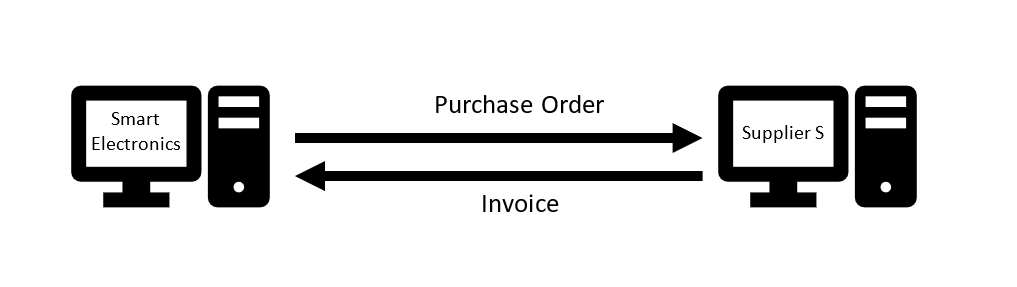
Here is a simple EDI use case in which Smart Electronics (a fictitious Manufacturing company) uses EDI to send Purchase Orders to Supplier S, and Supplier S sends corresponding invoices to Smart Electronics.
EDI follows specific message standards and formats like EDIFACT or X12 which are the main EDI message standards.
Other EDI standards have been developed for specific purposes or industries, such as:
- ODETTE: used in automotive industry in European countries
- HL7: used for healthcare data.
- IATA PATIS: used to exchange passenger and airport data, and is maintained by the IATA (the International Air Transport Association)
- SWIFT: used for transaction and message exchanges in the financial and banking sectors.
X12
The X12 Electronic data interchange (EDI) standard is developed and maintained by the Accredited Standards Committee X12 (ASC X12), which is a standards organization. X12 enables interoperability between trading partners through standardized data exchange.
Initially focused on Supply chain and Finance data exchange like purchase orders or invoices, X12 covers today a large set of transactions for a variety of functional domains and industries.
Here are some examples of EDI X12 transactions in Finance and Supply Chain:
EDI Transaction | Data Object or purpose | Domain |
810 | Invoice | Finance |
812 | Credit/Debit Adjustment | Finance |
820 | Payment Order | Finance |
850 | Purchase Order | Supply chain |
855 | Purchase Order Acknowledgment | Supply chain |
856 | Ship Notice / Manifest | Supply chain |
857 | Shipment and Billing notice | Supply chain |
862 | Shipping schedule | Supply chain |
945 | Warehouse shipping Advice | Supply chain |
Overall, there are 300+ EDI transaction sets, covering multiple needs. EDI X12 is widely used in North America, but less so elsewhere, where UN/EDIACT is the standard.
UN/EDIFACT
The United Nations/Electronic Data Interchange for Administration, Commerce and Transport (UN/EDIFACT) is an international standard for electronic data interchange (EDI) between information systems developed by the United Nations.
The UN/EDIFACT standard is used in many countries, particularly in Europe, but is less adopted in North America, where X12 is the standard. Its standard message structure allows it to be utilized across geographies and industries.
The following are some examples of document types used by the UN/EDIFACT standard:
Document type | Data object or purpose |
DELFOR | Delivery Schedule |
DISADV | Dispatch Advice |
INVOIC | Invoice |
INVRPT | Inventory Report |
ORDERS | Order |
ORDCHG | Change Order |
ORDRSP | Order Response |
IFTSTA | Transport Status Message |
INVRPT | Inventory Report |
RECADV | Receiving Advice |
Overall, the UN/EDIFACT standard defines 200+ document type standards covering a wide range of business operations and transactions between business partners.
EDI usage considerations:
Before implementing EDI, several usage considerations should be addressed. Hence, you need to ensure that EDI is a good fit for your organization. Below questions can help you assess whether it is a good option.
Is it used in your industry? Some industries do not rely heavily on EDI, whereas others like the automotive industry do. Thus, before implementing an EDI pattern, make sure it is suitable for your industry.
- Is it used by your customers? If your customers solely use EDI, you might be obliged to implement an EDI pattern. Failure to do so may have an influence on your revenues and your relationship with your customer, causing your business to suffer in the long run.
- Is it used by your suppliers? This is not a major criterion to consider because since you are their customer, they will have to conform to your requirement. Even so, if you have a large number of suppliers, and many of them use EDI, there might be an opportunity to streamline your integrations through implementing it as well.
- Are there any other alternatives if you do not want to use EDI? In general, and more so, the answer is Yes. Alternatives mainly include Web services and API-based integrations, which are more modern and secure, but EDI still has advantages in terms of reliability and deliverability since it is persistent by design. It will also depend on your negotiation leverage with your trading partners.
In the data world, EDI plays a crucial role in facilitating the exchange of structured business data in a standardized electronic format.
Electronic Data Interchange (EDI) is a method of electronically exchanging business documents such as purchase orders, invoices, shipping notices, and other transaction-related information between organizations in a standardized format.
The primary goal of EDI is to streamline and automate business processes by replacing traditional paper-based document exchange with electronic methods. This enhances efficiency, reduces manual errors, and accelerates the speed of business transactions.
Standardization: EDI relies on standardized formats for data exchange, which are often defined by international or industry-specific standards. Common EDI standards include ANSI X12 in North America and EDIFACT globally.
Data Formats: EDI transactions involve structured data formats that define the content and structure of business documents. These formats include segments, elements, and codes that allow systems to interpret and process the information accurately.
Communication Protocols: EDI transactions are typically transmitted over secure and standardized communication protocols, such as AS2 (Applicability Statement 2), FTP (File Transfer Protocol), or VANs (Value Added Networks).
Few Benefits are mentioned below:
- Efficiency: EDI eliminates the need for manual data entry, reducing processing time and errors.
- Accuracy: Standardized formats and automated processes enhance data accuracy.
- Cost Savings: The shift from paper-based to electronic transactions reduces printing, postage, and manual labor costs.
- Speed: Electronic transmission accelerates the speed of document exchange, improving overall business cycle times.
EDI is widely used in various industries, including manufacturing, retail, healthcare, logistics, and finance, where frequent and standardized exchange of business documents is essential. For example, an organization using EDI might send an electronic purchase order to a supplier in a standardized format. The supplier's system processes the order electronically, generates an electronic invoice, and sends it back to the buyer, all without the need for manual intervention.
In summary, Electronic Data Interchange (EDI) is a well-established practice in the data world, facilitating the electronic exchange of business documents between partners for increased efficiency and accuracy in business transactions.
Finished reading? Test yourself with 10 questions on this topic.
Go to the questions →From I Am Datapedia! by Mustafa Qizilbash, published here free by the author. Nothing about your reading is stored.