Learn free · topic 369
Quantum Computing
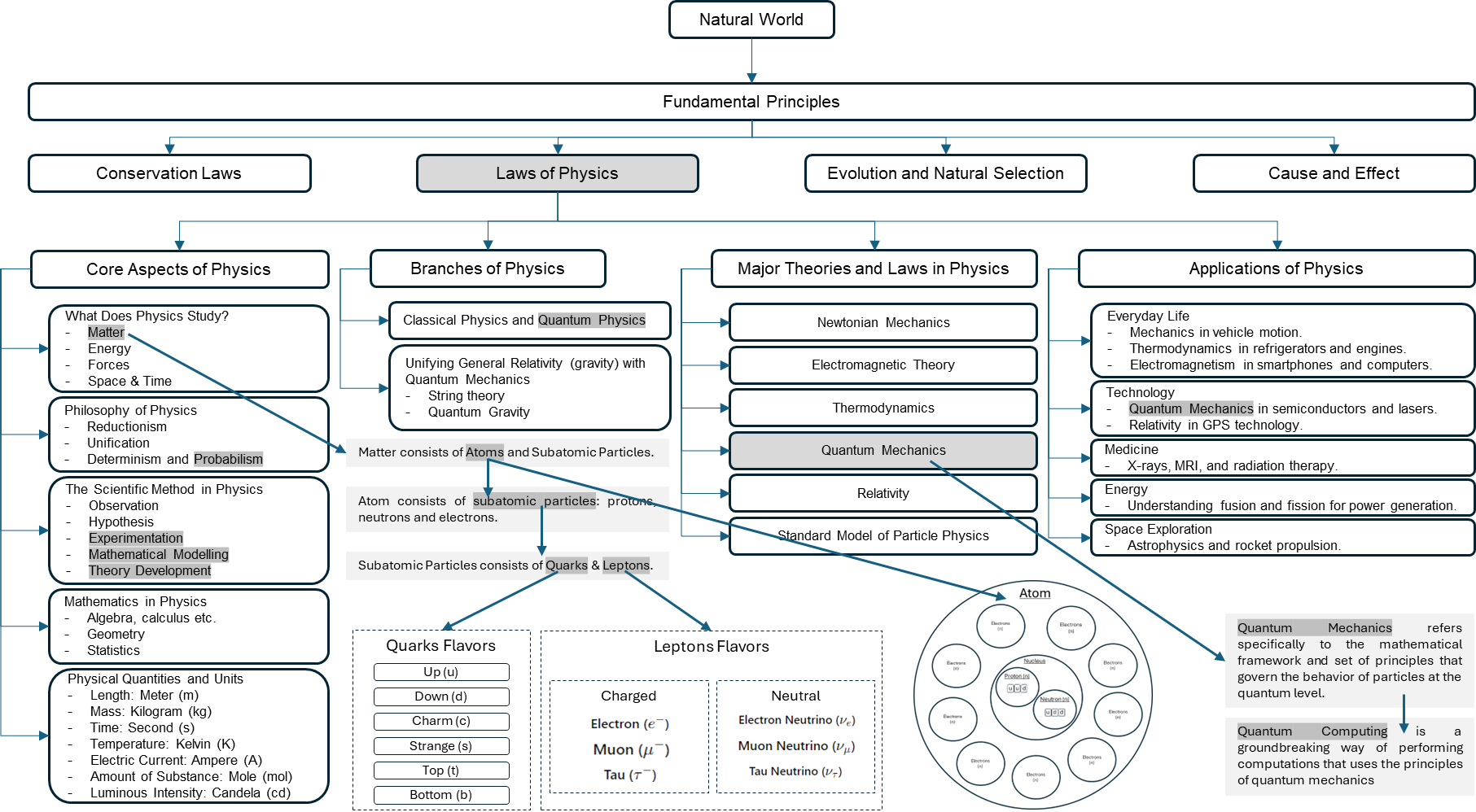
Quantum computing is a revolutionary form of computation that leverages the principles of quantum mechanics, a branch of physics that describes how matter and energy behave at subatomic levels. Unlike classical computers that use bits (0 or 1), quantum computers use qubits, which can exist in multiple states simultaneously due to a phenomenon called superposition.
This fundamental shift introduces a new way to process information, offering exponential speedups for certain problems, potential cost savings, and the ability to solve previously infeasible tasks in cryptography, optimization, healthcare, finance, and more.
Key Quantum Concepts
1. Superposition
- Definition: A qubit can exist in a combination of both 0 and 1 states at the same time until measured.
- Analogy: Imagine a person who is simultaneously present in every room of a house. Only when you check a room do you know where the person is.
- Implication: Enables quantum computers to process many possibilities in parallel.
2. Entanglement
- Definition: Qubits become so deeply connected that the state of one directly affects the state of the other, regardless of distance.
- Analogy: If a person’s identity (say, age or gender) is defined in one room, the same identity applies instantly to their presence in all rooms.
- Implication: Enables powerful coordination between qubits, improving problem-solving capabilities.
3. Interference
- Definition: Interference amplifies correct quantum outcomes and suppresses incorrect ones by manipulating probability amplitudes.
- Analogy: If it's nighttime, interference increases the chance of finding the person in a bedroom and reduces the chance of them being in the kitchen.
- Implication: Guides quantum algorithms toward optimal solutions efficiently.
Quantum vs. Classical Computing
Feature | Classical Computing | Quantum Computing |
|---|---|---|
Basic Unit | Bit (0 or 1) | Qubit (0, 1, or both simultaneously) |
Physics Basis | Classical (deterministic) physics | Quantum (probabilistic) mechanics |
Operation | Processes inputs one at a time | Processes all combinations simultaneously |
Data Handling | Linear, sequential | Parallel, probabilistic |
Speed | Slower for complex problems | Potentially exponential speedup |
Entanglement | Bits are independent | Qubits are interconnected |
Examples of Use | Word processing, browsing, spreadsheets | Factoring, optimization, drug discovery |
Quantum Gates and Circuits
- Classical Gates: Use logic operations like AND, OR, NOT to manipulate bits.
- Quantum Gates: Operate on qubits, allowing rotation and transformation of quantum states. These include Hadamard, Pauli-X, and CNOT gates, which enable complex quantum circuits.
Real-World Applications
1. Cryptography
- Example: Shor’s algorithm can factor large prime numbers exponentially faster, threatening traditional encryption systems.
2. Optimization
- Example: Solving supply chain logistics, portfolio optimization, or traffic routing problems faster and more efficiently.
3. Drug Discovery
- Example: Simulating molecular interactions at the quantum level to speed up the identification of potential medicines.
4. Material Science
- Example: Modelling atomic-level properties of new materials more precisely.
Classical vs Quantum Physics: The Foundation
- Classical Physics: Based on deterministic laws. Outcomes are predictable if all inputs are known.
- Example: Rolling a die with precise knowledge of force and angle yields a predictable outcome.
- Quantum Physics: Based on probabilistic laws. Outcomes are based on probabilities.
- Example: Rolling a die without knowing force or angle, outcomes are random but statistically predictable over many trials.
Quantum Parallelism and Speedup
- Parallelism: Quantum systems can evaluate many inputs at once.
- Example: Searching a database, quantum computers can search all entries in parallel.
- Speedup: Quantum algorithms, like Grover’s and Shor’s, can outperform classical counterparts drastically.
- Example: Breaking RSA encryption using quantum factoring.
Benefits of Quantum Computing
Advantage | Description |
|---|---|
Speed | Up to 1,000x faster for certain computations |
Cost Efficiency | Potential 30–50% cost savings in industries like drug discovery or logistics |
New Opportunities | Unlocks 10–20% new market growth by solving currently infeasible problems |
Parallel Processing | Processes multiple inputs at the same time |
Complex Problem Solving | Solves problems beyond classical reach, like simulating quantum systems |
Challenges in Quantum Computing
Challenge | Description |
|---|---|
Error Rates | Qubits are sensitive to noise and interference |
Decoherence | Quantum states collapse due to environmental interaction |
Scalability | Building stable large-scale quantum systems is technically complex |
Algorithm Design | Requires new thinking and understanding of quantum mechanics |
Infrastructure | Needs extremely controlled environments (e.g., near-absolute-zero temperatures) |
Conclusion
Quantum computing is not just a faster version of classical computing; it’s a fundamentally different approach that processes information in ways never before possible. With core principles like superposition, entanglement, and interference, quantum systems promise exponential gains in specific domains, from breaking encryption to revolutionizing drug development.
Although still in early stages, the field is advancing rapidly. As quantum hardware matures and algorithms become more refined, quantum computing will shift from theoretical to transformational, reshaping industries, solving complex challenges, and unlocking new frontiers of innovation.
Finished reading? Test yourself with 10 questions on this topic.
Go to the questions →From I Am Datapedia! by Mustafa Qizilbash, published here free by the author. Nothing about your reading is stored.