Learn free · topic 270
PVP Approach
Yes, you are right, you might not have heard about this approach. It is something new which Myself is working on.
Let’s decode it…..
Productionizable Viable Product (PVP): A Revolutionary Approach to reduce TTM (Time to Market) of adopting cutting-edge Data & Analytics Technologies while minimizing CAPEX (Capital Expenditure).
‘PVP focuses solely on new data & analytics initiatives rather than enhancements.’
Productionizable Viable Product (PVP) approach represents a distinctive approach in optimizing IT project execution by employing a singular Production environment throughout the project lifecycle. This streamlined architecture is designed to alleviate the complexities associated with managing multiple environments. To address data privacy concerns, the PVP architecture integrates controlled measures such as data masking or anonymization during the initial phases of development and testing, ensuring adherence to regulatory standards. The incremental provisioning strategy is a pivotal aspect, commencing with the provision of minimum required services or tools in the Production environment. The architecture emphasizes iterative testing cycles within the Production environment, allowing for continuous validation of integrated code sets through incremental Testing. This cyclic Testing in Production ensures thorough scrutiny before the final release to end users. In essence, the PVP architecture provides a structured and controlled framework, optimizing workflows, reducing complexities, and enhancing the reliability of Analytics project execution.
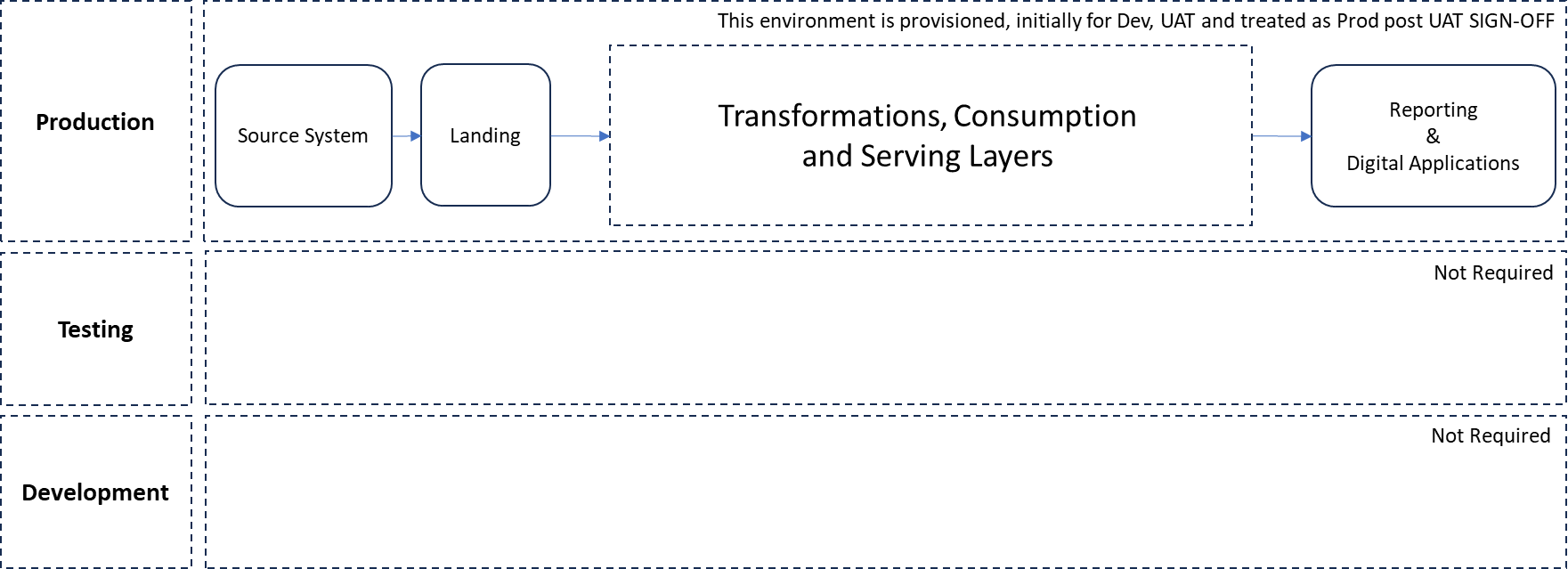
Time to Market Efficiency: Productionizable Viable Product (PVP) also aims to reduce the Time to Market (TTM) by 30-40% by implementing new initiative ONLY IN PRODUCTION. This time efficiency is a valuable outcome, enabling organizations to expedite the launch of their products or solutions to market. By cutting down TTM, PVP contributes to the acceleration of product development. This swift pace in bringing products to market enhances overall efficiency and competitiveness for organizations.
Cost Reduction: Primary objective of the Productionizable Viable Product (PVP) is to potentially decrease investments by nearly two-third of infrastructure cost, along with many other costs to incorporate other functions like DevOps, CI/CD, Metadata Management, Data Quality, Data Governance, and Data Lineage. This cost-saving initiative offers organizations a substantial opportunity to optimize resource utilization.
‘The primary benefit of the PVP approach is that in the event of project failure, the loss is limited to the cost of a single environment i.e., Production.’
Following the successful implementation of the Productionizable Viable Product (PVP) approach and its validation through User Testing sign-off, the subsequent steps involve transitioning to standard implementation approaches for a mature product or solution. At this juncture, conventional practices such as data governance, data quality, metadata management, data lineage, master and reference data management, DevOps, and Continuous Integration/Continuous Deployment (CI/CD) can be initiated. These standard practices are systematically applied across all three environments, development, Testing, and production, to ensure a comprehensive and consistent implementation. The entire set of components from the PVP /Production (PROD) environment is provisioned in both development and Testing environments, completing the cycle of the Software Development Life Cycle (SDLC). This transition allows for the full integration of best practices and standard procedures, further solidifying the product or solution's maturity and readiness for widespread deployment and utilization.
Finished reading? Test yourself with 10 questions on this topic.
Go to the questions →From I Am Datapedia! by Mustafa Qizilbash, published here free by the author. Nothing about your reading is stored.