Learn free · topic 334
Aggregation Functions
Aggregation Functions are used to perform calculations on a set of values to return a single summarized result. These functions are often applied to columns in a database to derive useful insights from the data.
For better understanding:
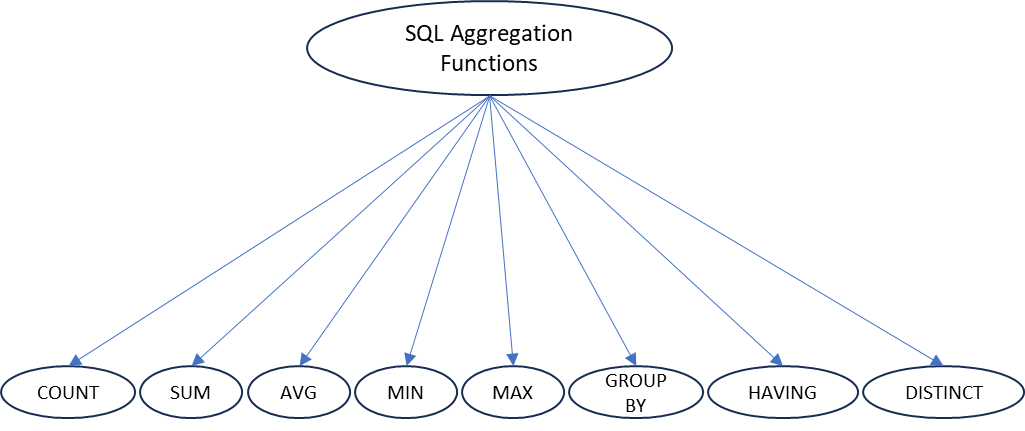
In the realm of data management and analysis, aggregation functions play a crucial role. These functions are specialized tools used to process and summarize data, particularly when dealing with large datasets. Instead of looking at individual data points, aggregation functions allow us to analyze groups of data and distill meaningful information.
2. Performing Calculations on a Set of Values:
Aggregation functions operate on sets of values, which are typically found in columns of a database. Instead of working with individual records, these functions work with groups or entire columns of data. This allows for the calculation of summary statistics, totals, averages, and other aggregated measures.
3. Returning a Single Summarized Result:
The primary goal of aggregation functions is to condense a set of data into a single, consolidated result. This result provides a high-level summary of the information contained in the dataset. For instance, instead of listing every employee's salary, you might use an aggregation function to get the total salary expenditure for a department.
4. Application to Columns in a Database:
Aggregation functions are commonly applied to columns within a database table. A column represents a specific type of data, such as salaries, quantities, or dates. By applying aggregation functions to these columns, you can analyze and summarize the characteristics of the data they contain.
5. Deriving Useful Insights from the Data:
The ultimate purpose of using aggregation functions is to extract valuable insights from the data. For example, you might use these functions to answer questions like "What is the average salary in a department?" or "How many orders were placed in a given month?" By summarizing the data, you gain a more manageable and interpretable view of the information.
6. Common Aggregation Functions in SQL:
SQL, a widely used language for database management, provides various built-in aggregation functions. Some common ones include:
- COUNT: Counts the number of rows.
- SUM: Calculates the sum of numeric values.
- AVG: Computes the average numeric values.
- MIN: Finds the minimum value.
- MAX: Finds the maximum value.
- GROUP BY: Groups rows based on specified columns.
- HAVING: Filters results based on conditions after using GROUP BY.
- DISTINCT: Removes duplicate values from the result set.
Here are some common aggregation functions in SQL along with examples:
1. COUNT:
Counts the number of rows in a result set.
SELECT COUNT(*) AS TotalEmployees FROM employees;
2. SUM:
Calculates the sum of values in a numeric column.
SELECT SUM(salary) AS TotalSalary FROM employees
WHERE department = 'IT';
3. AVG:
Calculates the average (mean) of values in a numeric column.
SELECT AVG(salary) AS AverageSalary FROM employees
WHERE department = 'Sales';
4. MIN:
Finds the minimum value in a column.
SELECT MIN(salary) AS LowestSalary FROM employees;
5. MAX:
Finds the maximum value in a column.
SELECT MAX(salary) AS HighestSalary FROM employees;
6. GROUP BY:
Groups rows based on the values in one or more columns and applies aggregation functions to each group.
SELECT department, AVG(salary) AS AvgSalary FROM employees
GROUP BY department;
7. HAVING:
Filters the results of a GROUP BY based on a specified condition.
SELECT department, AVG(salary) AS AvgSalary FROM employees
GROUP BY department
HAVING AVG(salary) > 50000;
8. DISTINCT:
Removes duplicate values from the result set.
SELECT DISTINCT department FROM employees;
These examples showcase how aggregation functions can be used to summarize and analyze data in a SQL database. It's important to note that these functions are powerful tools for data analysis and reporting, allowing you to derive valuable insights from large datasets.
In summary, aggregation functions are essential tools for data analysts and database professionals. They enable the transformation of raw data into meaningful insights, providing a concise and summarized view that facilitates decision-making and analysis in the data world.
Finished reading? Test yourself with 10 questions on this topic.
Go to the questions →From I Am Datapedia! by Mustafa Qizilbash, published here free by the author. Nothing about your reading is stored.