Learn free · topic 351
Data Product
Before we explore what constitutes a Data Product (DP), it is important to establish the foundational context within which these products exist. Most enterprise data environments comprise two distinct but interconnected types of systems:
- OLTP (Online Transaction Processing) systems, which are responsible for generating operational data through transactional processes.
- OLAP (Online Analytical Processing) systems, which are designed to serve data for analytical and decision-support purposes.
We will not dive into the technical specifics of OLTP and OLAP here, as those are covered in dedicated sections elsewhere in this book. However, it is essential to understand this distinction because Data Products are primarily built and operated within the OLAP ecosystem.
In essence, OLTP generates data. OLAP serves it.
Data products are almost always born, shaped, and consumed in the OLAP layer, where raw data is transformed into meaningful, trustworthy outputs for business consumption.
What Exactly Is a Data Product?
At its core, a data product is a tangible, consumable asset that derives its value from data. It is built by orchestrating a series of capabilities , data ingestion, transformation, modelling, storage, quality assurance, governance, and delivery , and presented in a way that users (human or machine) can act upon.
Data products take many forms, including:
- Reports or dashboards for executives and managers.
- Excel extracts or CSV data feeds for teams needing flexible, offline analysis.
- Curated datasets or semantic layers for analysts.
- APIs or real-time data feeds for integration with applications.
- Feature stores and models powering machine learning pipelines.
Their value lies not in what they are, but in what they enable: decisions, insights, automation, and innovation.
TYPES OF DATA PRODUCTS
Data Products typically fall into two broad categories based on their purpose and audience:
1. Data Product Applications (DPA)
A Data Product Application (DPA) is created to directly answer specific business questions. These are typically consumed in the form of visual dashboards, tabular reports, Excel files, or direct data exports.
- The purpose is immediate insight delivery.
- There are no expectations of this product being reused or integrated by other systems.
- The design focus is on usability, clarity, and meeting a defined set of business requirements.
2. Data-As-a-Product (DAaP)
Data-As-a-Product (DAaP) refers to curated, production-grade datasets or models designed explicitly for consumption by other users, systems, or applications. The goal is not only to serve information but also to enable further downstream processing, analytics, or transformation.
- DAaP places significant emphasis on semantic modelling, data contracts, and stability.
As multiple downstream consumers may depend on the product, changes to schema, structure, or logic require rigorous impact assessment and governance.
FROM DPA TO DAaP, AN EVOLVING JOURNEY
In practice, the boundary between DPA and DAaP is fluid. A product originally built as a DPA for internal business use may, over time, attract interest from other teams or applications seeking to reuse its curated data. In such cases, it may gradually evolve into a DAaP, requiring more robust modelling, stronger governance, and versioning protocols.
Equally, a DAaP initially developed as a shared resource may be repurposed into a DPA for a specific analytical use case.
Understanding this lifecycle flexibility is critical when architecting and managing data products at scale.
FIELD PERSPECTIVE
Successful data product development requires more than technical delivery. It demands careful consideration of:
- Who the end user or system is
- What questions the product is meant to answer
- How the data lifecycle and governance will be maintained
- Whether the product is application-facing (DPA) or platform-facing (DAaP)
Failing to clarify these dimensions often leads to products that are either underutilized, too rigid to evolve, or too fragile to scale.
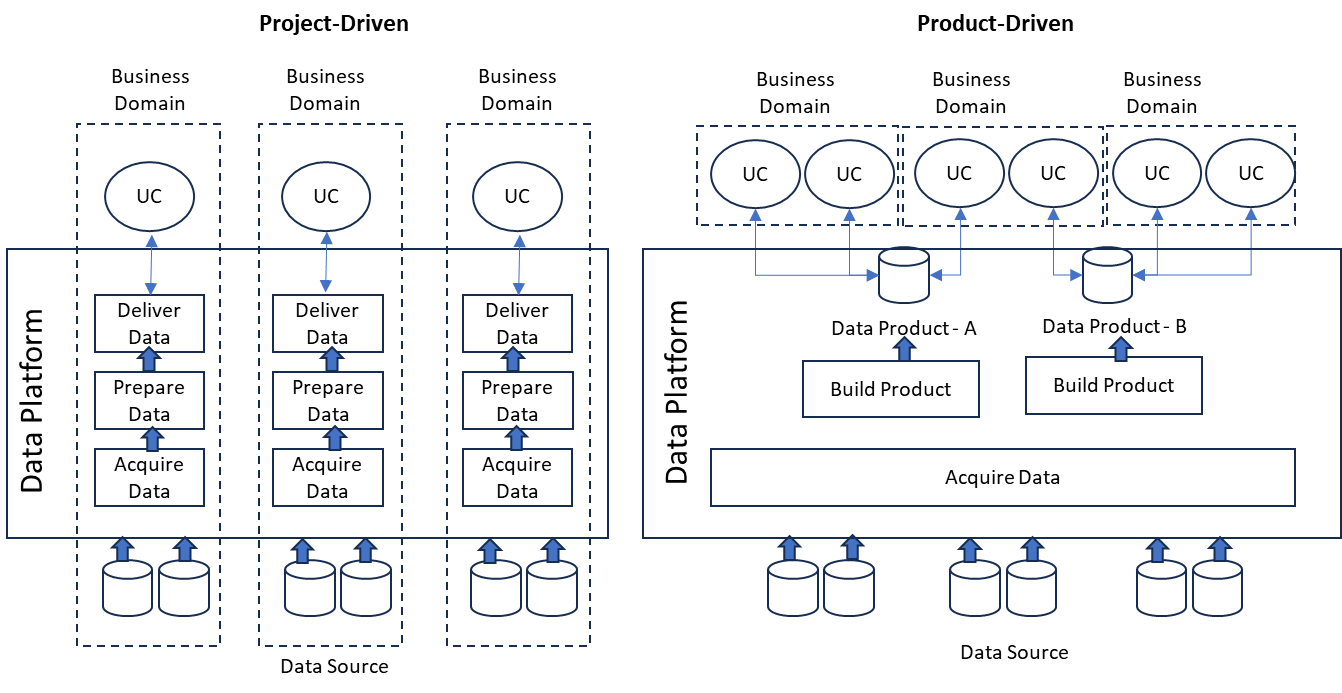
- Recommendation Systems: Products like Netflix or Amazon use data to analyze user preferences and provide personalized recommendations.
- Predictive Analytics Tools: Tools that forecast future trends based on historical data, such as weather forecasting or stock market prediction.
- Business Intelligence Dashboards: Platforms that aggregate and visualize business data, helping organizations make informed decisions.
- Health Monitoring Devices: Wearable devices that collect and analyze health-related data, providing insights into users' well-being.
- Fraud Detection Systems: Systems that analyze patterns in transactions to identify and prevent fraudulent activities.
Development Process of a data product involves stages such as data collection, processing, analysis, and the creation of a user interface or platform for users to access the insights.
The value of a data product lies in its ability to turn raw data into actionable insights, providing users with information that helps them make better decisions, improve processes, or gain a competitive advantage.
In summary, a data product is a tangible outcome that results from leveraging data to deliver valuable insights or functionality to end-users. These products play a crucial role in today's data-driven landscape, offering a wide range of applications across different industries and domains.
Finished reading? Test yourself with 10 questions on this topic.
Go to the questions →From I Am Datapedia! by Mustafa Qizilbash, published here free by the author. Nothing about your reading is stored.