Learn free · topic 37
Logical Data Modelling (LDM)
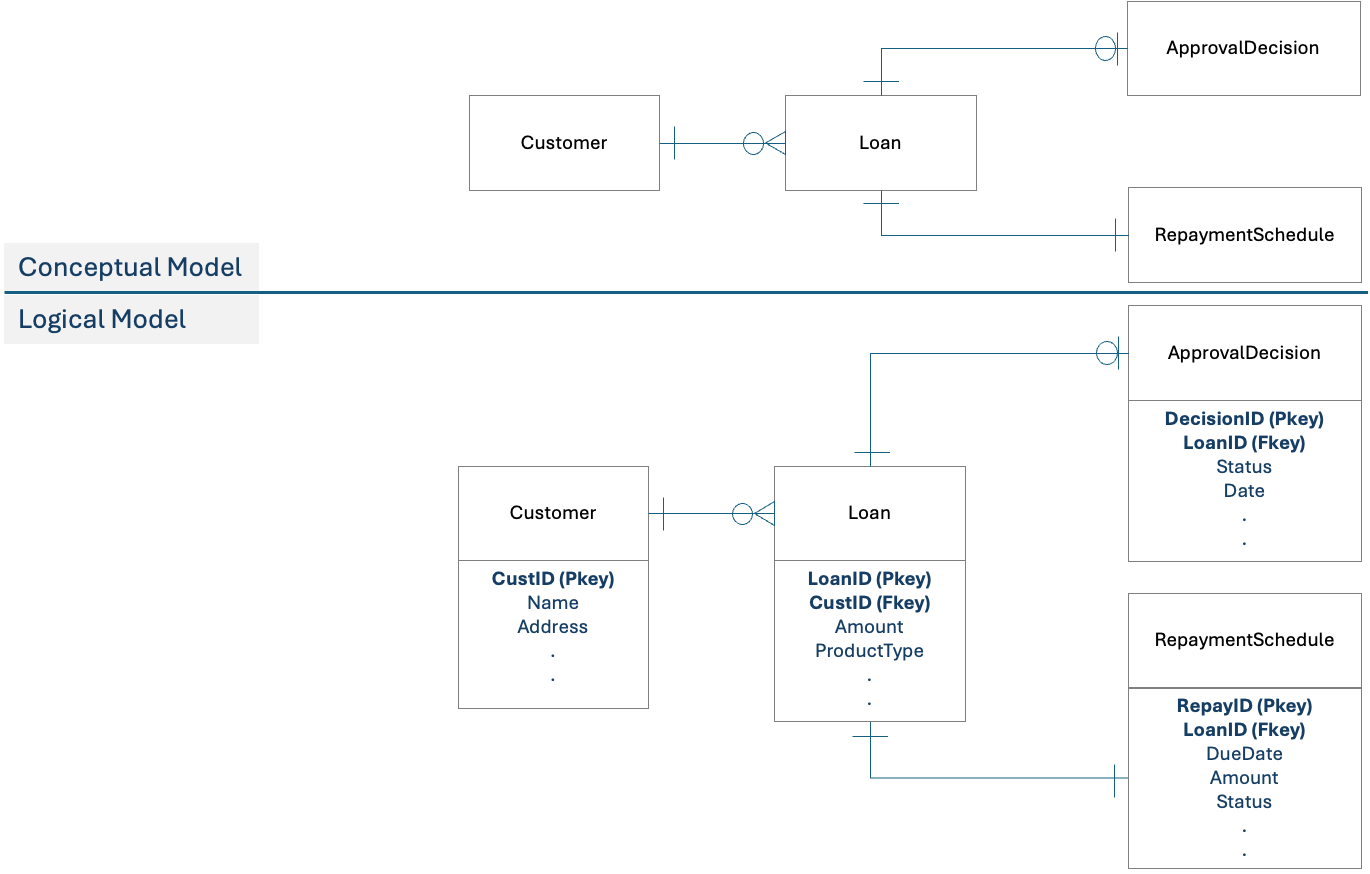
The primary goal of Logical Data Modelling is to create a precise and normalized representation of data that is implementation-ready but not yet tied to a particular platform. It acts as a structural blueprint that ensures data integrity, clarity of relationships, and enforcement of business rules before moving into physical optimization. At this stage, ambiguity is removed and formal definitions are introduced.
Logical modelling expands the conceptual entities by defining their attributes and keys. For example, instead of simply stating that a Customer applies for a Loan, the logical model specifies that Customer contains attributes such as CustID, Name, and Address, while Loan contains LoanID, CustID as a foreign key, Amount, and ProductType. ApprovalDecision and Repayment are also defined as separate entities, each with their own primary keys and foreign key references. Referential integrity rules ensure that a Loan cannot exist without a valid Customer, and an ApprovalDecision cannot exist without a valid Loan. The attached diagram illustrates this transition clearly: the upper portion represents the conceptual abstraction, while the lower portion shows detailed entities with primary and foreign keys explicitly defined.
Normalization plays a central role in Logical Data Modelling. Through successive normal forms, from First Normal Form to Third Normal Form, and in advanced scenarios up to Sixth Normal Form, the model removes redundancy and ensures that each fact is stored in only one place. In the loan example, instead of storing customer details repeatedly within each loan record, the Customer entity is separated and referenced through a foreign key. This reduces duplication, improves update consistency, and preserves data integrity. Logical modelling is therefore particularly aligned with OLTP (Online Transaction Processing) systems, where accuracy and consistency are critical.
However, logical modelling also accommodates analytical needs. In OLAP (Online Analytical Processing) environments, strict normalization may be relaxed in favor of performance and query simplicity. For analytical purposes, the same loan domain may be represented using a fact table such as FactLoanApproval, containing measures and foreign keys, linked to dimension tables such as Customer, Product, Date, and Decision. While this structure is denormalized compared to a 3NF design, it remains logically structured and rule-based. Logical modelling therefore supports both normalized transactional structures and analytically optimized dimensional structures, depending on workload requirements.
The strength of Logical Data Modelling lies in its balance between abstraction and precision. It introduces attributes, keys, constraints, and relationships while remaining independent of a specific database management system. Data types, indexing strategies, partitioning schemes, and storage optimizations are deferred to the physical modelling stage. This separation ensures portability, clarity, and architectural discipline.
Logical Data Modelling is detailed and structured but technology-independent. It is grounded in relational principles and formal data rules. It defines primary keys, foreign keys, cardinalities, uniqueness constraints, and optionality explicitly. It also supports integrity enforcement and schema validation. By doing so, it creates a stable and reliable foundation upon which physical implementations can be built.
In summary, Logical Data Modelling marks the transition from abstract business entities to structured schemas with attributes, keys, and formal constraints. It refines the high-level conceptual view into a rigorous and normalized representation of data, ready to be implemented in any database platform. This stage ensures that business meaning is preserved while structural precision is introduced, forming the essential blueprint for physical data design.
Finished reading? Test yourself with 10 questions on this topic.
Go to the questions →From I Am Datapedia! by Mustafa Qizilbash, published here free by the author. Nothing about your reading is stored.