← All topics
Learn free · topic 158
OLAP - Cube
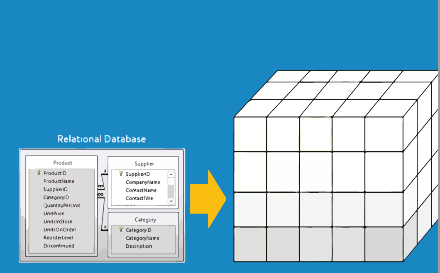
Cubes are a very controversial element of OLAP world where most of the folks think, it not worth having those.
Disadvantages
- These are huge in size.
- Very difficult to refresh in real time.
- Housekeeping is a challenge.
Below is Star or Snowflake schema representation. When data is joined from Fact and Dimension and loaded on one table it is called an OLAP Cube.
There are multiple types of OLAP i.e. ROLAP, MOLAP, HOLAP, HTAP, WOLAP, DOLAP and SOLAP.
- ROLAP [Relational On-Line Analytical Processing]: It sits directly on top of RDBMS which can be Star/ Snowflake Schema(s) and can be built using standard SQL. Another benefit, ROLAP doesn’t need additional storage as it runs on top of RDBMS.
- MOLAP [Multi-dimensional OLAP]: Cubes are the best example of MOLAP where multi-dimensional data can be loaded in a separate storage but in an extremely fast manner. Using Cubes, users can slice, dice, and drill up/ down, roll up and pivot the data within the same one cube eliminating the need to join with other tables. If a Cube has more than 3 dimensions of data in it, it’s called Hypercube.
- HOLAP [Hybrid]: This is a mixture of ROLAP or MOLAP.
- HTAP [Hybrid Transaction / Analytical Processing]: This is for in-memory data systems that do both online transaction processing (OLTP) and online analytical processing (OLAP).
- WOLAP [Web-enabled]: This refers to the only Web-Based OLAP with no connectivity with on-premises and is utilized through the internet browser.
- DOLAP [Desktop On-Line Analytical Processing]: In this OLAP, users can download a portion of OLAP on their machine for offline working.
- SOLAP [Spatial]: This is to tackle issues in the field of Geo-Business Intelligence.
Finished reading? Test yourself with 10 questions on this topic.
Go to the questions →From I Am Datapedia! by Mustafa Qizilbash, published here free by the author. Nothing about your reading is stored.