Learn free · topic 57
COLUMNAR (WIDE-COLUMN) DATABASES
Wide-Column databases, often referred to as column-family databases, organize data into rows and dynamic columns grouped into column families. Unlike traditional relational tables where every row follows a fixed schema, wide-column systems allow each row to contain a flexible and potentially sparse set of columns. They are optimized for distributed storage and partitioned queries across very large datasets.
The primary goal of wide-column databases is to enable high write throughput and scalable query performance over massive volumes of data. They are particularly well suited for time-series, event-driven, and high-velocity workloads where large amounts of data must be written and retrieved efficiently across distributed clusters.
In this model, data is partitioned by a primary key, for example, CustomerID or LoanID. All related data for that key is stored together within a partition. Within each partition, rows may contain flexible columns that vary between records. The schema is shaped primarily by access patterns. Instead of normalizing entities into separate tables, designers structure data to answer specific queries efficiently.
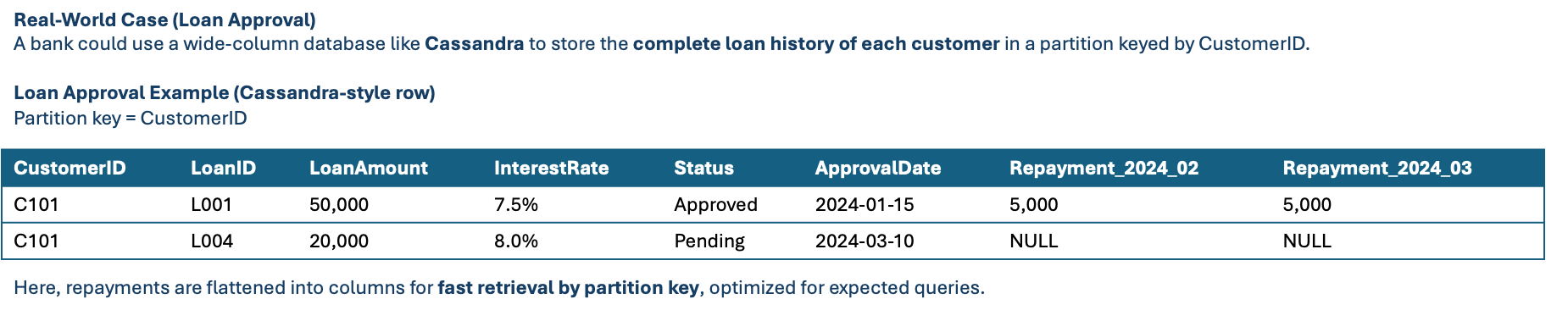
In a loan approval scenario, a bank might use a wide-column database such as Cassandra to store the full loan history of each customer. The partition key could be CustomerID, ensuring that all loans associated with that customer reside together. Within that partition, rows might represent different LoanIDs, with columns for LoanAmount, InterestRate, Status, ApprovalDate, and repayment-related fields such as Repayment_2024_02 or Repayment_2024_03.
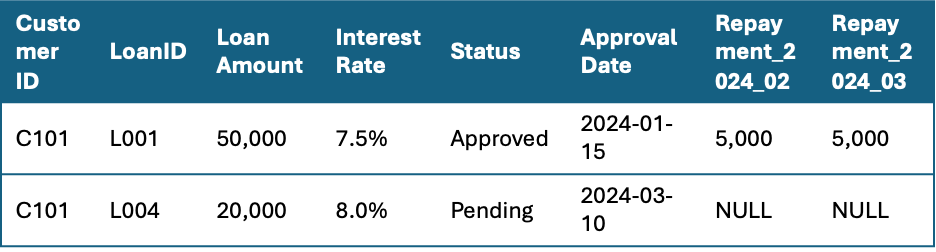
For example, under CustomerID C101, multiple LoanIDs could exist. Each loan’s details and repayment amounts are flattened into columns within the same partition. When the system needs to fetch all loans for CustomerID C101, it retrieves them efficiently in a single partition read. This design is optimized for predictable access patterns such as “show complete loan history for a customer.”
Wide-column databases offer strong advantages. They handle extremely high write and read throughput. They are well suited for time-series and event data. They scale horizontally across distributed clusters with relative ease. Their architecture is designed for fault tolerance and performance at large scale.
However, this performance comes with trade-offs. Query patterns must be known in advance because the schema is built around expected access patterns. Complex joins across partitions are impractical. If business requirements change and new query types are needed, schema redesign may be required. Flexibility for ad-hoc analytical queries is limited compared to relational systems.
Wide-column stores are therefore best suited for large-scale, high-velocity environments where workloads are predictable and performance is critical. In loan approvals, they enable rapid retrieval of a customer’s full loan history and repayment records. However, they are less suitable for flexible cross-entity analytics or complex relational reporting.
Relational vs Columnar Model (Loan Approval)
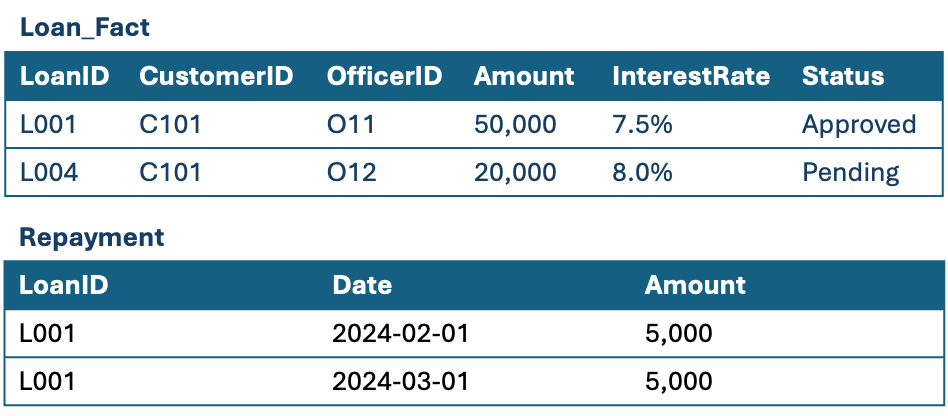
Relational Model (Fact + Dimensions)
- Loan data normalized into Fact Table + Customer, Officer, Repayment dimensions.
- Consistency ensured but requires multiple joins for complete history.
Example Tables
Columnar / Wide-Column Model
- Customer loans stored in a single partition, flattened into columns.
- Optimized for predictable query patterns (e.g., fetch all loans by CustomerID).
- No joins required; all history accessible in one read.
Example (Partition Key = CustomerID)
Key Difference
- Relational: normalized, flexible, consistent, but joins can be costly at scale.
- Columnar: denormalized, partitioned, built for high-volume throughput and predictable queries.
Finished reading? Test yourself with 10 questions on this topic.
Go to the questions →From I Am Datapedia! by Mustafa Qizilbash, published here free by the author. Nothing about your reading is stored.