Learn free · topic 56
KEY–VALUE DATABASES
Key–Value databases represent the simplest form of non-relational data storage. They store data as a pair consisting of a unique key and its associated value. The key serves as an identifier, while the value contains the data itself. This model eliminates structural complexity and focuses entirely on fast retrieval by key.
The primary goal of key–value databases is to deliver ultra-fast lookups with minimal overhead. They are designed for workloads where the access pattern is simple and predictable, such as caching, session management, token storage, or high-volume read/write operations. Instead of supporting complex queries, these systems optimize for speed and scalability.
In a key–value database, each record is accessed directly through its key. The value associated with that key can be a simple string, a JSON object, or even a binary blob. There is no concept of joins, relational constraints, or query-based filtering beyond key lookup. This makes the model extremely efficient for operations such as “fetch loan details by LoanID.”
In a loan approval environment, a bank might use a key–value store such as Redis to cache complete loan application details for rapid access. For example:
- Key: LoanID = L001
- Value: a JSON structure containing LoanAmount, InterestRate, Status, CustomerID, and OfficerID.
When a loan officer opens a dashboard or a customer checks loan status in a mobile app, the system retrieves the entire record in a single lookup. There is no need to query a relational database or traverse a document store. The result is near-instant response time, often measured in sub-millisecond latency.
Key–value databases offer clear strengths. They provide extremely fast read and write performance. They are simple to design and operate. They scale horizontally with ease. They are ideal for high-velocity access patterns and caching layers in distributed architectures.
However, their simplicity is also their limitation. They do not support ad-hoc queries beyond direct key retrieval. They are poorly suited for complex relationships, reporting, or analytical workloads. Schema enforcement is minimal, and consistency rules are limited compared to relational systems.
Key–Value databases are therefore best understood as performance accelerators rather than full enterprise data platforms. They complement relational or document databases by offloading high-speed access needs. In modern architectures, they are often deployed as a caching layer sitting alongside primary storage systems.
In summary, the key–value model is unmatched in speed for direct lookups, but too limited for relational integrity or analytics. It represents the purest form of workload-driven data modelling, optimized for simplicity and performance above all else.
Real-World Case (Loan Approval)
A bank could use a Key-Value store like Redis to cache complete loan application details for rapid access by mobile apps or officer dashboards.
Key: LoanID = L001
Value:
{
"LoanAmount": 50000,
"InterestRate": 7.5,
"Status": "Approved",
"CustomerID": "C101",
"OfficerID": "O11"
}
This way, the entire loan record is retrieved in a single lookup, giving loan officers and customer apps near-instant results without querying the relational or document store.
Relational vs Key-Value Model (Loan Approval)
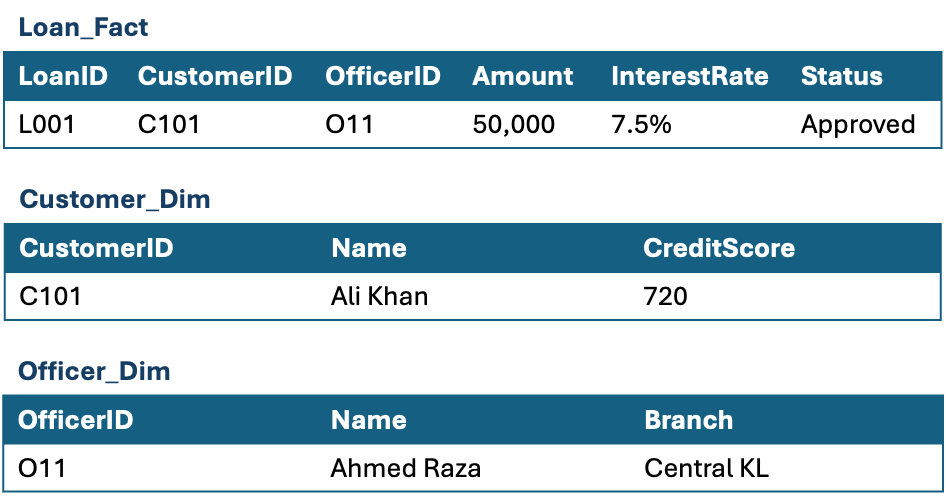
Relational Model (Fact + Dimensions)
- Loan stored in a Fact Table, linked to Customer and Officer dimensions.
- Normalized for consistency and reuse.
- Requires joins to fetch complete loan details.
Example Tables
Key-Value Model
- Loan stored as a single value retrieved by LoanID key.
- Denormalized object, all attributes in one place.
- No joins needed; one lookup retrieves everything.
Example
{ "LoanAmount": 50000,
"InterestRate": 7.5,
"Status": "Approved",
"CustomerID": "C101",
"OfficerID": "O11"}
Key Difference
- Relational: structured, normalized, supports complex queries and joins.
- Key-Value: ultra-fast lookups, but limited querying, best for caching or direct retrieval.
Finished reading? Test yourself with 10 questions on this topic.
Go to the questions →From I Am Datapedia! by Mustafa Qizilbash, published here free by the author. Nothing about your reading is stored.