Learn free · topic 43
1NF – First Normal Form
First Normal Form (1NF) introduces the first formal rule of relational structure: every attribute must contain atomic, indivisible values. This means that each cell in a table must hold exactly one value, not a list, not a set, and not a repeating group. In addition, each row must represent a single instance of an entity, and every record must be uniquely identifiable.
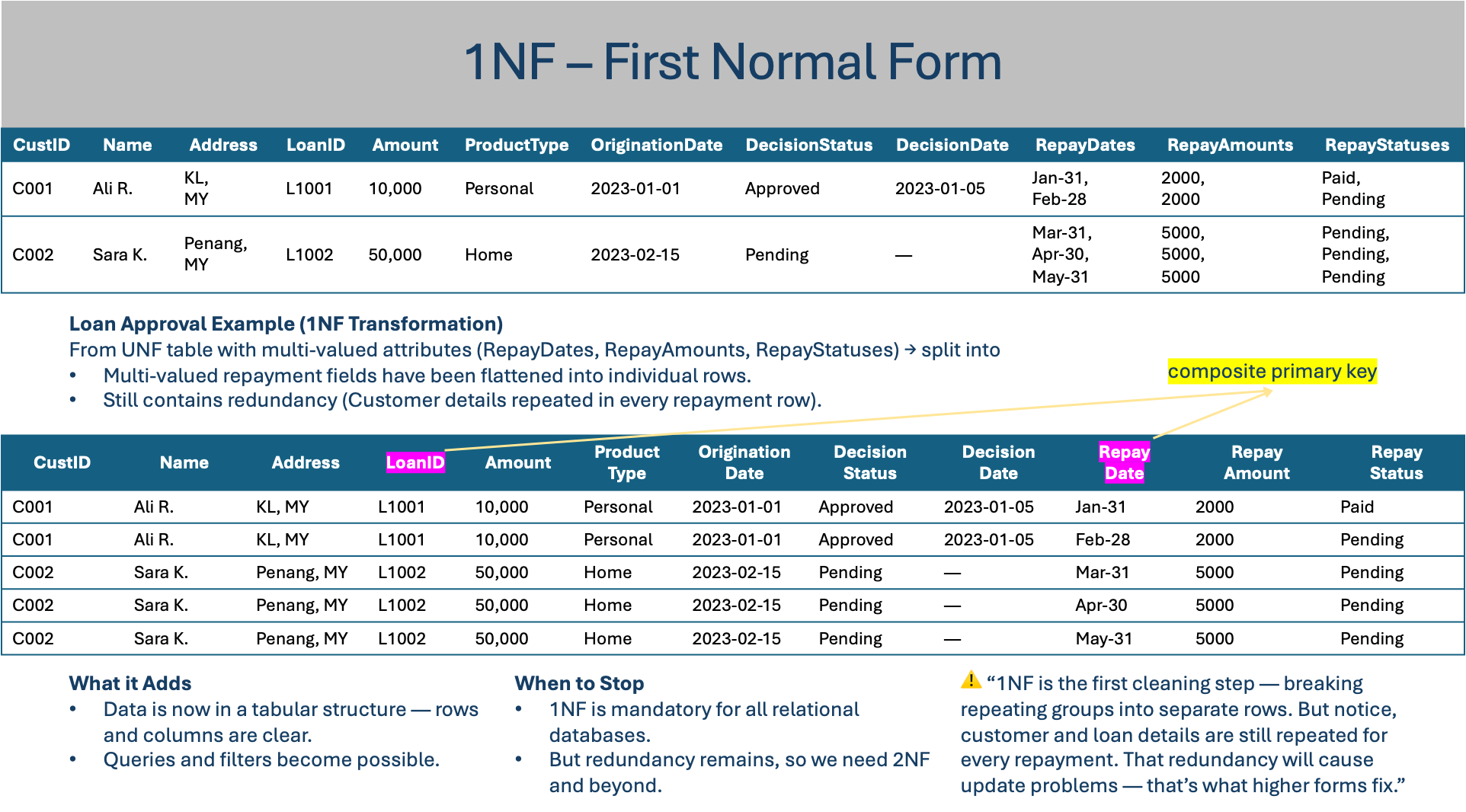
In the Unnormalized Form, we saw repayment dates, amounts, and statuses stored as multi-valued attributes inside a single row. This violates relational principles because a column should not contain multiple values. First Normal Form eliminates this issue by removing repeating groups and restructuring the data so that each field contains only one value.
Applying 1NF to the loan approval example means separating multi-valued repayment information into individual rows. Instead of storing multiple repayment dates in a single column such as “Jan-31, Feb-28,” we create separate rows for each repayment instance. Each repayment date, repayment amount, and repayment status becomes a distinct record. As a result, the table grows vertically rather than horizontally, and repeating groups are eliminated.
Another important aspect of 1NF is ensuring that every record is uniquely identifiable. A primary key must be defined so that no two rows represent the same entity instance. In the loan example, a composite key such as LoanID combined with RepaymentDate might initially serve to uniquely identify repayment entries, although later normalization stages may refine this further.
It is important to understand what 1NF does not do. It does not eliminate redundancy between related entities. Customer information may still repeat across multiple loan rows. Decision details may still depend on other non-key attributes. First Normal Form only addresses atomicity and repeating groups. It ensures that data is structurally compatible with relational systems but does not yet address deeper dependency problems.
The transition from UNF to 1NF represents the shift from loosely structured data to properly formed relational tables. The messy spreadsheet-like format begins to resemble a disciplined database structure. However, structural anomalies still exist, and further refinement is required.
First Normal Form establishes the minimum standard for relational design. From here, we proceed to Second Normal Form, where partial dependencies are eliminated and deeper structural integrity begins to take shape.
Finished reading? Test yourself with 10 questions on this topic.
Go to the questions →From I Am Datapedia! by Mustafa Qizilbash, published here free by the author. Nothing about your reading is stored.