Learn free · topic 362
MetaGraph
A MetaGraph provides information about the structure, schema, and semantics of a knowledge graph within a graph database. It essentially acts as a "graph of metadata" that defines how entities (nodes) and their relationships (edges) are organized and interact, including their attributes, constraints, and interdependencies.
‘The Metadata of Knowledge Graphs in Graph Databases.’
In the world of data management, the term MetaGraph represents an advanced layer of abstraction that encompasses the metadata of a knowledge graph. While knowledge graphs are designed to represent relationships between entities, a MetaGraph serves as the blueprint that defines the structure, schema, and semantics of those relationships. This topic delves into the concept of MetaGraph, their importance, use cases, and their impact on the evolving landscape of graph databases.
MetaGraph is an enabler for a complete digital twin of simple to complex reality. The MetaGraph technology offers a cutting-edge approach to define, manage and utilizing metadata in a digital ecosystem – thus providing rich context to data across functions and systems. This is critical for AI, machine learning and data driven as quality in decisions based on facts become more central to industry transformations. The demand for high-quality, relevant data has never been greater. In the end the MetaGraph can enhance how businesses operate and innovate.
What is a Knowledge Graph?
A knowledge graph organizes information in a graph structure, where nodes represent entities (e.g., people, places, things) and edges represent the relationships between them. This graph model allows for the representation of complex interconnected data, enabling advanced applications like recommendation systems, semantic search, and fraud detection.
What is a MetaGraph?
A MetaGraph, in essence, is the metadata of a knowledge graph. It defines the "graph about the graph," capturing details about the entities, relationships, attributes, and their interdependencies. The MetaGraph acts as a conceptual framework, specifying:
- Entity Types: Categories or classes of nodes (e.g., Person, Company, Product).
- Relationship Types: The types of edges that can exist (e.g., Works For, Buys, Located In).
- Attributes: Properties of both nodes and edges (e.g., Name, Date, Location).
- Constraints: Rules governing the relationships and attributes (e.g., cardinality, mandatory fields).
Evolution of Database Technologies

Importance of a MetaGraph
Traditional data collection methods have led to vast volumes of poorly structured, disparate data, creating confusion rather than clarity. This often results from a lack of focus on generating high-quality, contextual data from the outset, a process best guided by business domain experts who can ensure accuracy and relevance.
MetaGraphs address these issues by creating a seamless data integration framework that captures real-world dependencies, through structured metadata (including ontologies and taxonomies), and supports multidimensional data across different levels of abstraction.
A MetaGraph is critical for the following reasons:
- Semantic Integrity: It ensures that the knowledge graph adheres to a well-defined schema, preventing inconsistent or ambiguous relationships.
- Data Discovery: Metadata aids in querying and navigating the graph by providing context about the entities and relationships.
- Performance Optimization: By predefining the structure and constraints, MetaGraph can help optimize storage and retrieval processes.
- Interoperability: A MetaGraph can act as a universal schema to integrate multiple knowledge graphs, enabling seamless data exchange.
Components of a MetaGraph
The structure of a MetaGraph can be broadly categorized into:
- Node Classes: Represent types of entities and their associated attributes. For example, the class Person might have attributes like Name, Age, and Address.
- Edge Classes: Define types of relationships, such as FriendOf, EmployeeOf, or PartOf.
- Attribute Metadata: Details about properties, including data types, value ranges, and constraints.
- Graph Schema Rules: These include inheritance hierarchies, cardinality rules, and restrictions (e.g., A Company can have multiple Employees but not vice versa).
- Benefits of Using a MetaGraph
- Enhanced Query Capabilities: Queries can leverage metadata to fetch data efficiently, using predefined schemas to infer relationships.
- Data Governance: With clear metadata definitions, organizations can better manage data lineage, compliance, and security.
- Scalability: As graphs grow, MetaGraph provide a scalable way to maintain order and structure.
Applications of MetaGraph
In practical terms, MetaGraphs facilitate better design, configuration, simulation, production, and lifecycle management across an information landscape. This landscape today consists of many different digital twins, data silos and other applications. By embedding a smart layer that organizes and manages structured knowledge across systems, MetaGraph technology allows for more efficient and balanced day-to-day operations and analytics.
- Enterprise Knowledge Management: Companies use MetaGraph to manage complex information hierarchies and organizational structures.
- Semantic Web and Ontologies: MetaGraph underpin ontological frameworks, enabling machines to interpret and reason about data.
- AI and Machine Learning: Training models often require structured data, and MetaGraph help ensure that the underlying graphs are clean and semantically rich.
- Data Integration: Merging knowledge graphs from different domains or systems becomes easier with a defined MetaGraph.
Challenges in Implementing MetaGraph
- Complexity: Designing a comprehensive MetaGraph can be challenging, particularly for large-scale or dynamic data ecosystems.
- Performance Overhead: Managing metadata adds computational overhead, especially for real-time applications.
- Standardization: There is no universal standard for MetaGraph, which can create interoperability issues.
Future of MetaGraph
As graph technologies continue to evolve, MetaGraph are poised to play a pivotal role in advancing semantic data management. Innovations like automated MetaGraph generation, real-time schema validation, and enhanced integration with AI pipelines are expected to expand their utility.
Visualizing a MetaGraph
Below is a diagram that illustrates the concept of a MetaGraph:
- Node Level:
- Entity Types: Person, Company, Product
- Attributes: Name, Age, Location, etc.
- Edge Level:
- Relationship Types: Works For, Located In
- Attributes: Start Date, Role
- Constraints:
- Cardinality Rules, Data Types
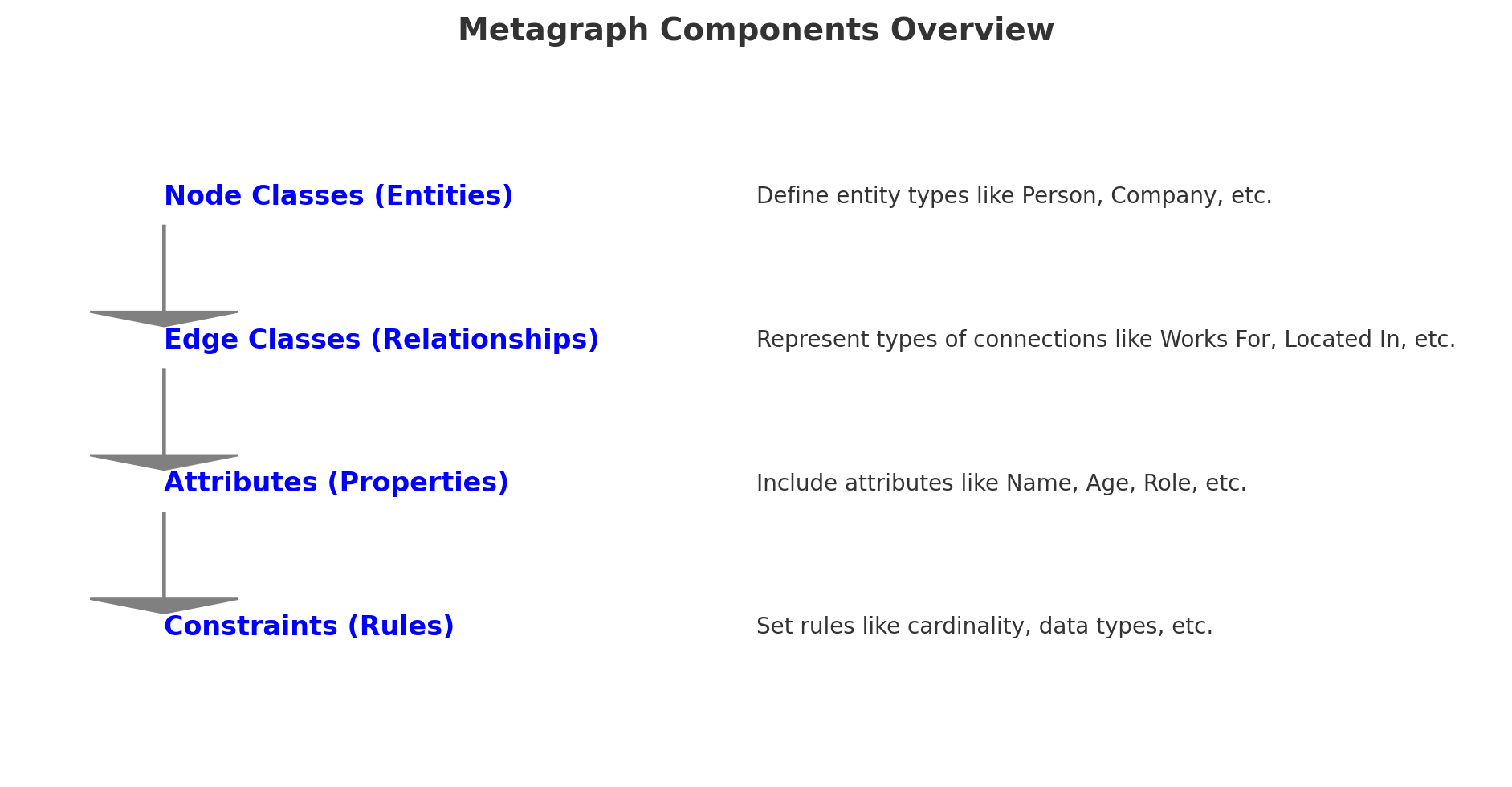
The diagram above represents the key components of a MetaGraph:
- Node Classes (Entities): Define entity types, e.g., Person, Company.
- Edge Classes (Relationships): Represent connections, e.g., Works For, Located In.
- Attributes (Properties): Include details like Name, Age, Role.
- Constraints (Rules): Define schema rules like cardinality and data types.
MetaGraph provide the backbone for managing and optimizing knowledge graphs. By capturing the metadata that defines the structure and semantics of a graph, they enable organizations to harness the full potential of their interconnected data. As the use cases for graph databases expand, MetaGraph will remain indispensable for ensuring scalability, consistency, and semantic clarity.
Finished reading? Test yourself with 10 questions on this topic.
Go to the questions →From I Am Datapedia! by Mustafa Qizilbash, published here free by the author. Nothing about your reading is stored.