Learn free · topic 49
6NF – Sixth Normal Form
Sixth Normal Form (6NF) represents the most fine-grained level of relational decomposition used in practical modelling. A table is in 6NF when it is already in Fifth Normal Form and has been decomposed so that each relation captures a single fact about a key, typically with explicit time validity. In this form, every table represents one attribute, or a tightly bound set of attributes, over time.
The guiding idea of 6NF can be summarized simply: one attribute, one timeline, one table.
Earlier normalization stages focused on eliminating redundancy caused by partial dependencies, transitive dependencies, multi-valued dependencies, and join dependencies. Sixth Normal Form goes further by decomposing data to its smallest meaningful components, particularly when time becomes an important dimension.
To understand 6NF in the loan approval context, consider a Loan table that includes attributes such as Amount, InterestRate, ProductType, and Status. In earlier normal forms, these attributes might coexist in a single table keyed by LoanID. However, if each of these attributes can change independently over time, storing them together may create temporal anomalies.
For example, suppose a loan’s interest rate changes due to refinancing, and its status changes independently due to payment behavior. If both attributes are stored in the same table with effective dates, updates may become complex and overlapping time intervals may be difficult to manage.
Sixth Normal Form addresses this by decomposing the structure into separate time-aware tables:
LoanAmount (LoanID, Amount, EffectiveStart, EffectiveEnd)
LoanInterestRate (LoanID, InterestRate, EffectiveStart, EffectiveEnd)
LoanStatus (LoanID, Status, EffectiveStart, EffectiveEnd)
Each table now represents a single fact about a loan over time. The primary key typically consists of the business key combined with a validity period, such as LoanID and EffectiveStart. This structure ensures that each attribute evolves independently along its own timeline.
In advanced implementations, transaction-time (when the record was stored in the system) may also be included alongside valid-time (when the fact is true in the business world). This enables full bi-temporal modelling, supporting auditability and regulatory compliance.
Sixth Normal Form is especially relevant in temporal modelling and ensemble techniques such as Data Vault, Anchor Modelling, and Focal Point Modelling. These approaches often embrace fine-grained decomposition to allow agile schema evolution, precise historical tracking, and reduced structural coupling.
It is important to recognize that 6NF is rarely necessary for standard transactional systems. The level of decomposition can increase table counts significantly and make queries more complex. However, in environments where history, auditability, and independent attribute evolution are critical, 6NF provides unmatched structural precision.
Conceptually, 6NF represents the extreme end of normalization. Each table captures one irreducible fact about a key, often with its own timeline. At this point, redundancy is minimized to its absolute theoretical limit, and structural flexibility is maximized.
Beyond 6NF lies Domain-Key Normal Form, which represents the theoretical ideal of relational design.
From 5NF → 6NF (temporal evolution)
- In our model, attributes like Repayment Amount and Repayment Status can change over time.
- Instead of one RepaymentSchedule row holding all attributes, split each time-varying attribute into its own history table keyed by the repayment identity.
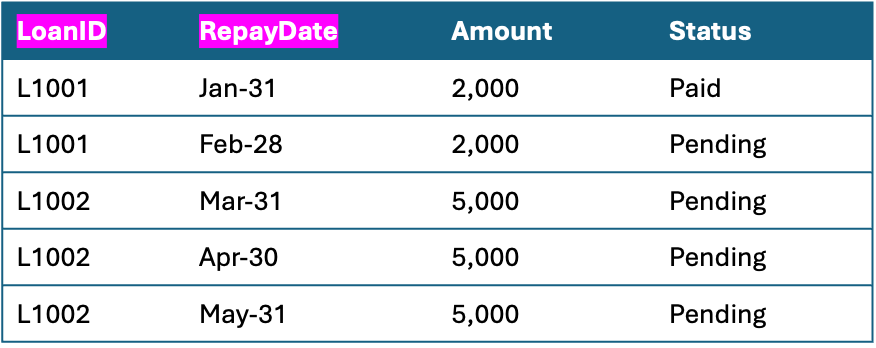
We’ll use the composite key (LoanID, RepayDate) as the repayment identity.
Original (pre-6NF) RepaymentSchedule (for context)
(You can model ApprovalDecision and other mutable attributes the same way, e.g., DecisionStatusHistory(LoanID, EffectiveStart, EffectiveEnd, Status).)
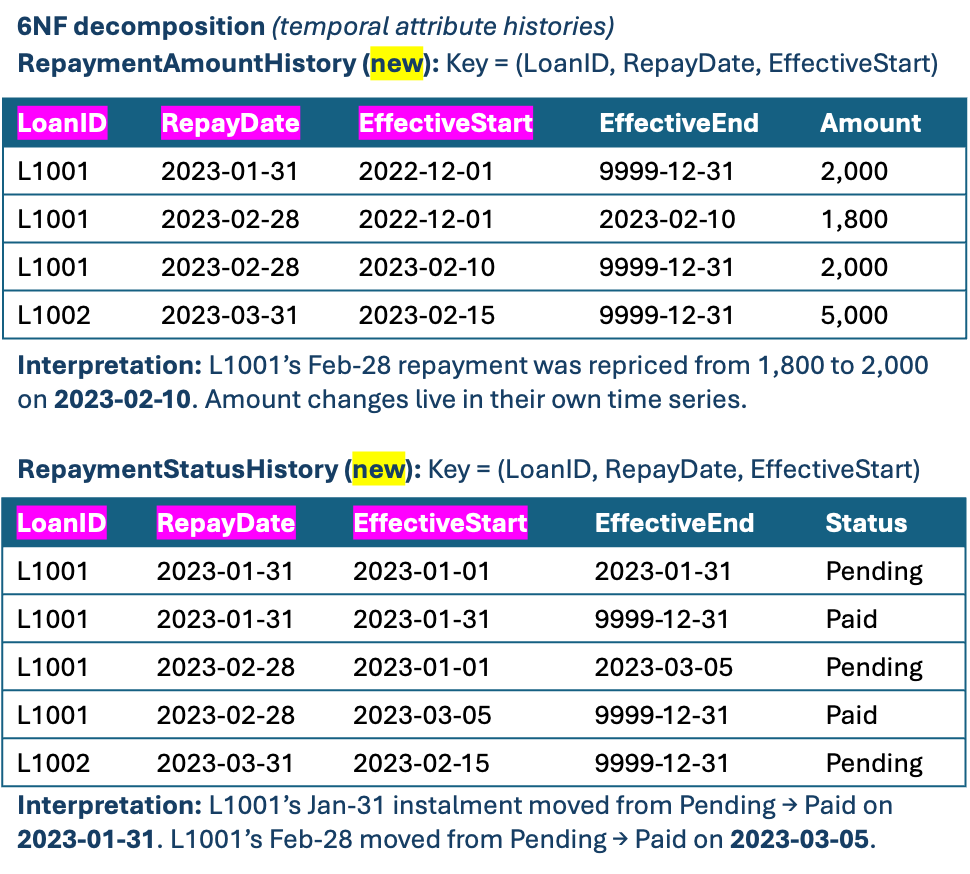
What it adds
- Audit-grade temporal lineage (who/what/when changed).
- Clean separation of independently changing attributes.
- Enables as-of queries and historical reconstructions precisely.
Trade-offs / When to stop
- Highly fragmented schema; queries require more joins.
- Best for regulatory, audit, pricing, contract scenarios; often overkill for general OLTP.
- Many shops normalize to 3NF/BCNF, then selectively apply 6NF-style histories only where needed.
⚠️ “6NF is where we stop pretending attributes change together. Amount and Status don’t share the exact same change times, so we give each its own timeline. That’s why 6NF looks like Data Vault or Anchor: one attribute (or attribute group), one key, one time axis. It’s brilliant for audits and ‘as-of’ analytics, but you pay with more tables and more joins, so apply it surgically.”
Finished reading? Test yourself with 10 questions on this topic.
Go to the questions →From I Am Datapedia! by Mustafa Qizilbash, published here free by the author. Nothing about your reading is stored.