Learn free · topic 50
DKNF – Domain–Key Normal Form
Domain–Key Normal Form (DKNF) represents the theoretical “ultimate” stage of normalization. A relation is in DKNF if every constraint on the table can be expressed solely as either a domain constraint or a key constraint. If any rule governing the data cannot be enforced purely through domain definitions or key definitions, the relation is not in DKNF.
A domain constraint defines what values are valid for a column. For example, a DecisionStatus column may allow only APPROVED, REJECTED, or PENDING. An InterestRate column may allow only non-negative numeric values. These constraints govern permissible values.
A key constraint defines uniqueness. It specifies which combination of attributes uniquely identifies a row. For example, LoanID may uniquely identify a loan. A composite key such as (LoanID, EffectiveStart) may uniquely identify a time-bound fact.
The rule for achieving DKNF is conceptually simple but practically demanding. Starting from Sixth Normal Form, all remaining constraints, including business rules, dependencies, conditional requirements, and cross-attribute logic, must be expressible through domain or key rules alone. No non-trivial constraints should remain outside these two categories.
To illustrate this in the loan approval domain, consider a business rule such as:
“If a loan is APPROVED, it must have a RepaymentSchedule.”
This rule cannot be expressed purely as a domain constraint (it is not just about valid values) nor purely as a key constraint (it is not about uniqueness). It is a cross-table conditional rule. Therefore, unless the schema is redesigned so that such logic is enforced structurally through keys or domain definitions, the relation does not satisfy DKNF.
In practice, most real-world schemas do not reach Domain–Key Normal Form because many business rules are conditional or cross-entity in nature. These rules often require triggers, application logic, or procedural enforcement beyond simple domain and key constraints.
DKNF is therefore best understood as a theoretical ideal. It represents a state where the relational schema itself fully captures all data constraints without relying on external logic. Every permissible state of the data can be validated by checking domains and keys alone.
While rarely achieved in complete form, DKNF is valuable conceptually. It defines the endpoint of relational purity. It reminds us that the ultimate goal of normalization is to embed as much integrity as possible directly into the structure of the data model.
In practical architecture, most systems stabilize between 3NF and BCNF, occasionally extending to 4NF or 6NF in specialized cases. DKNF stands as the logical conclusion of the normalization ladder, the point where structural discipline fully governs the data.
With DKNF, the normalization journey reaches its theoretical summit. From here, architectural decisions shift from eliminating redundancy to deliberately shaping data for performance, analytics, agility, and domain-specific needs, the territory of specialized modelling techniques.
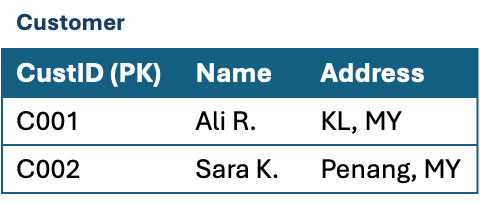
Domain constraints:
- CustID domain = Unique alphanumeric IDs.
- Name domain = String (non-null).

Domain constraints:
- Amount domain = PositiveInteger (> 0).
- DecisionStatus domain = {Approved, Pending, Rejected}.
- DecisionDate domain = must be ≥ OriginationDate.
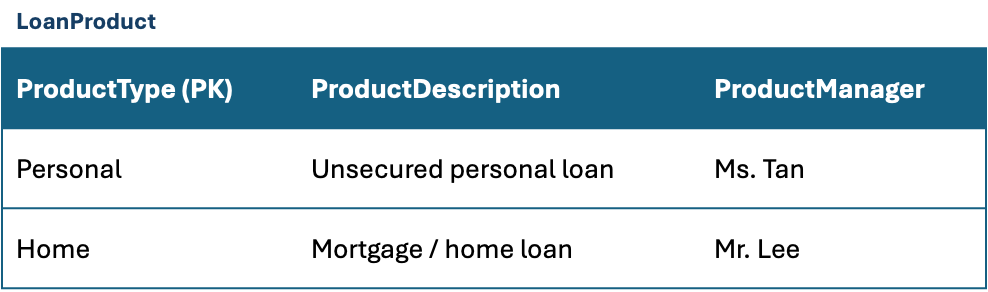
Domain constraints:
- ProductType domain = {Personal, Home, …}.
- ProductManager domain = Valid employee names.
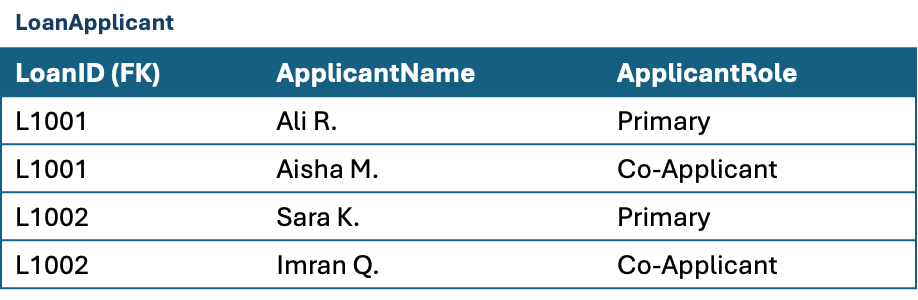
Domain constraint: ApplicantRole domain = {Primary, Co-Applicant}.
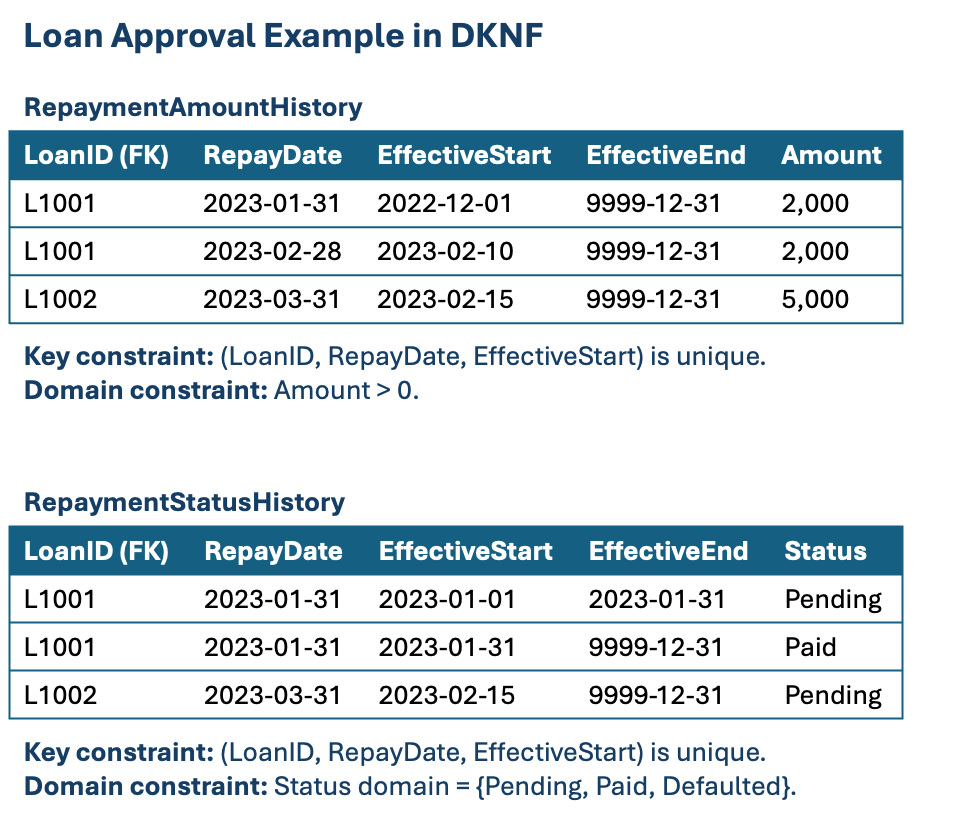
What this shows
- Every constraint is captured as domain or key.
- No hidden dependencies left in the design.
- This is the theoretical endpoint of normalization.
⚠️ “In DKNF, every single business rule becomes either a domain or a key constraint. For example, repayment status must come from a fixed list, repayment amount must be positive, decision status must be one of three allowed states. You’ll never see DKNF in production because not all business rules can be captured in keys/domains, but it’s the logical endgame of the normalization ladder.”
Normalization vs. Specialized Modelling Techniques
A Conceptual Comparison
Before moving further into specialized modelling techniques, an important clarification must be made.
The normalization forms, from First Normal Form through Sixth Normal Form, including BCNF and DKNF, are constructs of relational database theory. They were developed within the relational model, which is based on tables, rows, keys, and formal functional dependencies. Normalization is meaningful only when working within this framework.
However, many specialized modelling techniques do not operate purely within the relational model. Some predate it. Others extend beyond it. Some intentionally violate normalization principles for performance reasons. In these cases, asking whether a model is in “3NF” or “6NF” is often meaningless or conceptually misplaced.
Normalization belongs to relational theory. Specialized modelling techniques belong to workload-driven architecture.
The following comparison clarifies where normalization is relevant and where it is not.
Normalization Relevance Across Modelling Techniques
Technique | NF Relevance | Comment |
Dimensional (Star, Snowflake, USS) | ❌ Opposite (Denormalization) | Designed for analytical performance; intentionally introduces redundancy for faster queries. |
Hierarchical / Network | ❌ Not Applicable | Pre-relational models; normalization theory does not apply. |
Object-Oriented | ❌ Not Applicable | Focused on inheritance and object semantics, not relational dependency theory. |
NoSQL | ❌ Not Applicable | Schema-flexible or schema-on-read; normalization is not formally defined. |
Event-Driven | ❌ Not Applicable | Append-only log structures; dependency-based normalization is irrelevant. |
JSON / XML Schema | ❌ Not Applicable | Can be structured cleanly, but formal normal forms do not apply. |
API / Service Modelling | ❌ Not Applicable | Focus is on canonical representation and contract design, not relational normalization. |
Data Vault | ⚠️ Related | Satellites resemble 6NF-style decomposition for historical tracking. |
Focal Point Modelling | ⚠️ Related | Similar to Data Vault; fine-grained attribute separation resembles 6NF principles. |
Hook Modelling | ⚠️ Related | Attribute decomposition and structural flexibility align with 6NF ideas. |
Anchor Modelling | ✅ Yes | Explicitly grounded in 6NF-style decomposition and temporal principles. |
Temporal Modelling | ⚠️ Often Requires 5NF/6NF | Fine-grained decomposition supports accurate time-based history tracking. |
Key Insight
Normalization is a relational discipline. It ensures structural purity, eliminates redundancy, and enforces dependency integrity within relational schemas.
Specialized modelling techniques, by contrast, are architectural strategies. They are designed to meet specific workload requirements such as analytics performance, auditability, scalability, or schema agility. Some build directly on high normal forms. Others intentionally break them.
It is therefore incorrect to measure all modelling techniques by the yardstick of normal forms. Instead, normalization should be viewed as foundational theory, a structural baseline that informs, but does not constrain, specialized modelling approaches.
Understanding this distinction allows us to appreciate why some techniques embrace extreme decomposition, while others deliberately flatten and duplicate data. Each technique solves a different architectural problem.
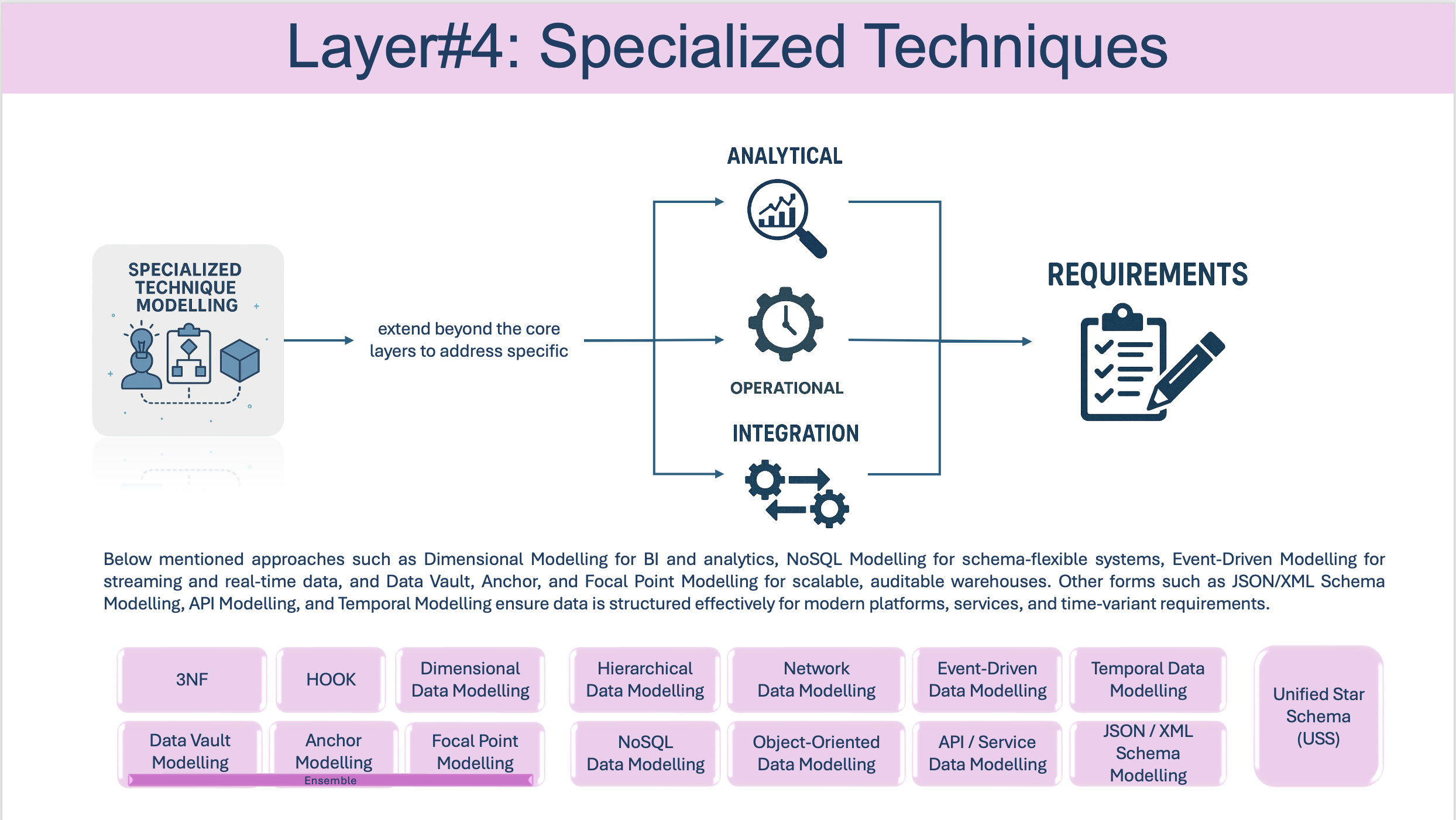
Transition to Layer #4: Specialized Techniques
Layer #3 established the core foundation of data modelling. We examined Conceptual, Logical, and Physical modelling and explored how normalization, from Unnormalized Form through Sixth Normal Form and even Domain–Key Normal Form, provides a rigorous framework for structuring data. These forms enforce integrity, eliminate redundancy, and ensure consistency through disciplined relational design.
Normalization has traditionally been associated with Online Transaction Processing (OLTP) systems, where accuracy and consistency are paramount. However, its influence extends beyond transactional workloads. Bill Inmon’s Enterprise Data Warehouse (EDW), built on Third Normal Form principles, demonstrates that normalized design can also support analytical environments (OLAP) by ensuring enterprise-wide integration and semantic consistency. In this sense, normalization is not merely a transactional tool; it is a structural philosophy that underpins reliable data architecture.
Yet normalization, for all its rigor, has limits.
Modern organizations operate in environments that stretch beyond classical relational theory. Business stakeholders demand intuitive, query-friendly models that reduce complexity for reporting and analytics. Cloud-native platforms must ingest and process structured, semi-structured, and unstructured data at scale. Streaming and event-driven architectures require real-time responsiveness rather than batch-oriented consistency. Artificial intelligence and machine learning workloads demand historization, lineage, flexibility, and schema evolution across rapidly changing domains.
These realities introduce challenges that normalization alone cannot fully address.
This is where Specialized Modelling Techniques emerge. They do not reject normalization; rather, they complement, extend, or deliberately diverge from it depending on architectural goals. Dimensional Modelling simplifies data structures for reporting and business intelligence by intentionally denormalizing for performance. Ensemble approaches such as Data Vault, Anchor Modelling, and Focal Point Modelling prioritize historization, auditability, and schema agility, often drawing inspiration from higher normal forms like 6NF. NoSQL, JSON/XML, and API-oriented models respond to distributed systems, application flexibility, and interoperability requirements. Temporal and event-driven modelling techniques capture time-based realities and streaming contexts that traditional schemas struggle to represent.
Layer #4 therefore marks a shift in perspective. The focus moves from foundational relational rigor to purposeful specialization. Instead of asking, “Is the model fully normalized?” we now ask, “What problem is this model designed to solve?” Specialized techniques address the scale, speed, and structural complexity of modern data ecosystems while still respecting the principles established in earlier layers.
If Layer #3 provided structural discipline, Layer #4 provides architectural adaptability. Together, they form the complete spectrum of modern data modelling practice, from theoretical integrity to pragmatic design for real-world systems.
Finished reading? Test yourself with 10 questions on this topic.
Go to the questions →From I Am Datapedia! by Mustafa Qizilbash, published here free by the author. Nothing about your reading is stored.