Learn free · topic 47
4NF – Fourth Normal Form
Fourth Normal Form (4NF) addresses multi-valued dependencies. A table is in 4NF if it is already in Boyce–Codd Normal Form and does not contain two or more independent multi-valued facts about the same key. In simpler terms, a single row should not attempt to store multiple independent lists related to the same primary key.
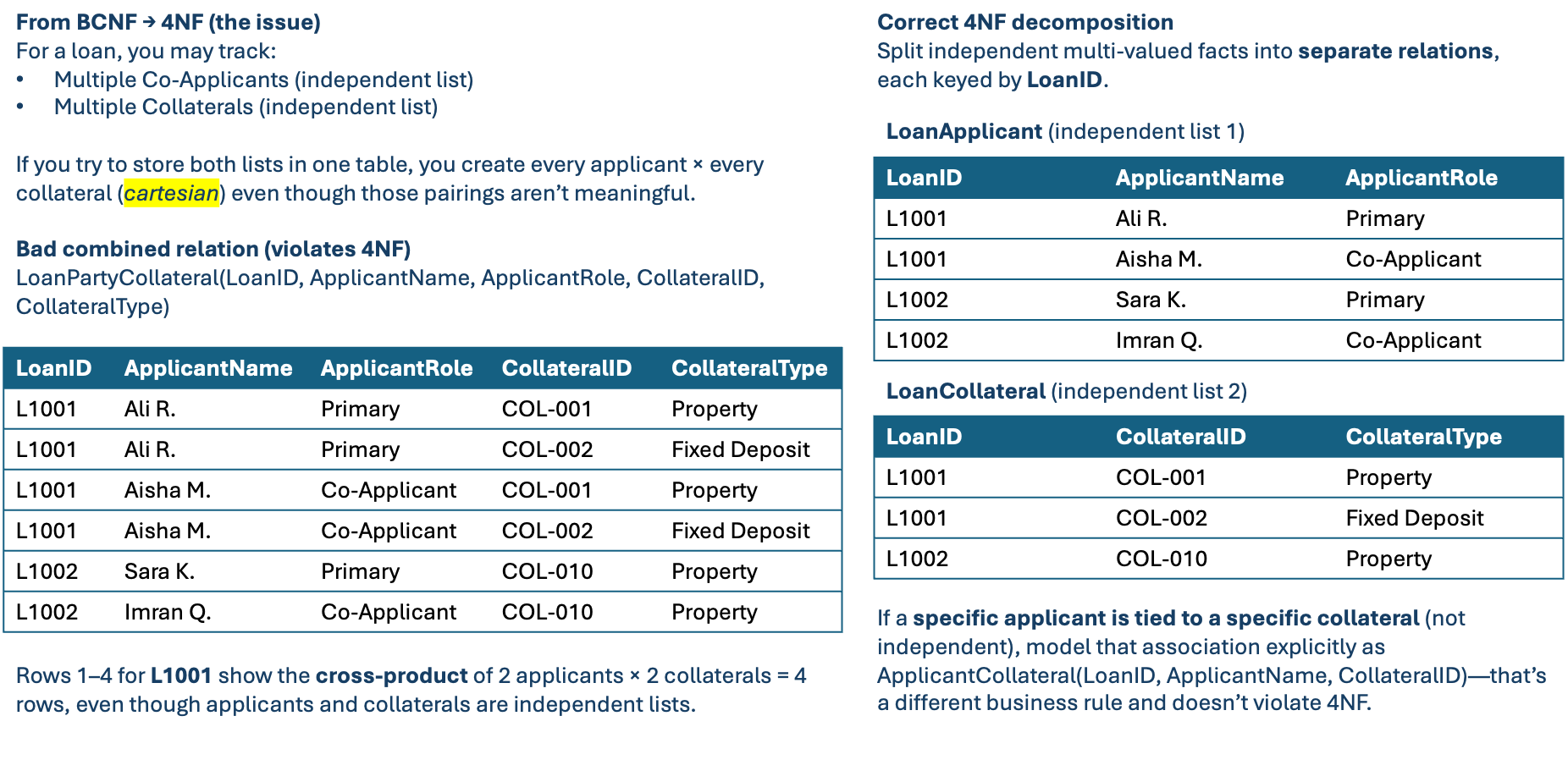
A multi-valued dependency occurs when one key determines multiple independent sets of values that are unrelated to each other. When these independent lists are stored in the same table, they can unintentionally create false combinations, often described as a Cartesian explosion. This happens because relational tables combine values across columns, even when those values are logically independent.
Consider an extension of the loan domain. Suppose we attempt to store, in one table, the following information about each LoanID:
- A list of CollateralTypes (e.g., House, Car)
- A list of Guarantors (e.g., PersonA, PersonB)
Assume that the types of collateral associated with a loan are independent of the guarantors associated with that loan. If both lists are stored in the same table, the database will produce all possible combinations of collateral and guarantors for that loan. If there are two collateral types and two guarantors, the table will produce four rows, even if no such paired relationships actually exist. This creates artificial data combinations that do not reflect real-world facts.
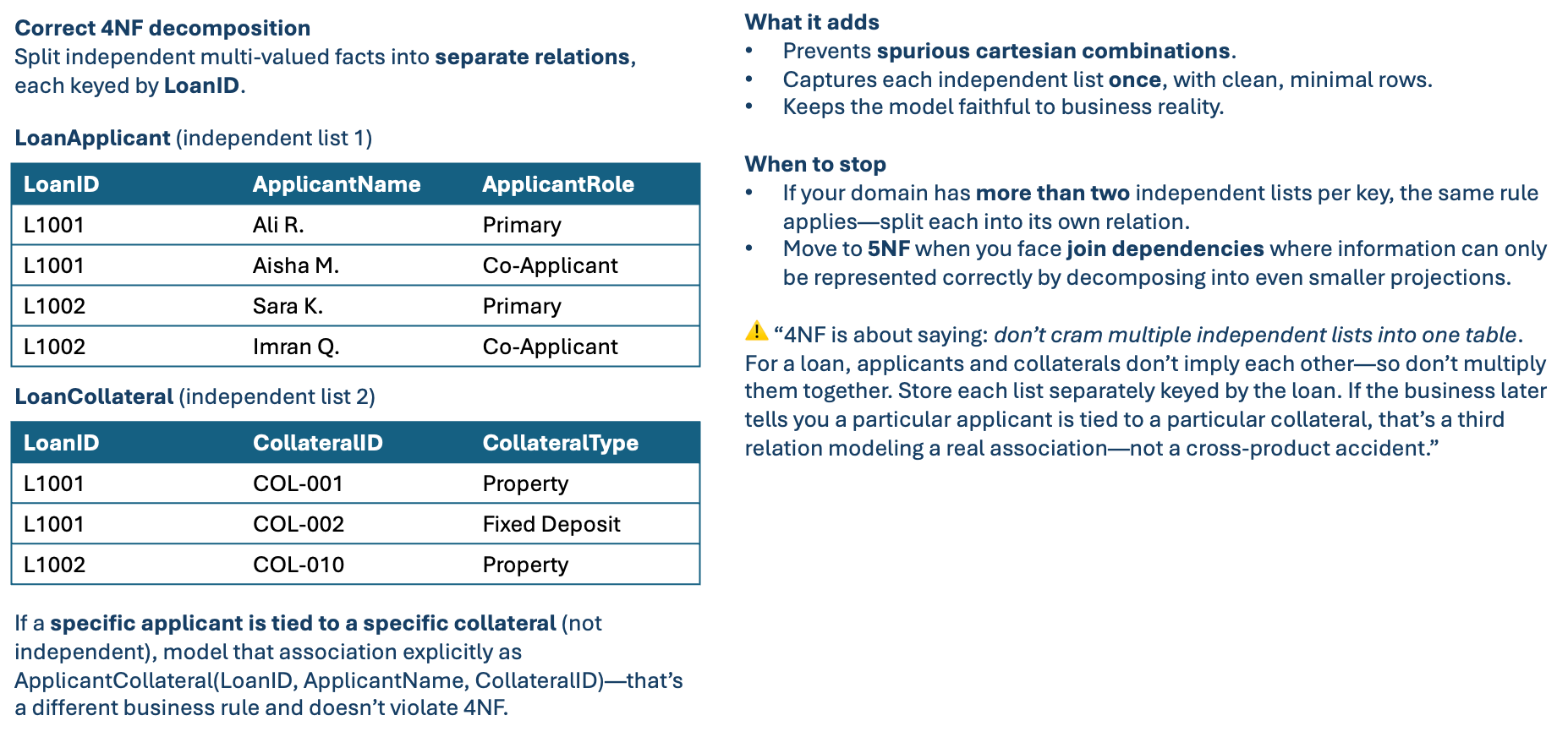
The rule of Fourth Normal Form is therefore clear: a relation must not contain multiple independent multi-valued dependencies for the same determinant. If such dependencies exist, each independent multi-valued fact must be separated into its own table, keyed by the same primary key.
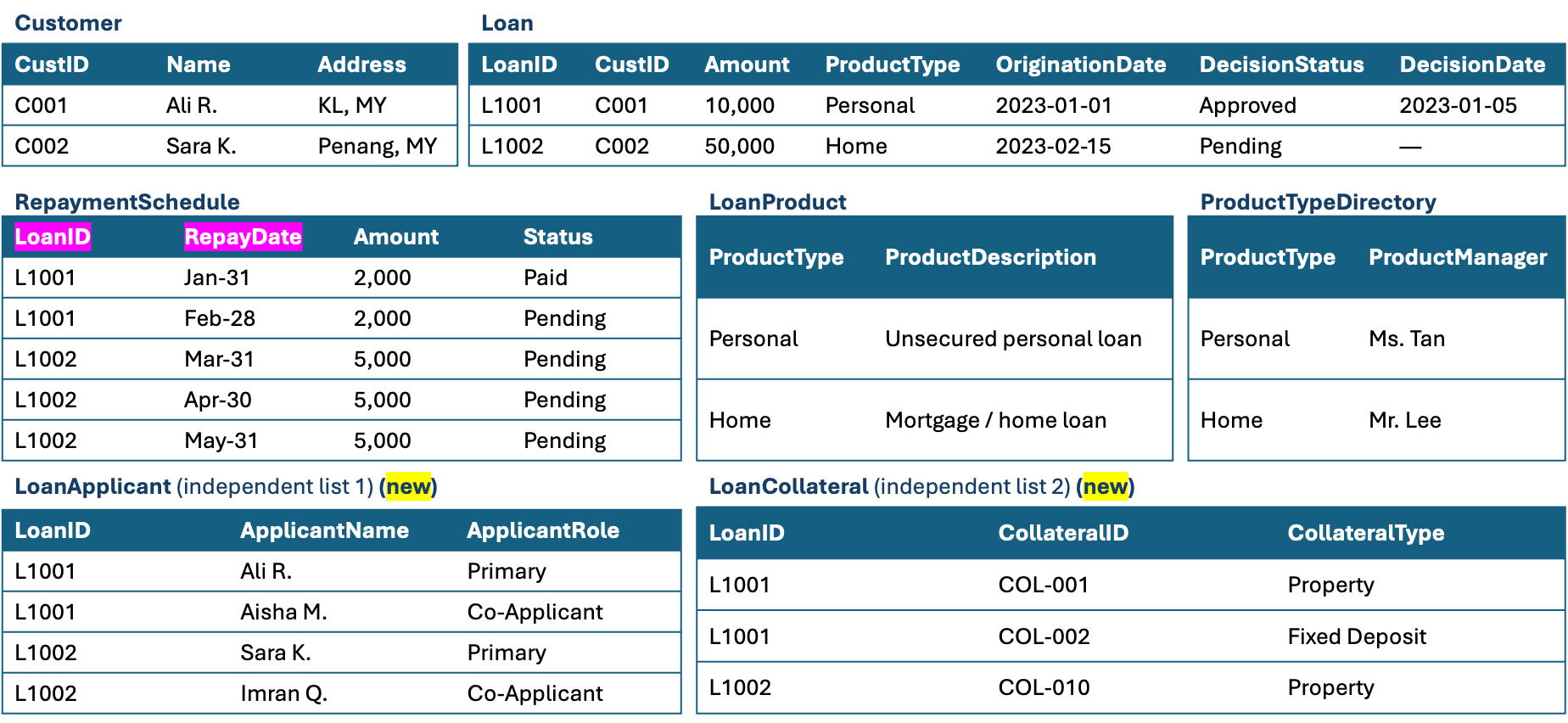
In the loan example, we would create:
- LoanCollateral (LoanID, CollateralType)
- LoanGuarantor (LoanID, GuarantorID)
Each table now captures one independent multi-valued relationship. The false combinations disappear because the two lists are no longer forced into a single relational structure.
Fourth Normal Form extends the normalization discipline beyond functional dependencies. While earlier forms focused on how attributes depend on keys, 4NF focuses on how independent lists behave when stored together. It ensures that unrelated sets of facts are not artificially combined through table structure.
In practice, many real-world systems implicitly satisfy 4NF because designers instinctively separate independent relationships. However, in more complex schemas, especially in domains involving multiple independent classifications, tags, roles, or attributes, failure to recognize multi-valued dependencies can lead to subtle data distortions.
Fourth Normal Form therefore protects against structural inflation and logical inaccuracies caused by storing independent facts together. It refines the model further, ensuring that each table represents one coherent type of relationship without generating unintended combinations.
Beyond 4NF, normalization begins to address even more advanced structural concerns, such as join dependencies in Fifth Normal Form.
Finished reading? Test yourself with 10 questions on this topic.
Go to the questions →From I Am Datapedia! by Mustafa Qizilbash, published here free by the author. Nothing about your reading is stored.