Once you sign in, your details will show here.
Knowledge Hub
+ New Topic
Filter
DAMA Knowledge Area
Learning Level
Content Type
Sort
Every topic is free to read. A free account also lets you search the topics, react to a topic and comment under it.
- I Am Datapedia!
Data Modeling and Design
NIAM Modelling
NIAM, which stands for Natural Language Information Analysis Method, is an early fact-oriented approach to Information Modelling that was developed in the 1970s and 1980s. Its key idea is simple but powerful: business information should first be expressed in plain natural language before being transformed into formal models. By doing this, NIAM allows business users to understand and validate information models without needing technical knowledge.
- NIAM originally stood for “Nijssen’s Information Analysis Methodology.” This refers to the fact-based modeling approach developed by G. M. Nijssen in the 1970s.
- Later on, the acronym was generalized to “Natural Language Information Analysis Method.” This change was made because many people contributed to the method, not just Nijssen, and to emphasize its basis in natural language.
The primary goal of NIAM is to capture business information in a way that is both easy to understand and structurally precise. Instead of starting with diagrams or tables, NIAM begins with sentences that describe facts about the business. These sentences reflect how people naturally talk about their work, making it easier to confirm whether the model accurately represents reality.
3 min readMore
- I Am Datapedia!
Data Modeling and Design
ORM Modelling
Object-Role Modelling, commonly known as ORM, is a fact-oriented conceptual modelling method that represents information as objects playing roles in facts. Unlike traditional data modelling approaches that focus on attributes or tables, ORM treats facts as the core building blocks of information. Each fact describes how one or more objects participate in a relationship.
The main goal of ORM is to provide a precise and expressive way to capture business information and rules directly in the model. It allows modellers to describe not only what facts exist, but also the constraints that govern those facts. This makes ORM particularly useful in environments where accuracy, consistency, and clarity of business rules are critical.
ORM builds on the ideas introduced by NIAM but adds much stronger structure and formality. In ORM, every piece of information is modelled as a fact type. For example, instead of saying that an employee has a department attribute, ORM represents the information as the fact “Employee works for Department.” In this statement, both Employee and Department are objects, and “works for” describes the roles they play in the fact. This approach keeps the model close to business language while making relationships explicit.
4 min readMore
- I Am Datapedia!
Data Modeling and Design
FCO-IM Modelling
Fully Communication Oriented Information Modelling, commonly referred to as FCO-IM, is a modern fact-oriented information modelling method that focuses on capturing information exactly as it is communicated in natural language. Developed from the 2000s onward, FCO-IM addresses a long-standing problem in modelling: the loss of meaning that often occurs when business statements are translated into technical models.
The primary goal of FCO-IM is to eliminate the gap between business communication and technical design. Instead of forcing business facts to fit immediately into predefined structures such as entities and attributes, FCO-IM records facts in their original verbal form. These verbalized facts are then systematically transformed into formal models, ensuring that nothing is lost or reinterpreted along the way.
Unlike earlier modelling approaches, FCO-IM treats communication itself as the object of modelling. It recognises that business knowledge is first expressed through spoken or written sentences. These sentences carry nuances, timing, responsibility, and intent that are often weakened or removed when models jump too quickly into abstraction. FCO-IM preserves this richness by treating each sentence as a first-class modelling artefact.
9 min readMore
- I Am Datapedia!
Data Modeling and Design
Taxonomy Modelling
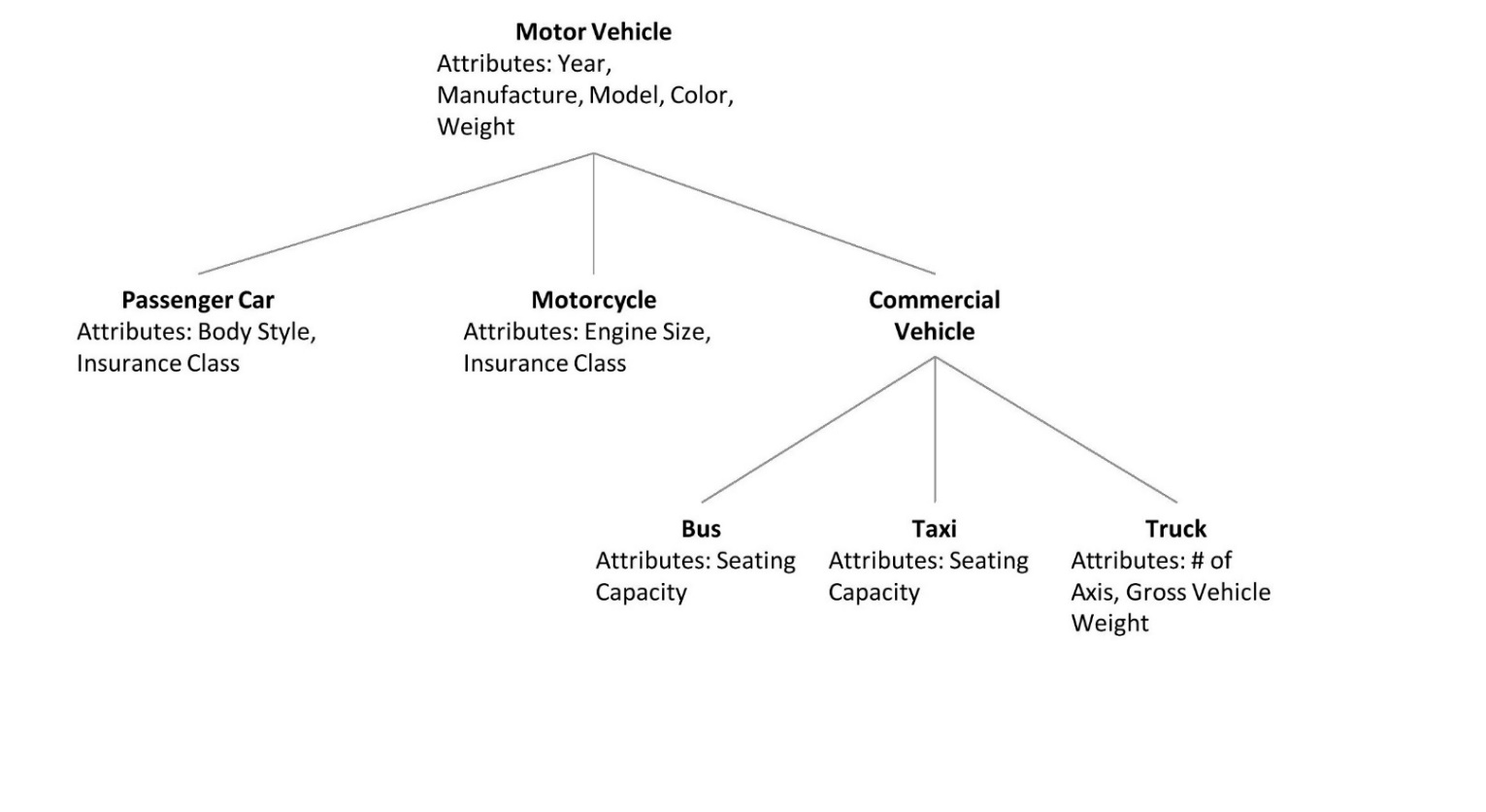
Taxonomy Modelling is the practice of organizing concepts into hierarchical categories, typically arranged in parent–child structures. Its purpose is to classify terms in a structured and consistent way so that they are easier to understand, navigate, and manage.
The main goal of Taxonomy Modelling is to provide a clear and simple classification framework. By grouping related concepts under broader categories, organizations can standardize terminology, improve search and navigation, and ensure that everyone uses the same structure when referring to business terms.
A taxonomy focuses purely on classification. It arranges concepts into levels of abstraction, moving from general to specific. For example, in healthcare, one might classify Diseases at a high level, then Infectious Diseases beneath that, followed by Viral Infections, and then specific conditions such as COVID-19. Each level refines the previous one. The structure is hierarchical and orderly, but it does not attempt to capture complex rules or reasoning.
3 min readMore
- I Am Datapedia!
Data Modeling and Design
Ontology / Knowledge Modelling
Ontology or Knowledge Modelling is the practice of defining a formal and structured representation of knowledge within a domain. It identifies the important concepts, shows how they are related, and defines rules that govern those relationships. The purpose is to create a shared understanding that can be interpreted consistently by both humans and machines.
The main goal of Ontology Modelling is to build a framework that supports semantic clarity, interoperability, and reasoning. Unlike traditional data models that primarily focus on structure and storage, ontologies are designed so that systems can understand meaning and draw logical conclusions from it. This makes them especially valuable in environments where information must be integrated across different systems and interpreted intelligently.
Ontologies go beyond simple definitions of concepts. They define categories, hierarchies, constraints, and rules within a domain. For example, in a healthcare context, an ontology may define that a Patient undergoes a Treatment, and that Treatment can be classified as either a Procedure or a Medication. It may further define that a Medication is a type of Therapeutic Intervention. By establishing such hierarchies and relationships, the ontology provides a structured knowledge framework rather than just isolated definitions.
10 min readMore
- I Am Datapedia!
Data Modeling and Design
Knowledge Graph Modelling
Knowledge Graph Modelling is the practice of representing information as a network of interconnected entities and relationships, enriched with semantic meaning. Instead of viewing data as isolated records stored in tables, this approach treats knowledge as a web of connections. Entities become nodes in a graph, and relationships between them become edges. The structure itself reflects how concepts are linked in the real world.
The primary goal of Knowledge Graph Modelling is to create a flexible and interconnected view of knowledge. By explicitly representing relationships, it becomes easier to integrate information from multiple sources, discover hidden patterns, and enable reasoning across domains. This modelling approach is especially valuable in environments where connections matter as much as individual data points.
A knowledge graph models the world as nodes and edges. Nodes represent entities such as Customer, Loan, or Product. Edges represent relationships such as applies for, owns, guarantees, or reviews. Unlike traditional relational models, where relationships are often embedded in foreign keys, the connections in a knowledge graph are first-class elements. They are visible, traversable, and central to the model.
4 min readMore
- I Am Datapedia!
Data Modeling and Design
Metagraph Modelling
Metagraph Modelling is an advanced form of graph-based modelling in which nodes and relationships can themselves represent groups, sets, or even entire subgraphs. In other words, it allows relationships to carry their own structure and meaning. This makes it possible to represent complex, multi-level interactions that traditional graph models cannot fully capture.
The primary goal of Metagraph Modelling is to provide a more expressive framework for modelling context, grouping, and higher-order relationships. While a standard graph connects entities through simple relationships, a metagraph can describe relationships about relationships. This added expressiveness is particularly useful in domains where context, provenance, and interaction details are as important as the entities themselves.
To understand the difference, consider a simple graph example. In a loan system, we might represent the fact that a Customer applies for a Loan Application. In a traditional knowledge graph, this would appear as a node for the Customer, a node for the Loan Application, and an edge labeled appliesFor connecting them. This captures the relationship, but it does not fully describe the circumstances under which the application occurred.
4 min readMore
- I Am Datapedia!
Data Modeling and Design
Canonical Data Modelling
Canonical Data Modelling is the practice of defining a standard, enterprise-wide representation of core data entities so that all systems within an organization can exchange information consistently. Instead of allowing each application to maintain its own version of key business objects such as Customer, Product, or Loan Application, a canonical model establishes a shared and authoritative structure that serves as the common reference point for integration. The term “canonical” refers to a standard or accepted form. In mathematics, a canonical representation expresses something in a normalized and agreed structure. In enterprise architecture, the same principle applies: a canonical model defines how a business entity should be represented when it moves between systems, even though each system may maintain its own internal structure.
In many organizations, integration evolves through point-to-point connections. In a point-to-point model, each system directly maps its data format to every other system it communicates with. While this may work in small environments, it becomes increasingly complex as more systems are added. If five systems need to exchange information, each system may require multiple custom mappings. As the enterprise grows, the number of integrations expands rapidly, creating tight coupling, duplicated transformation logic, and high maintenance overhead. Any change to one system, such as an upgrade or replacement, can require modifications in many connected systems. Over time, the integration landscape becomes fragile and difficult to manage.
4 min readMore
- I Am Datapedia!
Data Modeling and Design
Semantic Data Modelling
Semantic Data Modelling is the practice of designing data structures that are enriched with explicit business meaning so that both humans and machines can interpret and use the data consistently. Unlike purely structural models that define tables, fields, and relationships without deeper context, semantic data models embed meaning directly into the design. They ensure that data is not only structured correctly, but also understood correctly across systems, domains, and even organizational boundaries.
The primary goal of Semantic Data Modelling is to create data models that are self-descriptive and semantically precise. In traditional modelling, a field such as CustomerID may simply be defined as a numeric identifier. In a semantic model, however, that identifier is linked to a formal definition stating that it represents a unique identifier for a person or organization holding an account within a specific business context. The model clarifies what the data means, not just how it is stored. This added semantic layer enables interoperability, governance, and machine-driven reasoning.
6 min readMore
- I Am Datapedia!
Data Modeling and Design
Conceptual Data Modelling (CDM)
Conceptual Data Modelling (CDM) provides a high-level, business-oriented view of data by identifying core entities and the relationships between them without introducing technical implementation details. Its purpose is to describe how the business views its data, not how the database stores it. At this stage, the emphasis is on clarity and shared understanding rather than normalization, indexing, or storage optimization.
The primary goal of Conceptual Data Modelling is to capture the essence of business information in a way that non-technical stakeholders can understand and validate. Business leaders, analysts, and architects must first agree on what exists in the domain and how those things relate to each other before moving into more detailed design stages. CDM therefore serves as a bridge between business requirements and logical data modelling.
In a loan approval domain, for example, the conceptual model identifies high-level entities such as Customer, Loan, Application, Approval Decision, and Repayment Schedule. It then defines how these entities relate. A Customer applies for a Loan. A Loan results in an Approval Decision. A Loan has a Repayment Schedule. These relationships are represented visually as connected entities, as shown in the referenced diagram, where lines between boxes indicate how entities are associated. At this level, attributes such as interest rate, date fields, or data types are intentionally omitted. The focus remains on “what exists” and “how it connects.”
7 min readMore
Build a strong foundation in Data & AI
Follow the Data Foundations learning path (Beginner to Advanced).