Once you sign in, your details will show here.
Knowledge Hub
+ New Topic
Filter
DAMA Knowledge Area
Learning Level
Content Type
Sort
Every topic is free to read. A free account also lets you search the topics, react to a topic and comment under it.
- I Am Datapedia!
Metadata
Data Wrapping
Data Wrapping is the practice of augmenting raw data with additional layers of value, such as tools, metadata, and context, to make it easier to use, understand, and act upon. This process is crucial in transforming data from a passive resource into an actionable asset.
The Core Elements of Data Wrapping
Data wrapping goes beyond merely presenting raw data, it involves transforming it into a meaningful and actionable resource. Here are the core elements, expanded with practical insights:
1. Metadata and Context
Metadata acts as the "data about data," providing essential context that helps users interpret and utilize data effectively.
- What It Includes: Descriptions of data sources, timestamps, definitions, units of measurement, and relationships between datasets.
- Why It’s Important: Without metadata, users may misinterpret data or struggle to understand its significance.
- Example: A dataset tracking customer orders might include metadata about the region, the time zone in which orders were placed, and the categorization of product types.
5 min readMore
- I Am Datapedia!
AI and Machine Learning
RAG(Retrieval-Augmented Generation)
The widespread adoption of large language models (LLMs) has led to increased expectations for factual accuracy. However, LLMs often generate incorrect answers with confidence. A notable example is when users query general-purpose models like OpenAI’s “gpt-4o” or DeepSeek’s “DeepSeek-V3” about recent events or niche topics; they may decide not to respond or provide fabricated yet convincing responses. The leading industry solution to mitigate this issue is Retrieval-Augmented Generation (RAG), introduced in Retrieval-Augmented Generation for Knowledge-Intensive NLP Tasks (Lewis et al., 2020). RAG enhances LLMs by integrating external retrieval, ensuring more reliable and factual outputs while improving response contextuality and robustness.
Just like how a human is more likely to give a wrong answer when lacking information, AI models are more likely to make mistakes and hallucinate when they are missing context. For a given application, the model’s instructions are common to all queries, whereas context is specific to each query. By incorporating retrieval mechanisms, RAG enables LLMs to interact with real-time information, improving applications in search engines, customer support, academic research, and business intelligence. Unlike traditional search engines, which rely on keyword-based ranking, RAG synthesizes knowledge dynamically, allowing AI-driven solutions to be more adaptable and responsive. This chapter explores RAG’s framework, applications, implementation, security considerations, and future trends.
22 min readMore
- I Am Datapedia!
Others
Quantum Computing
Quantum computing is a revolutionary form of computation that leverages the principles of quantum mechanics, a branch of physics that describes how matter and energy behave at subatomic levels. Unlike classical computers that use bits (0 or 1), quantum computers use qubits, which can exist in multiple states simultaneously due to a phenomenon called superposition.
This fundamental shift introduces a new way to process information, offering exponential speedups for certain problems, potential cost savings, and the ability to solve previously infeasible tasks in cryptography, optimization, healthcare, finance, and more.
Key Quantum Concepts
1. Superposition
- Definition: A qubit can exist in a combination of both 0 and 1 states at the same time until measured.
- Analogy: Imagine a person who is simultaneously present in every room of a house. Only when you check a room do you know where the person is.
- Implication: Enables quantum computers to process many possibilities in parallel.
4 min readMore
- I Am Datapedia!
Data Storage and Operations
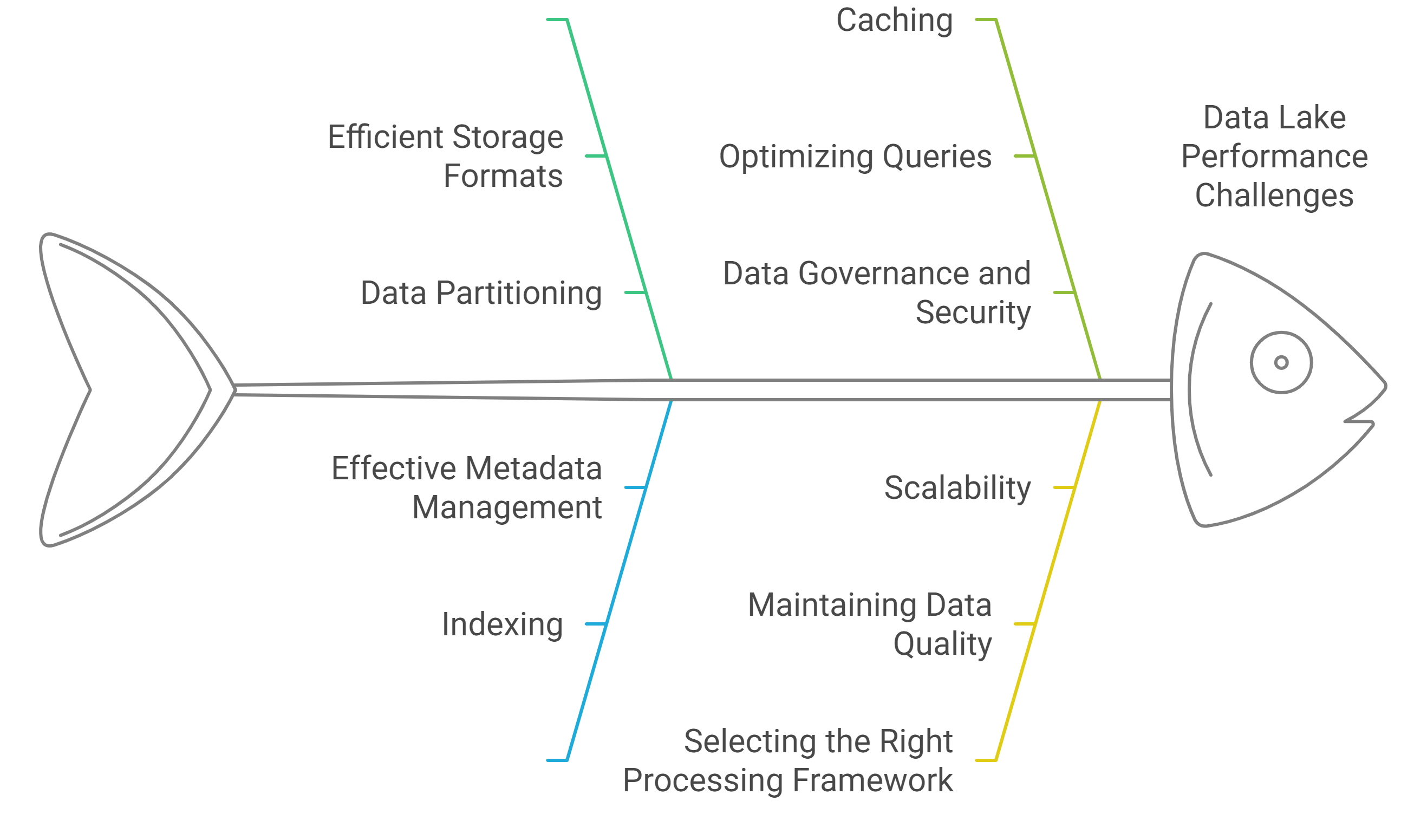
Performance in Data Lake
When discussing performance in a data lake, it refers to the efficiency with which data is stored, retrieved, and processed. To ensure high performance in a data lake, several factors need to be addressed:
- Efficient Storage Formats: Opt for optimized formats like Parquet or ORC, which store data in columns, allowing for better compression and faster retrieval, especially when dealing with large datasets.
- Data Partitioning: Dividing large datasets into smaller, more manageable parts (partitions) is crucial. For example, partitioning data by time, region, or product category ensures that only the relevant portion of data is accessed during queries.
- Indexing: Although data lakes are often schema-less, introducing indexes, when supported, or utilizing frameworks like Apache Hudi or Delta Lake, can accelerate query performance and make data access more efficient.
- Effective Metadata Management: Metadata helps in organizing and tracking the structure of data in a lake. Proper metadata management using tools like Apache Hive, AWS Glue, or Databricks Unity Catalog can greatly speed up data processing and query execution.
- Caching: Frequently accessed data can be stored in cache, which significantly reduces retrieval times for repeated queries. A caching layer can help in making data access more responsive.
- Optimizing Queries: Query engines such as Apache Spark, Presto, or AWS Athena can optimize SQL queries, particularly on large datasets. By leveraging distributed computing, these tools can run queries in parallel, improving overall performance.
- Data Governance and Security: While governance and security don’t directly impact performance, maintaining clear data access policies and ensuring encryption can prevent bottlenecks and help sustain operational efficiency.
- Scalability: One of the major benefits of data lakes is their ability to scale. Cloud storage platforms like AWS S3, Azure Data Lake, or Google Cloud Storage enable you to adjust storage capacity as needed. To maintain performance, it's crucial to ensure that your compute resources scale appropriately with the data.
- Maintaining Data Quality: High-quality, clean data reduces the need for time-consuming transformations or error handling, thus speeding up data processing and improving overall performance.
- Selecting the Right Processing Framework: Choose an appropriate data processing engine based on your needs. Solutions like Apache Spark, Flink, or Databricks are designed for handling large volumes of data, and you may opt for batch processing or real-time stream processing depending on your requirements.
2 min readMore
- I Am Datapedia!
Data Quality
Functional andNon-Functional Testing
At its core, functional testing involves validating all the use cases and requirements outlined in the Functional Requirements Document (FRD) or other business requirement specifications to ensure the product operates as intended. In contrast, non-functional testing focuses on evaluating the product's quality attributes, such as performance, compliance with governance standards, security measures, and overall system reliability, ensuring it meets predefined benchmarks beyond functional correctness.
Testing is a critical phase in the software development lifecycle, ensuring that a product meets its requirements and functions as intended. It is broadly divided into two categories: functional testing and non-functional testing. Understanding these categories is essential for developing robust, reliable, and user-friendly software systems. This chapter explores these two testing types, their significance, methodologies, examples, and key differences.
5 min readMore
- I Am Datapedia!
AI and Machine Learning
Agentic AI
Let’s start here: traditional AI predicts. Agentic AI acts.
Instead of just answering your questions or generating text, Agentic AI can pursue goals, make decisions, use tools, and even coordinate with other agents to get things done. It’s not a passive model waiting for instructions. It’s a collaborator, a kind of digital teammate.
That’s what “agentic” means: having agency. The ability to decide, adapt, and operate with autonomy in a live environment.
So, while older AI models were smart calculators, Agentic AI is more like a strategist who:
- Understands your goal (not just your prompt)
- Makes a plan
- Takes action, sometimes with improvisation
- Learns and adjusts along the way
How Does It Work?
Most agentic systems follow a process called the Agent Loop:
- Observe: Take in input from users or systems
- Plan: Break the goal into steps
- Act: Use tools, APIs, or sub-agents to perform tasks
- Reflect: Evaluate what worked (or didn’t)
- Adjust: Update plan or memory and repeat
3 min readMore
- I Am Datapedia!
Data Warehousing and Business Intelligence
Data Storytelling
Turning Insights into Impact
Data storytelling is the art of translating complex data into a compelling narrative that drives action. Just like a well-structured story, data storytelling involves characters, context, risks, and resolution.
- Engage Key Stakeholders (Characters)
Every good story has characters, and in data storytelling, these characters are your key stakeholders. They include business leaders, data teams, regulators, and end-users. Each stakeholder has different interests and priorities, so engaging them effectively ensures that data initiatives align with real needs.
Example (Banking Sector):
Imagine a bank wants to improve customer satisfaction. The key stakeholders might include:
- Bank Managers (who need insights to improve customer service),
- Customers (who want quick and secure banking services),
- Loan Officers (who need better data to approve or reject loan applications),
- Regulators (who ensure the bank follows financial laws).
3 min readMore
- I Am Datapedia!
Data Governance
Data Contract
In the world of modern software development, data contracts serve as the foundation for reliable, scalable, and secure communication between systems. As businesses increasingly adopt microservices architectures, APIs, and distributed systems, defining clear and structured data contracts becomes essential to ensure seamless interoperability.
A data contract is a formal agreement between systems that defines the structure, format, and rules of data exchanged between them. It outlines the expected data fields, data types, constraints, and validation rules that govern the interaction, ensuring that all parties adhere to a consistent standard.
Importance of Data Contracts
Data contracts play a crucial role in software development for several reasons:
- Consistency: They provide a standardized way to define and communicate data structures across systems, reducing ambiguity.
- Interoperability: By adhering to a common contract, different systems, even those built with different technologies, can seamlessly interact.
- Data Integrity: Contracts enforce validation rules that help maintain the integrity and quality of data.
- Security: Clearly defined structures help prevent unintended data exposure and ensure compliance with security standards.
- Scalability: Well-defined contracts enable systems to evolve independently while maintaining compatibility.
- Documentation: They serve as a living document that helps developers understand and integrate with APIs efficiently.
3 min readMore
- I Am Datapedia!
Data Architecture
Data and AI Cognitive (DAC)Architecture
In today’s rapidly evolving technological landscape, the biggest challenge organizations face is, data integration and maintainability. With the exponential growth of data and the widespread adoption of AI technologies, businesses are increasingly grappling with the need to manage both effectively. Unfortunately, many traditional architectures treat data and AI as distinct entities, leading to a host of challenges that hinder an organization’s ability to innovate, scale, and adapt.
One of the primary issues with the traditional approach is, the fragmentation of data and AI systems into separate silos. Data is often stored and managed in one architecture, while AI models are built, trained, and deployed in another. This separation creates significant friction points.
To overcome these challenges, organizations must embrace a more integrated approach that treats data and AI as interconnected components of a single architecture.
4 min readMore
- I Am Datapedia!
Data Storage and Operations
Lakebase
While “Lakebase” may sound like a new term, its conceptual foundation is rooted in an established class of systems known as HTAP (Hybrid Transactional/Analytical Processing). HTAP systems emerged to break the artificial divide between OLTP and OLAP by enabling both workloads within a single environment. Lakebase carries this ambition forward, but fundamentally rearchitects it for the cloud-native, AI-first era.
Rather than merely merging OLTP and OLAP capabilities, Lakebase introduces a modernized architectural paradigm:
- Decoupled compute and storage
- Metadata-as-control-plane execution
- Branchable workloads and snapshot isolation
- AI-native compatibility and elastic serverless scaling
Lakebase doesn’t reinvent convergence, it modernizes it for distributed ecosystems that demand autonomy, agility, and intelligence.
FROM LEGACY FRAGMENTATION TO UNIFIED INTELLIGENCE
For decades, enterprises were shackled by siloed tooling:
3 min readMore
Build a strong foundation in Data & AI
Follow the Data Foundations learning path (Beginner to Advanced).