Once you sign in, your details will show here.
Knowledge Hub
+ New Topic
Filter
DAMA Knowledge Area
Learning Level
Content Type
Sort
Every topic is free to read. A free account also lets you search the topics, react to a topic and comment under it.
- I Am Datapedia!
Data Foundations
Syntax Error
Syntax Errors are like common mistakes that happen a lot in the developer's world. I'm pretty sure every developer, no matter how experienced, must have come across this error before. Once in my experience in New Zealand, a so-called Senior Architects spent three days, trying to fix a syntax error. Later he told the senior management that they found a problem in the business logic, making it sound like a big achievement. I am sure, if my that time Management and team is reading this topic, they will remember and must be smiling now lolz 😊. But just so you know, syntax errors are really just about how skilled a developer is and not about problems in the business stuff.
A syntax error is a type of error that occurs when the code you write does not conform to the syntax rules of the programming language. Syntax errors prevent the interpreter or compiler from translating your code into machine-readable instructions, and as a result, the program cannot be executed until the syntax errors are corrected.
2 min readMore
- I Am Datapedia!
Data Integration and Interoperability
Importance ofStaging Layer
Yes, you are right, in Data World, Staging Layer is one of the most important zones then why to write about it. Trust me it's been underutilized in most implementations.
Let's decode it.....
The Staging Layer in data architecture plays a crucial role in the data processing pipeline, providing a temporary and structured area for incoming data before it is integrated into the data warehouse or other storage systems.
Many a times Staging Layer is confused with Landing Layer. Yeah trust me, I have seen people doing nothing in Staging Layer except minor things. Please note, especially in the era of cloud, if one doesn’t properly utilize Staging Layer, the consumption cost from Staging Layer to Transformed Layer will be significantly higher.
The importance of the staging layer lies in several key aspects:
- Data Quality and Validation: The staging layer acts as a checkpoint for data quality and validation. Before data is moved to the main storage or processing area, it undergoes validation checks to ensure it meets quality standards. This helps identify and address issues such as missing values, formatting errors, or inconsistencies early in the data pipeline.
Data Enrichment: Staging allows for data enrichment processes to take place before the data reaches its final destination. This step involves cleaning, enhancing the data, making it more suitable for analysis and reporting. It ensures that the data conforms to the desired format and structure.
- Incremental Loading: The staging layer facilitates incremental loading of data, allowing for efficient updates and additions. Instead of reloading the entire dataset, only new or modified data needs to be processed, reducing the computational load and improving overall system performance.
- Data Auditing and Lineage: Staging provides a historical record of the ingested data, enabling auditing and tracing of changes over time. This is essential for tracking the lineage of data, understanding its origin, and ensuring compliance with data governance and regulatory requirements.
- Fault Tolerance and Recovery: Staging serves as a buffer against data processing failures. If an error occurs during data integration or transformation, the staging layer allows for easier recovery without affecting the main data storage. It provides a level of fault tolerance and helps maintain the integrity of the overall data processing pipeline.
- Isolation of Source and Destination Systems: Staging separates the source systems (where data originates) from the destination systems (where data is stored for analysis). This isolation ensures that any changes or issues in the source systems do not immediately impact the data warehouse or analytics environment, providing a layer of protection.
- Performance Optimization: By pre-processing and validating data in the staging layer, the main data storage systems are relieved of some of the computational overhead. This optimization contributes to improved performance and responsiveness in data processing.
3 min readMore
- I Am Datapedia!
Data Governance
GDPR
GDPR, or the General Data Protection Regulation, is a significant law in the European Union focused on data protection and privacy. In very simple terms, it's a set of rules about how companies and organizations should handle personal information of individuals. It gives people more control over their personal details like their names, addresses, and photos, ensuring that this information is handled in a secure and lawful manner.
The main principles of the GDPR center around responsible data management.
- Transparency is key, requiring clear communication about how personal data is used.
- Purpose limitation means data can only be used for specific, clearly stated reasons.
- Data minimization insists on collecting only the data that is absolutely necessary.
- The principle of accuracy ensures that personal information is kept up-to-date and correct.
- Storage limitation mandates that data should not be kept longer than necessary.
- Integrity and confidentiality require that the data is kept safe and secure, protected from unauthorized access or breaches.
- Accountability places the responsibility on organizations to ensure all these principles are adhered to, making sure personal data is managed in a compliant and ethical way.
4 min readMore
- I Am Datapedia!
Data Integration and Interoperability
Web Service
Web Service is a service offered by an application to enable communication and data exchange at an application-level.
There are mainly two types of webservices used when integrating applications: REST and SOAP.
Web services are widely used in Data Integration. They allow real-time (or near-real-time) integrations and are suitable for use over the internet and in hybrid architectures (Cloud, SaaS, or on-premises).
In terms of architecture, web services enable the implementation of SOA (Service-oriented Architecture) and WOA (Web-oriented Architecture).
REST Web Services
REST, or Representational State Transfer, is a software architecture style for designing and communicating web applications.
A web service (or API) that follows REST principles is referred to as RESTful API. In the following sections, the terms REST web service and RESTful API will be used interchangeably.
A REST web service allows you to access a resource (data object, entity, etc.) via a URL (Uniform Resource Locator) [or web address].
3 min readMore
- I Am Datapedia!
Data Integration and Interoperability
ElectronicData Interchange (EDI)
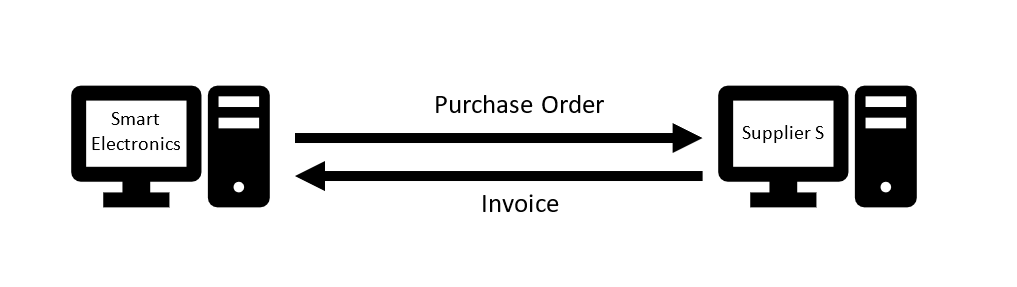
EDI, or Electronic Data Interchange has been introduced since the seventies. The main use case addressed by EDI is to automate data exchange between trading partners (Customers and Suppliers) for business documents, such as purchase orders and invoices as well as for payments and shipment information.
Here is a simple EDI use case in which Smart Electronics (a fictitious Manufacturing company) uses EDI to send Purchase Orders to Supplier S, and Supplier S sends corresponding invoices to Smart Electronics.
EDI follows specific message standards and formats like EDIFACT or X12 which are the main EDI message standards.
Other EDI standards have been developed for specific purposes or industries, such as:
- ODETTE: used in automotive industry in European countries
- HL7: used for healthcare data.
- IATA PATIS: used to exchange passenger and airport data, and is maintained by the IATA (the International Air Transport Association)
- SWIFT: used for transaction and message exchanges in the financial and banking sectors.
6 min readMore
- I Am Datapedia!
Others
Socratic Questions
Socratic questioning is a form of inquiry and discussion named after the ancient Greek philosopher Socrates. It involves a method of cooperative argumentative dialogue to stimulate critical thinking and illuminate ideas. Socratic questions are designed to encourage individuals to think deeply, consider various perspectives, and arrive at their own conclusions. The goal is not to provide answers but to facilitate a process of self-discovery and learning.
When applying Socratic questioning to data solutions, the goal is to stimulate critical thinking, uncover assumptions, and encourage a deeper understanding of the data-related challenges or opportunities. Here's how Socratic questioning can be applied in the context of data solutions:
- Clarifying Questions: Can you clarify the specific data issue you're trying to address to ensure a clear understanding of the problem or goal in the context of data solutions.
- Probing Assumptions: What assumptions are you making about the quality of the data to uncover any preconceived notions or assumptions that might impact the approach to handling data.
- Exploring Evidence and Reasons: What evidence supports the decision to use a particular data processing method to understand the rationale behind the chosen data processing techniques or tools.
- Considering Alternative Perspectives: How might a data scientist approach this problem differently than a business analyst to encourage thinking about different viewpoints and approaches within the realm of data solutions.
- Examining Implications and Consequences: What are the potential consequences of using incomplete or inaccurate data in decision-making to explore the downstream effects of data-related decisions and their impact on the organization?
2 min readMore
- I Am Datapedia!
Data Warehousing and Business Intelligence
Attribution Data Models
Over the years, our approach to measuring marketing performance has drastically evolved and continues to change with advancing technology and evolving data policies. The days of rigidly assigning budgets to different marketing channels and relying solely on P&L statements to gauge the success of our efforts are behind us.
Assessing the performance of our ads involves understanding the correlation between our marketing spend and revenue generated. With data sources and clear models, especially when running campaigns across various channels simultaneously (e.g., Facebook, Google, Out Of Home, TV), the key question remains:
Which channels and touchpoints contribute significantly to the final sale?
To evaluate that, we employ distinct data models in marketing, each carrying its own set of advantages and limitations. These models must be tailored to fit each use case and align with how people interact with our business:
4 min readMore
- I Am Datapedia!
Data Warehousing and Business Intelligence
Incrementality inPerformance Marketing
Success in the dynamic landscape of marketing depends on engaging the right audience effectively. However, not all audiences respond the same to advertisements.
At the core of this lies a pivotal question:
Would customers buy without the corresponding paid advertising?
This question is at the core of incrementality in marketing, revealing three different ways people react to ads.Understanding Audience Behavior
This basic exploration breaks down how audiences react into three different groups:
- Non-responsive Audience: This group is unaffected by ads no matter how much they see them. They don't feel like engaging or buying because of ads.
- Pre-existing Demand Audience: People in this group were already planning to buy, ads or not. Ads might change when they buy, but they won't change their mind about buying.
- Incremental Audience: Importantly, this group includes people who are directly affected by ads. These potential customers engage or buy only because they saw ads, showing how much ads affect their behavior.
2 min readMore
- I Am Datapedia!
Data Integration and Interoperability
Ontology-DrivenData Integration andHarmonization
The role of ontology in data integration and harmonization is to describe structure and relations. Ontologies enable a coherent structure for data across systems, functions, and domains. As the cost of maintaining and point-to-point integrations is growing along with the cost for running specific data pipelines there is a need for a new approach. By having an ontological approach to an organization’s data-driven strategy cost control will be easier to achieve.
The Concept of Ontology in Data Management
Ontologies in data management involve the use of a shared vocabulary and a set of relationships and rules to model a domain. They provide a common language for data and thus enable different systems and stakeholders to 'speak' the same language.
Data Integration Challenges
- Disparate Data Sources: Organizations often deal with data from various sources each with their unique format and structure.
- Semantic Discrepancies: Different interpretations of data across systems can lead to inconsistencies and misunderstandings.
2 min readMore
- I Am Datapedia!
Data Modeling and Design
The Operational Reference Model:Implementing Dynamic Information Models
To succeed with metadata management, you will need an Operational Reference Model. It is the way to describe the structures and relationships of your business metadata.
The Role and relationship of an Operational Reference Model
Conceptual models, logical models, physical models and canonical models have a specific purpose which is either communication and understanding, or representation of an individual system. Operational Reference Models come into play when organizations require an operational layer which bridges multiple systems and functions and provides a common point of reference or shared language for the enterprise. The Operational Reference Model is similar. to an anti-corruption layer and a semantic layer in its purpose but with an important difference, it's owned and governed by your subject matter experts.
Operational reference model governance
An operational reference model is at its core a set of metadata structured with the help of taxonomies and ontologies. Each part, each domain, is governed by the subject matter experts in the organization in accordance with a federated governance approach.
3 min readMore
Build a strong foundation in Data & AI
Follow the Data Foundations learning path (Beginner to Advanced).