Once you sign in, your details will show here.
Knowledge Hub
+ New Topic
Filter
DAMA Knowledge Area
Learning Level
Content Type
Sort
Every topic is free to read. A free account also lets you search the topics, react to a topic and comment under it.
- I Am Datapedia!
Reference and Master Data
ISO 3166For Locations
ISO 3166, one type of Reference Data, is an international standard that defines codes for the names of countries, territories, and special areas of geographical interest. In the data world, ISO 3166 codes are widely used for various purposes, such as uniquely identifying countries in databases, international transactions, and data exchange.
Let's break down ISO 3166 in more detail:
Country Codes: ISO 3166 provides three types of codes for each country or territory:
- ISO 3166-1 Alpha-2: Two-letter country codes (e.g., US for the United States, CA for Canada).
- ISO 3166-1 Alpha-3: Three-letter country codes (e.g., USA for the United States, CAN for Canada).
- ISO 3166-1 Numeric: Three-digit numeric codes.
ISO 3166 standardizes the representation of country names to avoid confusion in international communication, commerce, and data exchange. The standard is maintained by the International Organization for Standardization (ISO) and is periodically updated to reflect changes in country names and geopolitical developments.
2 min readMore
- I Am Datapedia!
Data Governance
Basel Standards
In the context of the data world, "BASEL" likely refers to the Basel Committee on Banking Supervision. The Basel Committee is not directly related to data management but plays a significant role in shaping international banking regulations, including requirements related to risk management and data reporting.
Basel Committee on Banking Supervision (BCBS) is an international committee of banking supervisory authorities. It was established by the Bank for International Settlements (BIS) to strengthen the regulation, supervision, and practices of banks worldwide. The committee is known for developing and maintaining global regulatory frameworks, commonly known as the Basel Accords, which set standards for bank capital adequacy, risk management, and prudential supervision.
Basel Accords/ Standards:
- Basel I: Introduced in 1988, Basel I established minimum capital requirements based on credit risk.
- Basel II: Developed in 2004, Basel II expanded the framework to address credit, operational, and market risks. It introduced more risk-sensitive capital requirements.
- Basel III: Implemented in response to the 2008 financial crisis, Basel III further strengthened capital requirements, introduced new liquidity standards, and enhanced risk management practices.
3 min readMore
- I Am Datapedia!
Data Foundations
Digitization andDigitalization
In the data world, "Digitalization" and "Digitization" are related concepts, but they have distinct meanings and implications.
Let's decode the difference between the two.
Digitization: It refers to the process of converting analog information into digital format. It involves taking physical or analog data, such as text, images, or sound, and transforming it into digital form, typically represented as binary code (0s and 1s) that computers can understand. For example, scanning a paper document and converting it into a digital PDF file is an example of digitization. The original document exists in analog (paper) form, and digitization converts it into a digital representation.
Digitalization: It is a broader concept that involves the use of digital technologies to transform business processes, activities, or models. It goes beyond converting analog data to digital format and encompasses the integration of digital technologies into various aspects of an organization or system to enhance efficiency, functionality, or value.
3 min readMore
- I Am Datapedia!
AI and Machine Learning
LLM(Large Language Model)
The term "Large Language Model" (LLM) generally refers to advanced artificial intelligence models designed to understand and generate human-like language. These models are typically trained on massive amounts of diverse text data and leverage deep learning techniques to capture the complexities of language. One of the notable examples of an LLM is GPT (Generative Pre-trained Transformer) like GPT-3 for ChatGPT in current era.
Here are key characteristics and aspects associated with Large Language Models:
- Training on Extensive Datasets: LLMs are trained on large and diverse datasets, which often include a wide range of text sources such as books, articles, websites, and other textual content from the internet.
- Pre-training and Fine-tuning: LLMs go through a pre-training phase where they learn to predict the next word in a sentence or fill in missing words. After pre-training, they can be fine-tuned on specific tasks or domains to enhance their performance in particular areas.
- Transformer Architecture: Many LLMs, including GPT models, use a transformer architecture. Transformers enable the models to capture long-range dependencies and contextual information in the data efficiently.
- Natural Language Understanding: LLMs excel in natural language understanding, allowing them to comprehend the meaning, context, and nuances of human language. This includes tasks such as language translation, summarization, question answering, and more.
- Generative Capabilities: One of the distinctive features of LLMs are their generative ability. They can generate coherent and contextually applicable textual content primarily based totally on a given activate or input.
- Applications: LLMs have found applications in various domains, including chatbots, language translation, content generation, summarization, sentiment analysis, and more.
- GPT Series: The GPT (Generative Pre-trained Transformer) series, developed by OpenAI, is a notable example of LLMs. GPT-3, the third iteration, is one of the largest and most powerful language models to date.
3 min readMore
- I Am Datapedia!
Data Warehousing and Business Intelligence
Type of Analytics
We have already gone through Analysis and Analytics. Analytics refers to the systematic analysis of data or statistics to uncover meaningful patterns, insights, and trends. There are several types of analytics, each serving specific purposes and addressing different aspects of data analysis.
The major types of analytics include:
- Descriptive Analytics: It describes what has happened in the past, providing a historical overview. For example, summarizing sales data to understand total revenue for a specific period.
- Diagnostic Analytics: It focuses on why a particular event or trend occurred by identifying its root causes. For example, investigating a drop in website traffic to determine the reasons behind the decline.
- Predictive Analytics: It predicts future outcomes or trends based on historical data and statistical algorithms. For example, using machine learning models to predict customer churn or stock prices.
Prescriptive Analytics: It recommends actions to optimize outcomes based on predictive analytics results. For example, suggesting marketing strategies to increase customer retention based on predictive insights.
- Other types of analytics include:
- Text Analytics (Text Mining): It analyzes unstructured text data to extract insights, sentiment, or patterns. For example, analyzing customer reviews to understand sentiment and identify common themes.
- Spatial Analytics: It analyzes geographic or location-based data to uncover spatial patterns and relationships. For example, mapping crime rates in a city to identify high-crime areas.
- Social Media Analytics: It analyzes social media data to understand trends, sentiments, and user interactions. For example, monitoring brand mentions on social media to assess brand sentiment.
- Web Analytics: It analyzes website data to understand user behavior, track performance, and optimize user experience. For example, tracking page views, bounce rates, and click-through rates on a website.
- Business Intelligence (BI): It involves the use of tools and processes to analyze and visualize business data for decision-making. For example, creating dashboards to monitor key performance indicators (KPIs) in real-time.
- Big Data Analytics: It analyzes large and complex datasets to uncover hidden patterns and insights. For example, analyzing vast amounts of sensor data for predictive maintenance in manufacturing.
- Customer Analytics: It analyzes customer data to understand behavior, preferences, and trends. For example, creating customer segmentation based on purchasing patterns.
3 min readMore
- I Am Datapedia!
AI and Machine Learning
MRKL
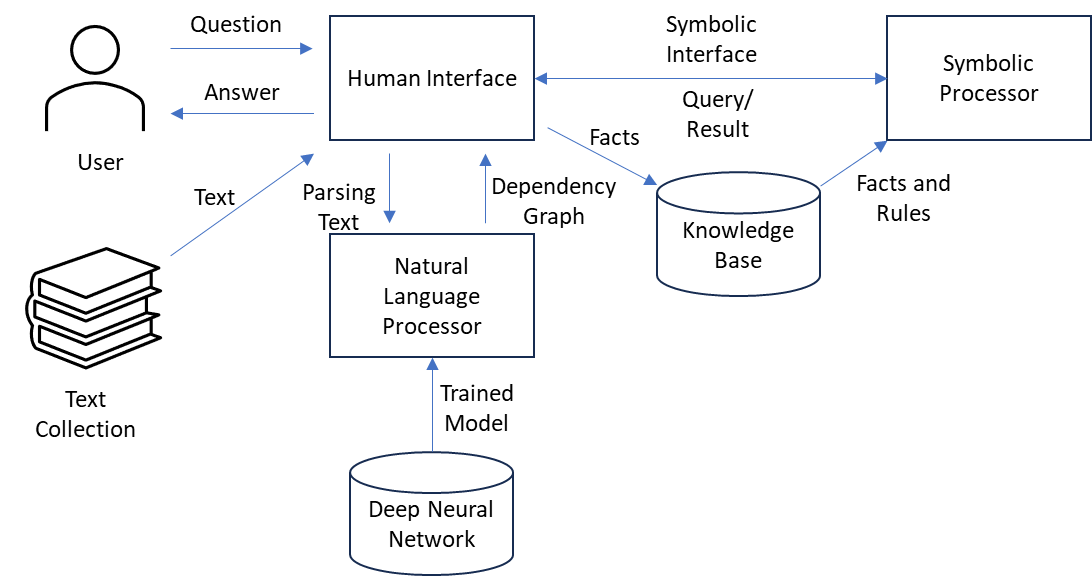
MRKL stands for Modular Reasoning, Knowledge, and Language. This neuro-symbolic architecture is designed to address complex problems by combining elements of neural computation (specifically Large Language Models, or LLMs) with symbolic computation tools such as calculators. (ref: LLM is separate topic)
Neuro-Symbolic Architecture implies that the system combines aspects of neural computation (associated with LLMs) and symbolic computation. Neural computation involves processing information in a way inspired by the human brain, while symbolic computation involves manipulating symbols to perform operations.
LLMs (Large Language Models) are sophisticated artificial intelligence models trained on extensive text data. They surpass in recognizing and producing human-like dialect.
External Tools Like Calculators in addition to neural computation, the system incorporates external symbolic computation tools, specifically mentioning calculators. This suggests a hybrid approach where both neural and symbolic methods are employed.
2 min readMore
- I Am Datapedia!
Data Storage and Operations
FinOps
FinOps is a term derived from "financial operations." It represents a set of practices and principles aimed at optimizing the financial aspects of cloud computing especially in an era where Cloud is the to-go approach for everyone.
- Management Practice: FinOps is not just a set of guidelines; it's a management practice, indicating that it involves a structured and ongoing approach to managing financial aspects within the context of cloud operations.
- Shared Responsibility: One of the central tenets of FinOps is the promotion of shared responsibility. This means that financial considerations are not solely the concern of the finance department; instead, there is a collective responsibility across different organizational functions.
- Cloud Computing Infrastructure: FinOps is specifically tailored to address the financial aspects related to cloud computing infrastructure. This includes services, resources, and functionalities provided by cloud service providers such as AWS, Azure, or Google Cloud.
- Cost Management: The primary focus of FinOps is on effectively managing the costs associated with cloud usage. This involves understanding, optimizing, and controlling expenditures to ensure they align with business goals.
- Organizational Involvement: FinOps encourages participation and collaboration across various teams within an organization. It brings together stakeholders from finance, operations, and IT/engineering to collectively manage and optimize cloud costs.
- Efficiency and Optimization: The ultimate goal of FinOps is to enhance efficiency and optimize cloud spending. This may involve identifying cost-saving opportunities, optimizing resource usage, and making informed decisions to achieve a balance between cost, performance, and reliability.
- Continuous Improvement: FinOps is not a one-time initiative but a continuous improvement process. Teams regularly assess, analyze, and refine their practices to adapt to changing business needs and technological advancements.
- Educational Component: The statement doesn't explicitly mention it, but part of FinOps often includes educational initiatives. Teams are educated about cloud financial management practices to enhance their understanding of how their decisions impact costs.
2 min readMore
- I Am Datapedia!
Data Quality
Testing vs QA
Testing and Quality Assurance (QA) are commonly mixed up, but let's break down the differences.
Testing:
Testing is about discovering problems or bugs in processes or code, either during or after implementation. Various stages of testing happen during an IT project, such as Unit Testing (checking individual parts), System Integration Testing (verifying components work together), and User Acceptance Testing (ensuring the solution meets user requirements).
QA (Quality Assurance):
QA, on the other hand, is all about making sure that the standards and output of processes or solutions meet customer satisfaction. Even if testing doesn't find bugs, QA checks if the output aligns with the expected quality. For example, if we create a table with a million rows, testing may show all rows are there, but QA might reveal differences in country name spellings or data formats.
For example, imagine you're building a database with country names. Testing might confirm that all million rows are there, but QA would catch if the spellings were inconsistent or if data formats are not uniform.
2 min readMore
- I Am Datapedia!
Others
Difference between IT and Digital
The terms "IT" (Information Technology) and "Digital" are related but refer to different concepts within the broader technological landscape.
Information Technology (IT) encompasses the use, development, and management of computer systems, software, networks, and information. It is primarily concerned with the technology used to store, retrieve, transmit, and manipulate data. For example, IT includes hardware (computers, servers, storage), software (applications, operating systems), networking (local area networks, wide area networks), and the management of databases and information systems. IT is essential for the efficient storage, processing, and communication of information within organizations.
Digital is a broader term that extends beyond just technology and includes the transformation of processes, businesses, and society through the use of digital technologies. It is concerned with the integration of digital technologies into various aspects of life and business to improve efficiency, create new opportunities, and enhance experiences. For example, Digital transformation involves not only IT but also areas such as data analytics, artificial intelligence, internet of things (IoT), cloud computing, and other emerging technologies. Digital initiatives aim to leverage technology to bring about fundamental changes in how organizations operate, interact with customers, and deliver value.
2 min readMore
- I Am Datapedia!
Data Storage and Operations
Sandbox
Sandbox typically refers to a controlled and isolated environment where data scientists, analysts, or developers can explore, test, and experiment with data without affecting the production environment. The concept is borrowed from the idea of a children's sandbox, where they can play and experiment freely within a confined area.
Here are key aspects of a Data Sandbox:
- Isolation: A Data Sandbox is isolated from the production environment to prevent any unintended consequences or disruptions. It allows users to experiment without affecting critical systems or data.
- Experimentation and Testing: Users can perform various activities, such as running queries, testing algorithms, or developing and refining code, in a risk-free environment. This is crucial for data analysis, machine learning, and software development.
- Data Exploration: Data Sandboxes often provide a space for exploring datasets, trying out different queries, and gaining insights without altering the original data or systems.
- Prototyping: Data scientists and developers can use the sandbox to prototype new solutions, algorithms, or models before deploying them to the production environment.
- Learning and Training: Sandboxes are valuable for training purposes. Data professionals can use them to train and educate others without the risk of impacting live systems.
- Security and Access Control: While sandboxes are designed for experimentation, they still need to adhere to security best practices. Access controls and permissions are implemented to ensure that sensitive or confidential data is not misused.
- Version Control: Some Data Sandboxes incorporate version control mechanisms, allowing users to track changes and revert to previous states if needed.
- Data Masking and Anonymization: To comply with privacy regulations, data in a sandbox may be masked or anonymized to protect sensitive information while still allowing meaningful analysis.
- Integration with Development Processes: Sandboxes are often integrated into the overall development and deployment processes, enabling a seamless transition from testing and experimentation to production deployment.
2 min readMore
Build a strong foundation in Data & AI
Follow the Data Foundations learning path (Beginner to Advanced).