Once you sign in, your details will show here.
Knowledge Hub
+ New Topic
Filter (2)
Sort
222 topics · Intermediate · Article · 10 shown
Show allEvery topic is free to read. A free account also lets you search the topics, react to a topic and comment under it.
- I Am Datapedia!
Data Security
Accessibility and Visibility
Accessibility and Visibility are often used interchangeably, especially in simple terms. However, in the world of data solutions, it's crucial to distinguish between them.
Let’s decide it…..
Accessibility pertains to your ability to connect to and utilize data for decision-making purposes.
On the other hand, Visibility involves having a comprehensive understanding of what's happening behind the scenes with your data.
For instance, if you request your Data Warehousing or Data Lakehouse datastore owners to extract data from source systems and transform it into the desired format for decision-making, two key concepts come into play:
Accessibility: This is achieved when your database administrator or datastore owner grants you privileges within the database, allowing you to read, write, or update your data.
Visibility: This extends beyond mere access. It encompasses a deep understanding of various aspects of your data, such as what was sourced, the business rules used for transformations, the presence of business, technical, or operational metadata, the formula for golden records, data quality assurance methods, data loading approaches (e.g., CDC, batch, real-time), SLAs, and lineage information, among other things. All of these elements collectively provide you with comprehensive Visibility into your data.
2 min readMore
- I Am Datapedia!
Data Integration and Interoperability
ETLT
ETLT is a way of talking about how we handle information. Think of it like this: first, we take out the data we need. Then, we change it to make sure it's clean and ready to use. After that, we put it where we want it to be. Lastly, we might make some more changes to the data to make it even better for understanding. ETLT is like a helpful addition to the usual process (ETL) that makes our data even more useful and organized.
ETLT stands for "Extract, Transform, Load, and Transform" in the context of data integration and processing. Please don’t worry about where this ETLT has come from. ETLT just includes another stage in ETL world to support semantic layers.
Let’s understand each:
- Extract: Involves extracting data from various sources, which could be databases, applications, logs, or other systems.
- Transform (First T): Refers to the process of cleaning, structuring, and enriching the extracted data so that it is suitable for analysis. Transformation may include data cleansing, normalization, aggregation, and other operations.
- Load: Involves loading the transformed data into a target database or data warehouse where it can be used for reporting, analysis, or other purposes.
- Transform (Second T): This additional transformation step might be included in some interpretations of ETLT. It represents further processing or transformation that occurs after the data has been loaded into the target system. This step acknowledges that data transformation can be an ongoing and iterative process.
2 min readMore
- I Am Datapedia!
Data Integration and Interoperability
Synchronization andPropagation
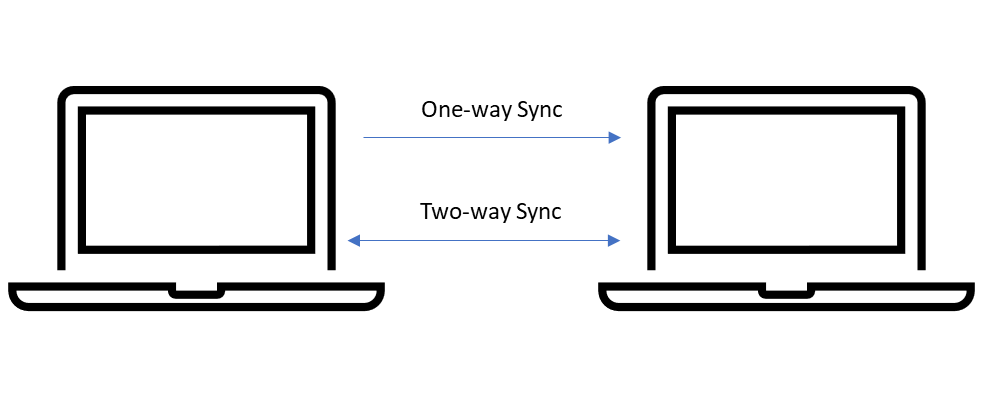
In the world of data, synchronization and propagation are like superheroes that make sure our information stays accurate and consistent, even when it's spread out in different places.
Let's understand these ideas:
Synchronization:
- Synchronization is about keeping data the same and up to date in many different spots or systems.
- The goal is to ensure that if we change something in one place, like updating the inventory in an online store, those changes quickly show up everywhere else, such as on the website and in the physical store's system. This way, everyone using the data gets the latest and correct info.
- For example, imagine you run an online store, and you add new items to your inventory on your computer. Synchronization is like magic that makes sure those new items appear on your website and in your store's computer, so customers and the store both know what's available.
Propagation:
- Propagation is like the spreading of news, but for changes in data. It's about making sure updates in one part of a system travel to other connected parts.
- When something changes, like depositing money at an ATM in a bank, propagation helps that change reach all the places that need to know, such as your online bank account and the main bank database. It's like making sure the news of the deposit goes to all the right places.
- For example, if you put money into an ATM, propagation ensures that the information about your deposit reaches all the important places, like your online bank app and the bank's main computer. It's like making sure everyone in the banking system knows about the deposit.
2 min readMore
- I Am Datapedia!
Data Modeling and Design
Supertype and Subtype
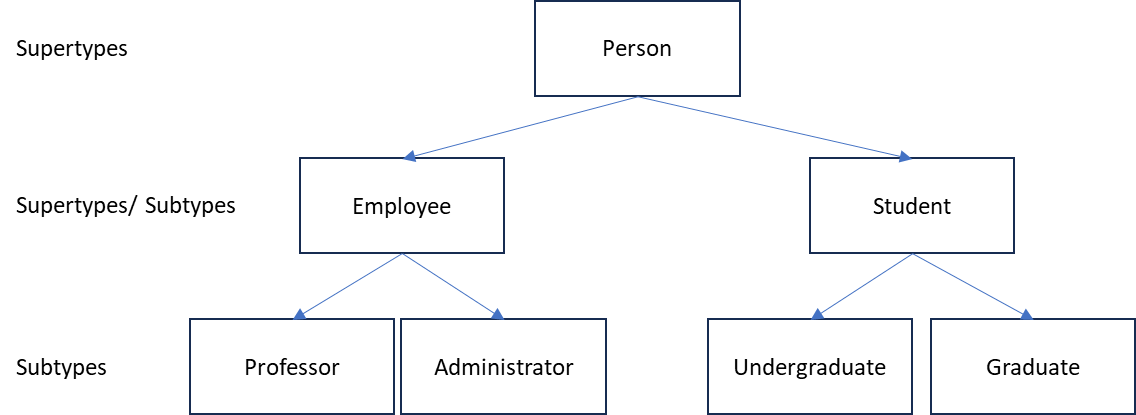
In data modelling, particularly in the context of relational databases, the terms "supertype" and "subtype" are used to describe the relationships between entities.
Let's explore these concepts:
Supertype: A supertype is a generalization that represents a higher-level entity. It encompasses common characteristics shared by multiple lower-level entities.
- It contains attributes common to multiple related entities.
- It represents the generalization of several entities.
- For example, consider a supertype "Vehicle" that includes common attributes like "Manufacturer," "Model," and "Year." Cars, motorcycles, and trucks could be subtypes of this supertype, inheriting these common attributes.
- Subtype: A subtype is a specialization of a supertype, representing a more specific entity with additional attributes or characteristics.
- It inherits attributes from the supertype and may have additional attributes.
- It represents a more specific category within the generalization.
- For example, using the "Vehicle" example, "Car" is a subtype that inherits attributes from the "Vehicle" supertype but may have additional attributes specific to cars, such as "Number of Doors" or "Body Type."
2 min readMore
- I Am Datapedia!
Reference and Master Data
ISO 3166For Locations
ISO 3166, one type of Reference Data, is an international standard that defines codes for the names of countries, territories, and special areas of geographical interest. In the data world, ISO 3166 codes are widely used for various purposes, such as uniquely identifying countries in databases, international transactions, and data exchange.
Let's break down ISO 3166 in more detail:
Country Codes: ISO 3166 provides three types of codes for each country or territory:
- ISO 3166-1 Alpha-2: Two-letter country codes (e.g., US for the United States, CA for Canada).
- ISO 3166-1 Alpha-3: Three-letter country codes (e.g., USA for the United States, CAN for Canada).
- ISO 3166-1 Numeric: Three-digit numeric codes.
ISO 3166 standardizes the representation of country names to avoid confusion in international communication, commerce, and data exchange. The standard is maintained by the International Organization for Standardization (ISO) and is periodically updated to reflect changes in country names and geopolitical developments.
2 min readMore
- I Am Datapedia!
Data Governance
Basel Standards
In the context of the data world, "BASEL" likely refers to the Basel Committee on Banking Supervision. The Basel Committee is not directly related to data management but plays a significant role in shaping international banking regulations, including requirements related to risk management and data reporting.
Basel Committee on Banking Supervision (BCBS) is an international committee of banking supervisory authorities. It was established by the Bank for International Settlements (BIS) to strengthen the regulation, supervision, and practices of banks worldwide. The committee is known for developing and maintaining global regulatory frameworks, commonly known as the Basel Accords, which set standards for bank capital adequacy, risk management, and prudential supervision.
Basel Accords/ Standards:
- Basel I: Introduced in 1988, Basel I established minimum capital requirements based on credit risk.
- Basel II: Developed in 2004, Basel II expanded the framework to address credit, operational, and market risks. It introduced more risk-sensitive capital requirements.
- Basel III: Implemented in response to the 2008 financial crisis, Basel III further strengthened capital requirements, introduced new liquidity standards, and enhanced risk management practices.
3 min readMore
- I Am Datapedia!
Data Storage and Operations
FinOps
FinOps is a term derived from "financial operations." It represents a set of practices and principles aimed at optimizing the financial aspects of cloud computing especially in an era where Cloud is the to-go approach for everyone.
- Management Practice: FinOps is not just a set of guidelines; it's a management practice, indicating that it involves a structured and ongoing approach to managing financial aspects within the context of cloud operations.
- Shared Responsibility: One of the central tenets of FinOps is the promotion of shared responsibility. This means that financial considerations are not solely the concern of the finance department; instead, there is a collective responsibility across different organizational functions.
- Cloud Computing Infrastructure: FinOps is specifically tailored to address the financial aspects related to cloud computing infrastructure. This includes services, resources, and functionalities provided by cloud service providers such as AWS, Azure, or Google Cloud.
- Cost Management: The primary focus of FinOps is on effectively managing the costs associated with cloud usage. This involves understanding, optimizing, and controlling expenditures to ensure they align with business goals.
- Organizational Involvement: FinOps encourages participation and collaboration across various teams within an organization. It brings together stakeholders from finance, operations, and IT/engineering to collectively manage and optimize cloud costs.
- Efficiency and Optimization: The ultimate goal of FinOps is to enhance efficiency and optimize cloud spending. This may involve identifying cost-saving opportunities, optimizing resource usage, and making informed decisions to achieve a balance between cost, performance, and reliability.
- Continuous Improvement: FinOps is not a one-time initiative but a continuous improvement process. Teams regularly assess, analyze, and refine their practices to adapt to changing business needs and technological advancements.
- Educational Component: The statement doesn't explicitly mention it, but part of FinOps often includes educational initiatives. Teams are educated about cloud financial management practices to enhance their understanding of how their decisions impact costs.
2 min readMore
- I Am Datapedia!
Data Quality
Testing vs QA
Testing and Quality Assurance (QA) are commonly mixed up, but let's break down the differences.
Testing:
Testing is about discovering problems or bugs in processes or code, either during or after implementation. Various stages of testing happen during an IT project, such as Unit Testing (checking individual parts), System Integration Testing (verifying components work together), and User Acceptance Testing (ensuring the solution meets user requirements).
QA (Quality Assurance):
QA, on the other hand, is all about making sure that the standards and output of processes or solutions meet customer satisfaction. Even if testing doesn't find bugs, QA checks if the output aligns with the expected quality. For example, if we create a table with a million rows, testing may show all rows are there, but QA might reveal differences in country name spellings or data formats.
For example, imagine you're building a database with country names. Testing might confirm that all million rows are there, but QA would catch if the spellings were inconsistent or if data formats are not uniform.
2 min readMore
- I Am Datapedia!
Data Storage and Operations
Sandbox
Sandbox typically refers to a controlled and isolated environment where data scientists, analysts, or developers can explore, test, and experiment with data without affecting the production environment. The concept is borrowed from the idea of a children's sandbox, where they can play and experiment freely within a confined area.
Here are key aspects of a Data Sandbox:
- Isolation: A Data Sandbox is isolated from the production environment to prevent any unintended consequences or disruptions. It allows users to experiment without affecting critical systems or data.
- Experimentation and Testing: Users can perform various activities, such as running queries, testing algorithms, or developing and refining code, in a risk-free environment. This is crucial for data analysis, machine learning, and software development.
- Data Exploration: Data Sandboxes often provide a space for exploring datasets, trying out different queries, and gaining insights without altering the original data or systems.
- Prototyping: Data scientists and developers can use the sandbox to prototype new solutions, algorithms, or models before deploying them to the production environment.
- Learning and Training: Sandboxes are valuable for training purposes. Data professionals can use them to train and educate others without the risk of impacting live systems.
- Security and Access Control: While sandboxes are designed for experimentation, they still need to adhere to security best practices. Access controls and permissions are implemented to ensure that sensitive or confidential data is not misused.
- Version Control: Some Data Sandboxes incorporate version control mechanisms, allowing users to track changes and revert to previous states if needed.
- Data Masking and Anonymization: To comply with privacy regulations, data in a sandbox may be masked or anonymized to protect sensitive information while still allowing meaningful analysis.
- Integration with Development Processes: Sandboxes are often integrated into the overall development and deployment processes, enabling a seamless transition from testing and experimentation to production deployment.
2 min readMore
- I Am Datapedia!
Data Storage and Operations
House Keeping
Housekeeping refers to the routine maintenance, organization, and management tasks that are necessary to ensure data quality, integrity, and efficiency. It involves activities such as cleaning, organizing, and optimizing data to keep databases, data warehouses, and other storage systems in good order.
With an optimistic outlook, effective housekeeping measures have the potential to save approximately 30% of operational costs.
Here are some examples of housekeeping tasks in the Data World:
- Data Cleaning: Identifying and rectifying errors, inconsistencies, or missing values in datasets. For example, if you have a dataset with student information, data cleaning may involve fixing typos in names, standardizing date formats, and filling in missing grades.
- Data Deletion: Removing obsolete or unnecessary data to free up storage space and reduce clutter. For example, deleting records of students who have graduated or left the school to keep the dataset relevant and manageable.
- Backup and Recovery: Regularly creating copies of data to prevent loss and establishing procedures for data recovery in case of accidental deletion or system failure. For example, saving multiple copies of your project work on different devices to avoid losing progress if a file becomes corrupted.
- Data Archiving: Moving older or less frequently used data to long-term storage to optimize performance in the primary data storage system. For example, archiving past school year records to a separate folder to keep the current year's data easily accessible.
- Indexing: Creating indexes on databases to accelerate data retrieval and query performance. For example, indexing a list of books by title or author's name for quicker reference when searching for specific information.
- Data Encryption: Applying encryption to sensitive data to protect it from unauthorized access. For example, using encryption tools to secure personal information in a project related to online privacy.
- Metadata Management: Organizing and documenting metadata (data about data) to enhance understanding and usability. For example, creating a spreadsheet that documents the meaning and format of each column in a dataset.
- Data Purging: Removing data that is no longer needed or relevant, especially in compliance with data retention policies. For example, deleting survey responses from previous years to keep the dataset focused on recent data.
- Performance Optimization: Fine-tuning databases and queries to improve overall system performance. For example, adjusting settings in a gaming app to improve its performance on a smartphone.
3 min readMore
Build a strong foundation in Data & AI
Follow the Data Foundations learning path (Beginner to Advanced).