Once you sign in, your details will show here.
Knowledge Hub
Your Reading List
Sign in to see your reading list.
Topics you save will appear here.
+ New Topic
Filter
DAMA Knowledge Area
Learning Level
Content Type
Sort
Every topic is free to read. A free account also lets you search the topics, react to a topic and comment under it.
- I Am Datapedia!
Data Governance
Data Literacy Assessment
Data Literacy Assessment involves evaluating an individual's ability to understand, interpret, and work with data effectively. It measures how well someone can read, analyze, and draw insights from data.
Let's elaborate on each aspect of data literacy assessment:
- Data Understanding: This aspect assesses an individual's ability to comprehend and make sense of the data presented. It involves understanding the data structure, variables, and context. For example, imagine you have a table with information about the number of apples sold each day at a fruit stand. A data literacy assessment might ask you to look at the table and answer questions like, "On which day were the most apples sold?" This tests your ability to understand the data presented.
- Data Interpretation: It evaluates how well someone can analyze and draw meaningful insights from the data. It includes recognizing patterns, trends, and relationships within the dataset. For example, you are given a chart showing the temperature variations over a week. A data literacy assessment could ask, "What can you conclude about the weather during this week?" This evaluates your capacity to interpret data trends and draw meaningful conclusions.
- Data Presentation: It focuses on the skill of effectively communicating data findings. It involves selecting appropriate visualizations or formats to convey information clearly to a specific audience. For example, suppose you are asked to create a simple bar chart using data about the number of books read by different students. This assesses your ability to choose an appropriate way to present data visually.
- Data Analysis: It evaluates an individual's capability to process and manipulate data to uncover patterns, correlations, and trends. It entails making use of statistical and computational strategies to derive insights. For example, you are provided with a data set on students' test scores and attendance. A data literacy assessment might request you to identify if there's a correlation between attendance and academic performance. This tests your ability to analyze data for patterns and relationships.
- Problem-Solving with Data: This aspect assesses the ability to use data to solve real-world problems. It involves applying data-driven approaches to make informed decisions and address challenges. For example, given data on the growth of plants under different conditions, a data literacy assessment could ask, "Which condition is most favorable for plant growth, and why?" This evaluates your capability to apply information to resolve real-international problems.
- Data Ethics: It examines an individual's understanding of ethical considerations related to data. It involves recognizing and addressing issues such as privacy, consent, and fairness in the handling of data. For example, you are presented with a scenario where a company is collecting customer data. A data literacy assessment might ask, "What ethical considerations should the company take into account when handling this data?" This assesses your understanding of ethical implications related to data.
- Data Communication: It assesses how well someone can convey data insights to others. It entails growing reports, visualizations, or narratives that efficiently talk findings to each technical and non-technical audience. For example, you are given a dataset on pollution levels in a city. A data literacy assessment could ask you to prepare a short report for a non-technical audience, explaining the findings and potential implications. This tests your ability to communicate data insights effectively.
- Critical Thinking with Data: Critical thinking with data evaluates the ability to approach data with a questioning mindset. It involves considering alternative perspectives, asking relevant questions, and identifying potential biases in the data. For example, you receive data about the popularity of different sports in a school. A data literacy assessment might ask, "What other information would you need to determine the factors influencing students' sports preferences?" This assesses your analytical reasoning abilities in consuming data.
4 min readMore
- I Am Datapedia!
Data Integration and Interoperability
Data Sources
Data Source is essentially where information comes from. It can be anything like a list of customer names in a spreadsheet, sales details in a company's database, or even tweets on social media. These sources can vary in size and complexity, ranging from simple text files to complex, large-scale databases.
In Information Systems, Data Sources can vary. Here are some examples:
- Databases: This is one of the most common data sources. It can be a relational database like MySQL, PostgreSQL, or Oracle, where data is organized in tables, or a NoSQL database like MongoDB or Cassandra, which may store data in more flexible formats.
- Business or Enterprise Applications like CRM and ERP Systems: Systems like Salesforce, SAP, or Oracle ERP are used by organizations to manage customer and business operations data. They serve as rich data sources for analytics and business intelligence.
- Spreadsheet Files: Files like Microsoft Excel or Google Sheets are common sources of data, especially in smaller scale or less technical environments. They store data in tabular form and are widely used for various analytical purposes.
- Flat Files: These include CSV (Comma Separated Values) or Text files etc. They are simple text files used to store data in a structured format and are commonly used for data exchange and storage.
- Cloud Storage: Services like Amazon S3, Google Cloud Storage, or Microsoft Azure Blob Storage. These platforms are used to store large amounts of data in the cloud and are accessible from anywhere.
- Logs: System logs, application logs, web server logs, etc., are used for monitoring, debugging, and security analysis. They provide raw data about the usage and performance of various systems. They can serve as a Data Source for monitoring applications.
2 min readMore
- I Am Datapedia!
Data Warehousing and Business Intelligence
Data Warehouse vs Data Lake
Data Warehouse
A data warehouse is a type of data platform that is designed to store and analyze structured data from various sources, providing a central repository for business intelligence (BI) and analytics applications. The data stored in a data warehouse is typically historical, integrated, and cleansed, and can be used to support decision-making, reporting, and analysis at all levels of an organization. The data stored in a data warehouse is typically structured and organized into tables and is optimized for efficient querying and analysis.
Data Lake
A data lake is a centralized repository that allows you to store all your structured, semi and unstructured data at any scale. The term was coined to represent the idea of a system where data flows in from various sources and resides in its most "natural" state, just like water in a lake. These data can range from raw, unprocessed files to transformed, structured records.
2 min readMore
- I Am Datapedia!
Data Storage and Operations
Data Deactivation
In general terms, deactivation often implies the action of making something inactive or turning it off. In the context of data, this refers to the intentional process of rendering certain data inactive, which involves restricting access, archiving, or taking it out of active use. Here are a few possible interpretations, but it's important to consider the specific context in which you encountered the term:
- Archiving or Disabling Data: Data deactivation refers to archiving data or making it temporarily inactive. This could be done for various reasons, such as compliance with data retention policies or reducing the storage load.
- User Account Deactivation: In the context of user accounts, data deactivation means disabling or deactivating a user account, preventing further access or updates to associated data.
- Temporary Suspension: It refers to a temporary suspension or deactivation of certain data processing activities for maintenance, security, or other reasons.
- Here are a few examples of scenarios where a similar concept might be applied:
- Archiving Inactive Customer Records: In a customer database, records of customers who haven't engaged with the business for an extended period might be archived or deactivated. This involves making the data inactive, but it is still retained for historical or compliance purposes.
- Account Deactivation: When an employee leaves a company, their user account in the company's systems may be deactivated. This deactivation prevents the former employee from accessing company data and systems.
- Temporary Suspension for Maintenance: A web application might temporarily deactivate certain features or services for maintenance or updates. During this period, certain data-related functionalities could be temporarily disabled.
- Data Retention Policies: Organizations might have data retention policies that specify when certain types of data should be deactivated, archived, or permanently deleted. This ensures compliance with regulations and reduces storage costs.
- Disabling Inactive Products or Services: In an e-commerce system, products or services that are no longer offered or are inactive may be flagged as such. This deactivation prevents customers from making new purchases of those items.
- Temporary Data Deactivation for Security Reasons: In the event of a security incident, certain data access might be temporarily deactivated to prevent unauthorized access. This could involve suspending certain user accounts or restricting access to sensitive information.
2 min readMore
- I Am Datapedia!
Data Governance
Data Embargo
In simple terms, when we talk about an Embargo, we're usually talking about a rule or limit, especially when it comes to trading or sharing information. Now, if we use "data embargo," it means there are rules or limits on using, sharing, or spreading certain information. This mostly happens for legal reasons, to keep things safe, to protect privacy, or because there are rules to follow.
Let's delve into the concept of an "embargo," especially in the context of data, using simpler language:
- Embargo Basics: An "embargo" is like a rule that says you can't do certain things. It often happens in trade or when sharing information.
- Data Embargo: Now, if we add "data" to the word "embargo," it means there's a rule or limit on how we can use, share, or spread specific information. Imagine it's like having a set of rules for how you can talk about or share certain details.
These rules could be there for different reasons:
2 min readMore
- I Am Datapedia!
Data Integration and Interoperability
Data Streaming
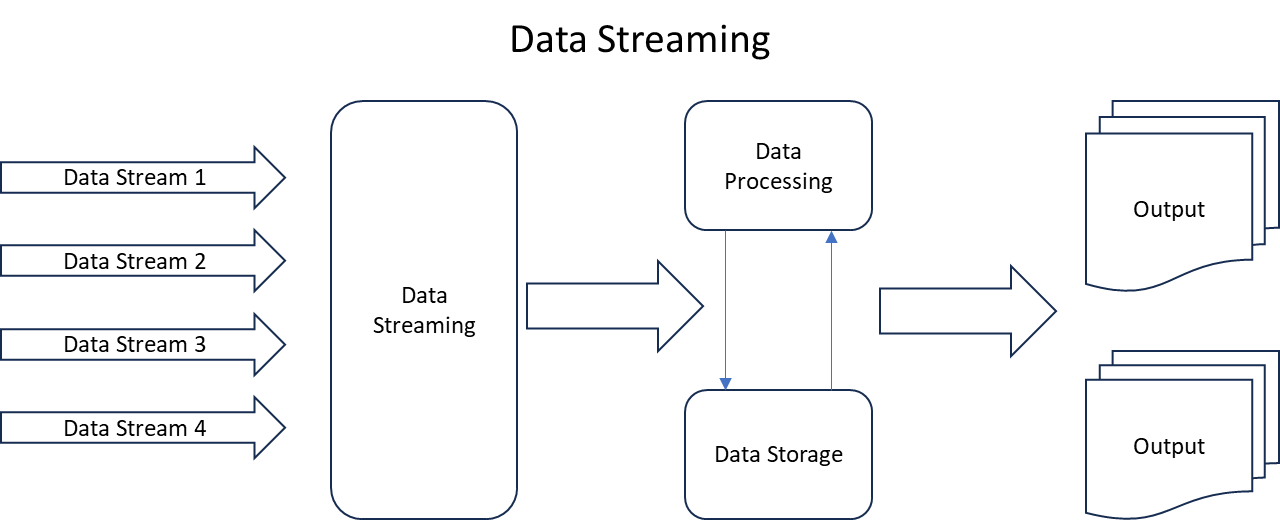
Data Streaming is a method of processing and transmitting data continuously and in real-time rather than in batches. It involves the continuous flow of data from sources to destinations, allowing for the rapid analysis, processing, and dissemination of information.
To understand Data Streaming, suppose data streaming is like water moving in a river on regular basis as compared to a place where water is stored one time with no more coming in. In traditional methods, we collect a bunch of data, like filling a bucket, and then analyze it all at once. On the other hand, in data streaming, it’s like regular pieces of data keep coming in piece by piece, in smaller size, rather than we pull in a huge size in one-go.
Few examples for better understanding.
- Social Media Feeds: Social media platforms use data streaming to show new posts, comments, and updates in real-time. For example, when you refresh your Instagram feed, you instantly see new photos and comments as they are posted.
- Weather Monitoring: Meteorologists use data streaming to receive and analyze continuous weather data. For example, temperature, humidity, and wind speed information are continuously sent and analyzed to provide real-time weather updates.
- Financial Transactions: Banks use data streaming to process and monitor financial transactions in real-time. For example, when you make a purchase with your credit card, the transaction is immediately reflected in your account balance.
- Health Monitoring Devices: Wearable devices use data streaming to provide real-time health information. For example, a fitness tracker continuously measures your heart rate, steps, and sleep patterns, updating your health stats in real-time.
- Traffic Monitoring: Traffic control systems use data streaming to monitor and manage traffic flow. For example, cameras and sensors on roads continuously provide real-time information about traffic conditions, helping optimize traffic signals.
- Online Video Streaming: Services like YouTube or Netflix use data streaming to deliver videos in real-time. For example, when you watch a video online, it starts playing almost instantly, with the data being streamed to your device as you watch.
2 min readMore
- I Am Datapedia!
Data Integration and Interoperability
Batch Processing
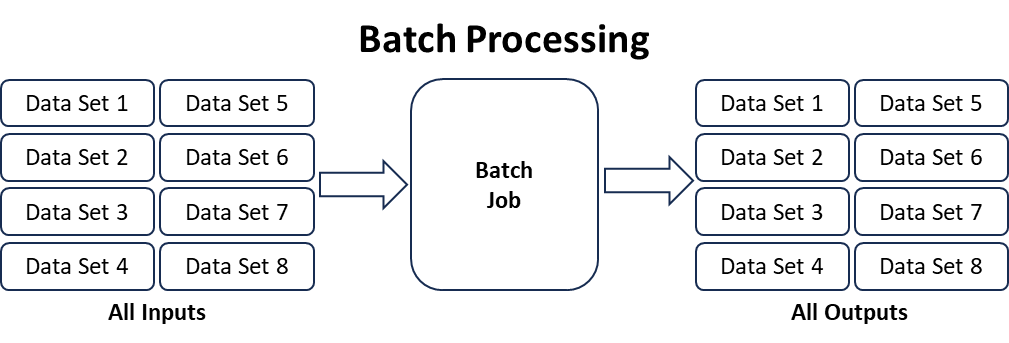
Batch Processing is a method of handling data in large quantities by grouping it into sets, or batches, and processing those sets together at scheduled intervals. Unlike real-time processing, where data is handled immediately, batch processing involves accumulating data over a period and then processing it as a group.
Think of batch processing like doing your homework assignments at the end of the day rather than right after each class. You collect all the tasks and work on them together. Similarly, in batch processing, data is gathered over time, and then, as a batch, it's processed all at once.
Few examples for better understanding.
- Grade Processing in Schools: Teachers collect students' assignments, quizzes, and tests over a week and then enter grades into the system at the end of the grading period. For example, instead of entering each student's grade immediately after they submit an assignment, the teacher waits and processes grades for the entire class at once.
- Bank Transactions: Banks often update account balances and transactions overnight, processing all the transactions that occurred during the day in a batch. For example, if you deposit money or make a purchase, the transaction might not immediately reflect in your account balance; it's updated in a nightly batch.
- Payroll Processing: Companies often process payroll in batches, calculating and distributing salaries at specific intervals. For example, employee work hours, overtime, and other payroll-related information are collected over a pay period and processed together to generate paychecks.
- Inventory Management: Retailers may update their inventory levels in batches rather than immediately after each sale. For example, Sales data is collected throughout the day, and inventory levels are adjusted during a nightly batch process.
- Billing and Invoicing: Utility companies may process billing information in batches, generating bills for all customers at specific intervals. For example, Instead of generating a bill for each customer as soon as they use a service, bills are created in a batch at the end of the billing cycle.
- Batch Photo Editing: When editing photos, a batch processing approach may be used to apply the same set of edits to multiple photos simultaneously. For example, if you want to resize, crop, or apply a filter to a set of pictures, you can process them all together in a batch.
- Report Generation: Organizations often generate reports based on collected data at specific intervals, such as daily or monthly. For example, Sales reports, customer analytics, or website traffic reports may be generated in batches to provide a comprehensive overview.
3 min readMore
- I Am Datapedia!
Data Storage and Operations
NewSQL
Indeed, it's an emerging database model. While there aren't many implementations yet, the concept is promising. If it materializes, it has the potential to streamline operations by eliminating the need for separate SQL and NoSQL datastores, saving significant effort.
Let’s decode it…..
NewSQL is a term that refers to a class of modern relational database management systems (RDBMS) designed to meet the performance and scalability requirements of modern applications, particularly in distributed and cloud computing environments. These databases aim to provide the benefits of traditional relational databases, such as ACID (Atomicity, Consistency, Isolation, Durability) compliance and structured query language (SQL) support, while addressing the challenges posed by large-scale and highly concurrent systems.
Key characteristics and features of NewSQL databases include:
- Scalability: NewSQL databases are designed to scale horizontally, allowing them to handle increasing workloads by adding more nodes to a distributed system.
- Performance: These databases often focus on providing high performance for read and write operations, especially in scenarios where traditional relational databases might face challenges in handling large volumes of data or high transaction rates.
- ACID Compliance: NewSQL databases maintain the ACID properties to ensure data integrity and consistency, crucial for applications where accuracy and reliability are paramount.
- SQL Compatibility: NewSQL databases support traditional SQL queries, making it easier for developers to transition from traditional relational databases to these newer systems.
- Architecture: They may use innovative architectural designs, such as distributed and shared-nothing architectures, to distribute data and workload across multiple nodes.
- Examples of NewSQL databases include:
- Google Spanner: A globally distributed; horizontally scalable database system developed by Google.
- CockroachDB: An open-source, distributed SQL database that is designed to be scalable, resilient, and strongly consistent.
- NuoDB: A distributed SQL database that provides on-demand scalability and continuous availability.
2 min readMore
- I Am Datapedia!
Data Integration and Interoperability
Delta Sharing
First, I wanted to name this topic as Data or Delta Sharing but to make it more interesting, kept it as Delta Sharing ONLY 😊.
Let’s decode it…..
We all have heard about Data Sharing. It is about sharing data across departments, across branches, across organizations or in DaaS model (explained separately) with the open wide world. In preceding era, Data was not huge, Data was not treated as THE SUCCESS factor, but it felt it is. So, sharing data to other entities was OK, giving them data itself was OK.
But in the current era where data has exponentially grown, and data has become THE SUCCESS factor for any organization. Plus, due to the data size, it’s no longer possible to transfer data even if it is, it’s not in timely manner, secondly due to Data Sovereignty, organizations don’t want their data to move out of their datastores.
Above scenario was even possible in previous era where, to others, we used to give access in our environment but on a very limited basis as accessing our environment or our databases used to impact our performance and used to impact our applications which was not acceptable, that is the reason we started masking or anonymizing data and started exporting actual data to other datastores.
2 min readMore
- I Am Datapedia!
Data Security
Cyber Security forData Solution
Implementing a robust cybersecurity strategy involves encryption, regular audits, access controls, employee training, and staying updated on emerging threats to safeguard sensitive information effectively.
Few pointers:
- Data Encryption: Employ end-to-end encryption to protect data during transmission and at rest. Utilize strong encryption algorithms to secure sensitive information.
- Access Controls: Implement strict access controls, granting users only the permissions necessary for their roles. Regularly review and update access privileges to ensure they align with current job responsibilities.
- Regular Audits: Conduct periodic security audits to identify vulnerabilities and weaknesses. Regularly assess and update security policies based on audit findings to address new threats.
- Employee Training: Provide comprehensive cybersecurity training for employees to raise awareness about potential threats. Promote a culture of security consciousness to minimize human-related risks, such as phishing attacks.
- Incident Response Plan: Develop and regularly test an incident response plan to respond to security incidents swiftly and effectively. Clearly define roles and responsibilities to minimize downtime during an incident.
- Data Backups: Establish regular and secure data backup procedures to ensure quick recovery in case of data loss or a security breach. Store backups in a remote location to save you from being compromised.
- Network Security: Employ firewalls, intrusion detection and prevention systems to monitor and protect the network. Regularly update and patch software to address known vulnerabilities.
- Vendor Security Assessment: Assess and monitor the cybersecurity measures of third-party vendors handling your data. Ensure vendors comply with security standards and protocols.
- Security Patching: Regularly apply security patches and updates to all systems and software to address known vulnerabilities. Monitor for vulnerabilities that may require immediate attention.
- Data Lifecycle Management: Implement data retention and destruction policies to minimize the risk of unauthorized access. Clearly define how data is collected, processed, stored, and disposed of throughout its lifecycle.
2 min readMore
Build a strong foundation in Data & AI
Follow the Data Foundations learning path (Beginner to Advanced).