Once you sign in, your details will show here.
Knowledge Hub
+ New Topic
Filter (2)
Sort
222 topics · Intermediate · Article · 10 shown
Show allEvery topic is free to read. A free account also lets you search the topics, react to a topic and comment under it.
- I Am Datapedia!
Data Governance
SLA
SLA stands for "Service Level Agreement" A Service Level Agreement is a contractual agreement or commitment between a service provider and a customer that outlines the level of service expected, including the quality, availability, and responsibilities related to the service. SLAs are commonly used in various industries, including the data and technology sectors.
Here's a breakdown of key aspects of SLAs in the data world:
- Quality of Service: Specifies the expected quality, accuracy, and reliability of the data service. For example, a data storage service may have an SLA stating that data will be stored securely, with minimal risk of loss or corruption.
- Availability: Defines the agreed-upon level of uptime or availability for a data service. For example, an SLA for a cloud-based data storage service might guarantee 99.9% uptime, ensuring that the service is accessible to users for the vast majority of the time.
- Response Time: Outlines the expected time frame within which the service provider commits to respond to queries, issues, or requests. For example, an SLA for a data analytics platform may specify that support tickets will be addressed within 24 hours.
- Data Security and Privacy: Addresses the security measures in place to protect data and the adherence to privacy regulations. For example, an SLA for a data processing service may include provisions for encryption, access controls, and compliance with data protection laws.
- Scalability: Defines how the service will scale to accommodate increased data volumes or user demands. For example, an SLA for a cloud-based database service might specify the procedures for scaling resources based on increased data loads.
- Data Backup and Recovery: Outlines procedures for regular data backups and the expected timeframe for data recovery in case of a failure. For example, an SLA for a data storage service might include provisions for daily backups and a commitment to restoring data within 48 hours in case of a system failure.
- Compliance: Addresses adherence to relevant industry standards, regulations, and legal requirements. For example, an SLA for a healthcare data management system might specify compliance with healthcare data privacy regulations such as HIPAA.
- Termination and Penalties: Outlines conditions under which either party can terminate the agreement and may include penalties for non-compliance. For example, an SLA might specify the process for termination if the service provider consistently fails to meet agreed-upon service levels.
3 min readMore
- I Am Datapedia!
Data Storage and Operations
Materialized View
Materialized View is a database object that stores the output of a query. Unlike a regular view, which is a virtual table derived from the result of a SELECT query, a materialized view physically stores the data in a structured form. This precomputed data can be periodically refreshed to reflect changes in the underlying tables.
It is a snapshot of the data at the time the materialized view was last refreshed. You create a materialized view by defining the structure of the view and specifying the query that populates it.
CREATE MATERIALIZED VIEW EmployeeProfile
AS
SELECT Employee.*, Department.*
FROM Employee, Department
WHERE Employee.DeptID = Department.DeptID
In this example, we create a materialized view named " EmployeeProfile " that summarizes Employees Details based on Employee and Department tables.
Unlike regular views, materialized views store the data physically. The result set of the query materialized, meaning it's stored in a table-like structure within the database.
3 min readMore
- I Am Datapedia!
Data Storage and Operations
External Tables
In the data world, when we work with databases, we often encounter scenarios where the data we want to query and analyze resides outside the database itself. This could be in the form of files, such as CSV (Comma-Separated Values), Parquet, or JSON files, stored in external storage systems like Hadoop Distributed File System (HDFS) or cloud storage platforms such as Amazon S3 or Azure Blob Storage.
Now, imagine a situation where we have large datasets stored in external files, and we want to treat them like database tables for analytical purposes. Here comes the concept of external tables.
External Tables are a database feature that allows you to define a table structure within the database, but the actual data is stored externally, typically in files. To create an external table, you specify the table structure (columns, data types) in the database, and you also provide a location that points to the external storage where the data files are stored.
3 min readMore
- I Am Datapedia!
Data Storage and Operations
UDF
UDF stands for User-Defined Function. It is a feature provided by many programming and database languages that allows users to define their own functions to perform specific tasks. UDFs are particularly useful for encapsulating commonly used logic, promoting code reusability, and enhancing the readability of code.
Few examples of UDFs in different programming and database contexts:
1. SQL UDF (User-Defined Function):
In SQL, you can create user-defined functions to perform specific tasks. Here's an example of a simple UDF in SQL that concatenates two strings:
-- SQL UDF Example
CREATE FUNCTION ConcatenateStrings(@str1 NVARCHAR(MAX), @str2 NVARCHAR(MAX))
RETURNS NVARCHAR(MAX)
AS
BEGIN
RETURN @str1 + ' ' + @str2;
END;
You can then use this UDF in SQL queries:
SELECT ConcatenateStrings('Hello', 'World') AS Result;
-- Result: Hello World
2. Python UDF:
In Python, you can define functions to encapsulate logic. Here's a simple example of a Python UDF that calculates the square of a number:
3 min readMore
- I Am Datapedia!
Data Integration and Interoperability
Importance ofStaging Layer
Yes, you are right, in Data World, Staging Layer is one of the most important zones then why to write about it. Trust me it's been underutilized in most implementations.
Let's decode it.....
The Staging Layer in data architecture plays a crucial role in the data processing pipeline, providing a temporary and structured area for incoming data before it is integrated into the data warehouse or other storage systems.
Many a times Staging Layer is confused with Landing Layer. Yeah trust me, I have seen people doing nothing in Staging Layer except minor things. Please note, especially in the era of cloud, if one doesn’t properly utilize Staging Layer, the consumption cost from Staging Layer to Transformed Layer will be significantly higher.
The importance of the staging layer lies in several key aspects:
- Data Quality and Validation: The staging layer acts as a checkpoint for data quality and validation. Before data is moved to the main storage or processing area, it undergoes validation checks to ensure it meets quality standards. This helps identify and address issues such as missing values, formatting errors, or inconsistencies early in the data pipeline.
Data Enrichment: Staging allows for data enrichment processes to take place before the data reaches its final destination. This step involves cleaning, enhancing the data, making it more suitable for analysis and reporting. It ensures that the data conforms to the desired format and structure.
- Incremental Loading: The staging layer facilitates incremental loading of data, allowing for efficient updates and additions. Instead of reloading the entire dataset, only new or modified data needs to be processed, reducing the computational load and improving overall system performance.
- Data Auditing and Lineage: Staging provides a historical record of the ingested data, enabling auditing and tracing of changes over time. This is essential for tracking the lineage of data, understanding its origin, and ensuring compliance with data governance and regulatory requirements.
- Fault Tolerance and Recovery: Staging serves as a buffer against data processing failures. If an error occurs during data integration or transformation, the staging layer allows for easier recovery without affecting the main data storage. It provides a level of fault tolerance and helps maintain the integrity of the overall data processing pipeline.
- Isolation of Source and Destination Systems: Staging separates the source systems (where data originates) from the destination systems (where data is stored for analysis). This isolation ensures that any changes or issues in the source systems do not immediately impact the data warehouse or analytics environment, providing a layer of protection.
- Performance Optimization: By pre-processing and validating data in the staging layer, the main data storage systems are relieved of some of the computational overhead. This optimization contributes to improved performance and responsiveness in data processing.
3 min readMore
- I Am Datapedia!
Data Governance
GDPR
GDPR, or the General Data Protection Regulation, is a significant law in the European Union focused on data protection and privacy. In very simple terms, it's a set of rules about how companies and organizations should handle personal information of individuals. It gives people more control over their personal details like their names, addresses, and photos, ensuring that this information is handled in a secure and lawful manner.
The main principles of the GDPR center around responsible data management.
- Transparency is key, requiring clear communication about how personal data is used.
- Purpose limitation means data can only be used for specific, clearly stated reasons.
- Data minimization insists on collecting only the data that is absolutely necessary.
- The principle of accuracy ensures that personal information is kept up-to-date and correct.
- Storage limitation mandates that data should not be kept longer than necessary.
- Integrity and confidentiality require that the data is kept safe and secure, protected from unauthorized access or breaches.
- Accountability places the responsibility on organizations to ensure all these principles are adhered to, making sure personal data is managed in a compliant and ethical way.
4 min readMore
- I Am Datapedia!
Data Integration and Interoperability
ElectronicData Interchange (EDI)
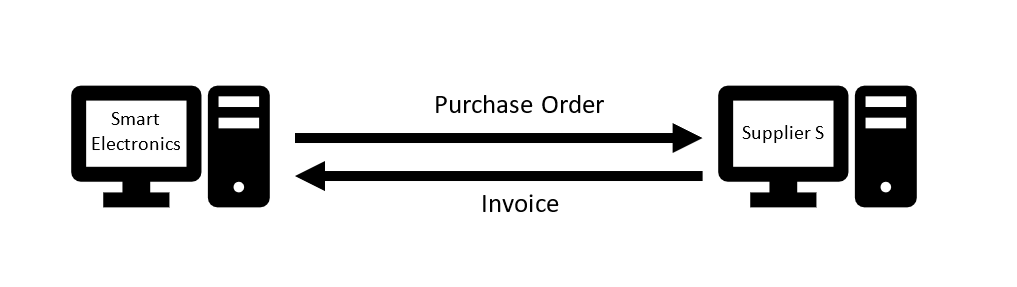
EDI, or Electronic Data Interchange has been introduced since the seventies. The main use case addressed by EDI is to automate data exchange between trading partners (Customers and Suppliers) for business documents, such as purchase orders and invoices as well as for payments and shipment information.
Here is a simple EDI use case in which Smart Electronics (a fictitious Manufacturing company) uses EDI to send Purchase Orders to Supplier S, and Supplier S sends corresponding invoices to Smart Electronics.
EDI follows specific message standards and formats like EDIFACT or X12 which are the main EDI message standards.
Other EDI standards have been developed for specific purposes or industries, such as:
- ODETTE: used in automotive industry in European countries
- HL7: used for healthcare data.
- IATA PATIS: used to exchange passenger and airport data, and is maintained by the IATA (the International Air Transport Association)
- SWIFT: used for transaction and message exchanges in the financial and banking sectors.
6 min readMore
- I Am Datapedia!
Data Warehousing and Business Intelligence
Attribution Data Models
Over the years, our approach to measuring marketing performance has drastically evolved and continues to change with advancing technology and evolving data policies. The days of rigidly assigning budgets to different marketing channels and relying solely on P&L statements to gauge the success of our efforts are behind us.
Assessing the performance of our ads involves understanding the correlation between our marketing spend and revenue generated. With data sources and clear models, especially when running campaigns across various channels simultaneously (e.g., Facebook, Google, Out Of Home, TV), the key question remains:
Which channels and touchpoints contribute significantly to the final sale?
To evaluate that, we employ distinct data models in marketing, each carrying its own set of advantages and limitations. These models must be tailored to fit each use case and align with how people interact with our business:
4 min readMore
- I Am Datapedia!
Data Warehousing and Business Intelligence
Incrementality inPerformance Marketing
Success in the dynamic landscape of marketing depends on engaging the right audience effectively. However, not all audiences respond the same to advertisements.
At the core of this lies a pivotal question:
Would customers buy without the corresponding paid advertising?
This question is at the core of incrementality in marketing, revealing three different ways people react to ads.Understanding Audience Behavior
This basic exploration breaks down how audiences react into three different groups:
- Non-responsive Audience: This group is unaffected by ads no matter how much they see them. They don't feel like engaging or buying because of ads.
- Pre-existing Demand Audience: People in this group were already planning to buy, ads or not. Ads might change when they buy, but they won't change their mind about buying.
- Incremental Audience: Importantly, this group includes people who are directly affected by ads. These potential customers engage or buy only because they saw ads, showing how much ads affect their behavior.
2 min readMore
- I Am Datapedia!
Data Security
ISO/IEC 27001 fromData Perspective
During the years of industrialization and first process automations, there was the first batch of international standards which has become the core of ISO “framework”. When data stormed through various industries, ISO/IEC 27001 was necessary to be defined. It is an international standard specifying the requirements for establishing, implementing, maintaining, and continually improving an information security management system (ISMS). From a data perspective, this standard is core, essentially pivotal to ensure the confidentiality, integrity, and availability (CIA) of data. It consists of 3 main sections, which encompasses policies, processes, and technical measures to manage information security risks.
There are 6 Key Components when dealing with data and data management.
- The foundational aspect for ISO/IEC 27001 is the systematic assessment of information security risks in your own data. Risk assessment includes identifying potential threats to data, assessing vulnerabilities, and risk impacts’ evaluation. The outcome guides the prioritization of security processes, monitoring and controls.
- Managing risk effectively, data must be classified according to its sensitivity and importance to the organization and its departments. Such classification influences how data is handled, stored, and transmitted, ensuring that more sensitive data receives higher levels of protection. The processing phase is called data classification.
- ISO/IEC 27001 highlights massive importance for limiting access to data based on the principle of least privilege. Access control lineage and its measures ensure that only authorized individuals can access or modify data, reducing the risk of unauthorized disclosure, alteration, partial loss, or total destruction.
- Encrypting data (both at rest and in transit], is a very common control in data protection process for keeping confidentiality and integrity. Encryption makes data unreadable to unauthorized parties, safeguarding it against spying or undesired interfering.
- Next component the ISO standard 27001 requires for all organizations to have procedures for managing information security incidents. Incident Management includes detecting, reporting, and investigating each incident to mitigate their impact on data and prevent recurrence.
- Last but not least ISO/IEC 27001 brought into place Business Continuity Management to keep development of any business continuity plan which includes data recovery procedures. “Continuity” ensures that critical data remains available or can be restored in the event of a disruption. Under “event” you can imagine a typical cyber-attack or natural disaster.
4 min readMore
Build a strong foundation in Data & AI
Follow the Data Foundations learning path (Beginner to Advanced).