Once you sign in, your details will show here.
Knowledge Hub
+ New Topic
Filter (1)
Sort
58 topics · Data Architecture · 8 shown
Show allEvery topic is free to read. A free account also lets you search the topics, react to a topic and comment under it.
- I Am Datapedia!
Data Architecture
Data Product
Before we explore what constitutes a Data Product (DP), it is important to establish the foundational context within which these products exist. Most enterprise data environments comprise two distinct but interconnected types of systems:
- OLTP (Online Transaction Processing) systems, which are responsible for generating operational data through transactional processes.
- OLAP (Online Analytical Processing) systems, which are designed to serve data for analytical and decision-support purposes.
We will not dive into the technical specifics of OLTP and OLAP here, as those are covered in dedicated sections elsewhere in this book. However, it is essential to understand this distinction because Data Products are primarily built and operated within the OLAP ecosystem.
In essence, OLTP generates data. OLAP serves it.
Data products are almost always born, shaped, and consumed in the OLAP layer, where raw data is transformed into meaningful, trustworthy outputs for business consumption.
4 min readMore
- I Am Datapedia!
Data Architecture
The Good, The Bad, and The Ugly
In the modern data landscape, few topics spark more debate than the question: “What is a Data Product?”
Across conferences, boardrooms, and industry discussions, the term has taken on a life of its own. Many practitioners argue over definitions, frameworks, and taxonomies, yet the underlying truth is simpler: most of us already know what a data product is.
The real challenge isn’t defining it. It’s understanding its quality.
At its core, a data product is any output, a curated dataset, analytical model, dashboard, that delivers tangible business value, offsets the cost of inaction (COI), and can be reused by multiple stakeholders. By that definition, its importance is undeniable.
But the real question is: Is the data product Good, Bad, or Ugly?
The Juice Analogy
To make this concept tangible, think about juice as an analogy.
When someone makes juice for you at home, is it a product? No. Even if it has the same ingredients, taste, and nutrition as a bottled juice, it’s not a product because:
5 min readMore
- I Am Datapedia!
Data Architecture
Data As A Product
The transformation of data into a strategic asset has led to the evolution of modern data products into what is now recognized as Data-As-a-Product (DAaP). Unlike traditional data products that serve narrow, predefined use cases, DAaP represents curated, production-grade datasets or models designed for consumption by multiple downstream users, systems, or applications. The goal is not just to serve information but to enable further processing, analytics, and transformation, with guaranteed semantic clarity, contract enforcement, and lifecycle stability.
The DAaP Shift: Two Pathways to Maturity
A data product evolves into DAaP under two primary scenarios:
- Organic Maturity
- Occurs when the utility of a data product extends beyond its original intent, powering other systems, dashboards, or models.
- Example: A sales insights dashboard originally built for a regional team becomes DAaP when its curated datasets feed into forecasting models, executive dashboards, or marketing analytics.
- Purposeful Design
- DAaP is built intentionally from day one to serve as a scalable, reusable, and governed data source across domains.
- Example: A centralized operational dataset constructed with clear semantic models and data contracts to serve finance, supply chain, and HR platforms in parallel.
4 min readMore
- Organic Maturity
- I Am Datapedia!
Data Architecture
The Evolution ofData Products and it’s Ecosystem
In today’s data-driven world, the creation, management, and delivery of data have evolved beyond pipelines and reports. At the heart of this transformation lies the concept of the data product, a curated, consumable asset designed to deliver value to internal and external consumers. But as enterprise data demands grow, so too does the need for a more governed, scalable model: Data-As-a-Product (DAaP).
To appreciate the full lifecycle, we must examine the zones, roles, and processes that underpin the ecosystem.
1. The Data Preparation Zone: Building the Foundation
The journey of every data product starts in the Data Preparation Zone, where raw, fragmented inputs are collected, validated, and modeled for reuse. This phase lays the architectural backbone needed for reliable analytics, machine learning, and productization.
Common modelling approaches in this zone include:
- 3NF Data Warehouse Modelling – Ideal for highly structured OLTP-aligned models with integrity constraints.
- Lakehouse Modelling (3NF in Data Lake) – Hybrid model allowing structured and unstructured data in open table formats with transactional consistency.
- Data Vault Modelling – Designed for agility, historization, and traceability in complex data landscapes.
- Ensemble Techniques (Focal Point, Anchor, etc.) – Used to unify fragmented entities across domains.
- Feature Store Design – Curated, versioned features for ML model consumption, supporting reuse across pipelines.
4 min readMore
- I Am Datapedia!
Data Architecture
Data Platform Gravity
A Unified Approach to Data Ecosystem Management
The concept of Data Platform Gravity revolves around a holistic framework where every aspect of data handling, from ingestion to transformation, analytics, and deployment, is achieved within a single, unified platform. Inspired by the Data Fabric paradigm, it advocates for seamless operations across the entire data lifecycle, reducing complexities, minimizing data silos, and empowering organizations to derive value efficiently and effectively.
Understanding Data Platform Gravity
In a traditional data management ecosystem, disparate tools and technologies often create bottlenecks. A single project might involve different platforms for:
- Extracting and loading data from sources,
- Transforming and enriching data,
- Performing analytics and data science experiments,
- Visualizing results in dashboards or reports, and
- Sharing data insights with external systems or stakeholders.
4 min readMore
- I Am Datapedia!
Data Storage and Operations
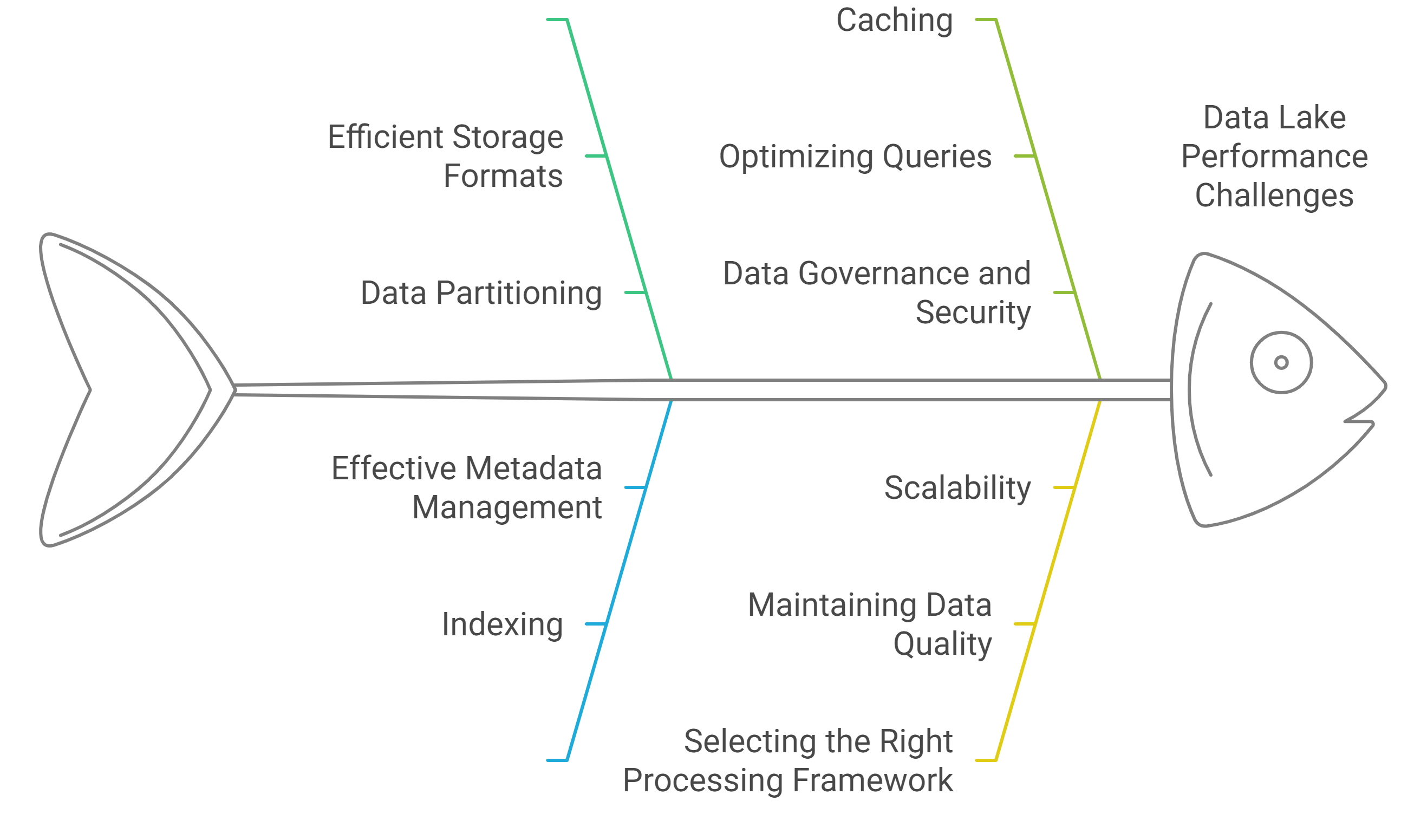
Performance in Data Lake
When discussing performance in a data lake, it refers to the efficiency with which data is stored, retrieved, and processed. To ensure high performance in a data lake, several factors need to be addressed:
- Efficient Storage Formats: Opt for optimized formats like Parquet or ORC, which store data in columns, allowing for better compression and faster retrieval, especially when dealing with large datasets.
- Data Partitioning: Dividing large datasets into smaller, more manageable parts (partitions) is crucial. For example, partitioning data by time, region, or product category ensures that only the relevant portion of data is accessed during queries.
- Indexing: Although data lakes are often schema-less, introducing indexes, when supported, or utilizing frameworks like Apache Hudi or Delta Lake, can accelerate query performance and make data access more efficient.
- Effective Metadata Management: Metadata helps in organizing and tracking the structure of data in a lake. Proper metadata management using tools like Apache Hive, AWS Glue, or Databricks Unity Catalog can greatly speed up data processing and query execution.
- Caching: Frequently accessed data can be stored in cache, which significantly reduces retrieval times for repeated queries. A caching layer can help in making data access more responsive.
- Optimizing Queries: Query engines such as Apache Spark, Presto, or AWS Athena can optimize SQL queries, particularly on large datasets. By leveraging distributed computing, these tools can run queries in parallel, improving overall performance.
- Data Governance and Security: While governance and security don’t directly impact performance, maintaining clear data access policies and ensuring encryption can prevent bottlenecks and help sustain operational efficiency.
- Scalability: One of the major benefits of data lakes is their ability to scale. Cloud storage platforms like AWS S3, Azure Data Lake, or Google Cloud Storage enable you to adjust storage capacity as needed. To maintain performance, it's crucial to ensure that your compute resources scale appropriately with the data.
- Maintaining Data Quality: High-quality, clean data reduces the need for time-consuming transformations or error handling, thus speeding up data processing and improving overall performance.
- Selecting the Right Processing Framework: Choose an appropriate data processing engine based on your needs. Solutions like Apache Spark, Flink, or Databricks are designed for handling large volumes of data, and you may opt for batch processing or real-time stream processing depending on your requirements.
2 min readMore
- I Am Datapedia!
Data Architecture
Data and AI Cognitive (DAC)Architecture
In today’s rapidly evolving technological landscape, the biggest challenge organizations face is, data integration and maintainability. With the exponential growth of data and the widespread adoption of AI technologies, businesses are increasingly grappling with the need to manage both effectively. Unfortunately, many traditional architectures treat data and AI as distinct entities, leading to a host of challenges that hinder an organization’s ability to innovate, scale, and adapt.
One of the primary issues with the traditional approach is, the fragmentation of data and AI systems into separate silos. Data is often stored and managed in one architecture, while AI models are built, trained, and deployed in another. This separation creates significant friction points.
To overcome these challenges, organizations must embrace a more integrated approach that treats data and AI as interconnected components of a single architecture.
4 min readMore
- I Am Datapedia!
Data Storage and Operations
Lakebase
While “Lakebase” may sound like a new term, its conceptual foundation is rooted in an established class of systems known as HTAP (Hybrid Transactional/Analytical Processing). HTAP systems emerged to break the artificial divide between OLTP and OLAP by enabling both workloads within a single environment. Lakebase carries this ambition forward, but fundamentally rearchitects it for the cloud-native, AI-first era.
Rather than merely merging OLTP and OLAP capabilities, Lakebase introduces a modernized architectural paradigm:
- Decoupled compute and storage
- Metadata-as-control-plane execution
- Branchable workloads and snapshot isolation
- AI-native compatibility and elastic serverless scaling
Lakebase doesn’t reinvent convergence, it modernizes it for distributed ecosystems that demand autonomy, agility, and intelligence.
FROM LEGACY FRAGMENTATION TO UNIFIED INTELLIGENCE
For decades, enterprises were shackled by siloed tooling:
3 min readMore
Build a strong foundation in Data & AI
Follow the Data Foundations learning path (Beginner to Advanced).