Once you sign in, your details will show here.
Knowledge Hub
+ New Topic
Filter (1)
Sort
383 topics · I Am Datapedia! · 10 shown
Show allEvery topic is free to read. A free account also lets you search the topics, react to a topic and comment under it.
- I Am Datapedia!
Data Modeling and Design
Data Modellingwith Graph Theory
Graph Theory offers an effective way to structure data as a graph, allowing efficient representation, querying, and analysis of relationships between data entities. This approach is particularly useful when relationships between data points are as important as the data itself. Here’s a guide to using Graph Theory for data modelling:
Why Use Graph Theory for Data Modelling?
- Natural Representation of Relationships: Graphs naturally represent relationships as edges between nodes. This is especially useful in situations like social networks, knowledge graphs, or hierarchical structures, where the connections are just as significant as the entities themselves.
- Flexibility: Graphs can handle evolving schemas and accommodate unstructured or semi-structured data. New nodes, edges, or properties can be added without needing to restructure the entire system.
- Efficiency in Traversal: Queries on connected data are faster with graph traversal algorithms compared to traditional relational databases. This is helpful for tasks like finding the shortest path, making recommendations, or identifying communities.
4 min readMore
- I Am Datapedia!
Data Modeling and Design
MetaGraph
A MetaGraph provides information about the structure, schema, and semantics of a knowledge graph within a graph database. It essentially acts as a "graph of metadata" that defines how entities (nodes) and their relationships (edges) are organized and interact, including their attributes, constraints, and interdependencies.
‘The Metadata of Knowledge Graphs in Graph Databases.’
In the world of data management, the term MetaGraph represents an advanced layer of abstraction that encompasses the metadata of a knowledge graph. While knowledge graphs are designed to represent relationships between entities, a MetaGraph serves as the blueprint that defines the structure, schema, and semantics of those relationships. This topic delves into the concept of MetaGraph, their importance, use cases, and their impact on the evolving landscape of graph databases.
MetaGraph is an enabler for a complete digital twin of simple to complex reality. The MetaGraph technology offers a cutting-edge approach to define, manage and utilizing metadata in a digital ecosystem – thus providing rich context to data across functions and systems. This is critical for AI, machine learning and data driven as quality in decisions based on facts become more central to industry transformations. The demand for high-quality, relevant data has never been greater. In the end the MetaGraph can enhance how businesses operate and innovate.
6 min readMore
- I Am Datapedia!
Data Modeling and Design
Knowledge Graph (KG)
Just like Row is the physical content in a Relational Database, Knowledge Graph (KG) is the physical content in a Graph Database.
Knowledge Graph (KG) integrates closely with Graph Theory, MetaGraph, Taxonomies, and Ontologies, acting as a unifying framework that bridges these concepts.
Let’s decode…..
A Knowledge Graph is a structured representation of knowledge, where entities (nodes) and their relationships (edges) are stored and queried in a graph format.
In a relational database, the schema (tables, columns, constraints) is empty until you populate it with rows (data). Similarly, the Knowledge Graph is the populated version of Graph Theory (structure), MetaGraph (metadata), Taxonomies (classification), and Ontologies (rules).
In Relational Database, Table Orders with columns OrderID, CustomerID, OrderDate having Rows with actual order records.
In Knowledge Graph, Nodes represent Customers and Orders; edges represent Purchases in this way i.e., (Customer: Alice) -[:Purchases {Date: '2023-12-12'}]-> (Order: #12345)
2 min readMore
- I Am Datapedia!
Data Integration and Interoperability
DAGs (Directed Acyclic Graphs) orExecuton Graph
An Execution Graph is a visual and logical representation of how tasks, operations, or computations are executed in a system. It shows the order in which activities run and how they depend on one another.
In data engineering and distributed computing, an execution graph is often represented as a Directed Acyclic Graph (DAG). “Directed” means tasks move in one direction. “Acyclic” means the graph does not loop back on itself. Once a task finishes, the flow moves forward.
In simple terms, an execution graph answers one important question:
What runs first, what runs next, and what depends on what?
Why Execution Graphs Matter
Modern data systems rarely execute tasks in a straight line. Instead, they perform multiple steps such as reading data, filtering, transforming, aggregating, and storing results. Some steps can run in parallel, while others must wait for previous tasks to complete.
An execution graph helps systems:
3 min readMore
- I Am Datapedia!
Data Modeling and Design
DOGs (Data Object Graphs)
DOGs, or Data Object Graphs, represent data objects and the relationships between them in the form of a graph. Instead of organizing data only in tables and rows, this approach visualizes data as connected objects.
In a Data Object Graph:
- A node represents a data object (such as Customer, Product, Order, or Employee).
- An edge represents a relationship between those objects (such as buys, works in, manages, owns).
This way of representing data focuses on how objects are connected rather than how they are stored.
Why Data Object Graphs Matter
Traditional relational systems organize data into tables. While this structure is powerful, it sometimes hides the complexity of relationships. In real-world business environments, data is deeply interconnected.
For example:
- A customer places multiple orders.
- An order contains multiple products.
- A product belongs to a category.
- An employee manages multiple customers.
3 min readMore
- I Am Datapedia!
Data Modeling and Design
Difference BetweenMetaGraph,Ontology andTaxonomy
In simple words, Graph Theory defines the structure i.e., data model, MetaGraph are the metadata, Taxonomies are the classifications, and Ontologies are the rules.
MetaGraph, Taxonomies, and Ontologies are essential tools in knowledge management, data governance, and AI, each serving distinct yet occasionally overlapping purposes. Below is a detailed breakdown of their characteristics and applications.
MetaGraph
MetaGraph represents metadata within a graph database or knowledge graph, providing a high-level overview of the data's structure, relationships, and properties.
Key Characteristics:
- Focus: Outlines the data model, specifying entities (nodes), relationships (edges), and their attributes.
- Structure: Functions like a schema, defining node and edge types, along with constraints.
Purpose:
- Aids in understanding the graph's structure.
- Supports data governance, lineage tracking, and semantic clarity.
- Enables enhanced searchability and automation by contextualizing graph content.
4 min readMore
- I Am Datapedia!
Metadata
Data Wrapping
Data Wrapping is the practice of augmenting raw data with additional layers of value, such as tools, metadata, and context, to make it easier to use, understand, and act upon. This process is crucial in transforming data from a passive resource into an actionable asset.
The Core Elements of Data Wrapping
Data wrapping goes beyond merely presenting raw data, it involves transforming it into a meaningful and actionable resource. Here are the core elements, expanded with practical insights:
1. Metadata and Context
Metadata acts as the "data about data," providing essential context that helps users interpret and utilize data effectively.
- What It Includes: Descriptions of data sources, timestamps, definitions, units of measurement, and relationships between datasets.
- Why It’s Important: Without metadata, users may misinterpret data or struggle to understand its significance.
- Example: A dataset tracking customer orders might include metadata about the region, the time zone in which orders were placed, and the categorization of product types.
5 min readMore
- I Am Datapedia!
AI and Machine Learning
RAG(Retrieval-Augmented Generation)
The widespread adoption of large language models (LLMs) has led to increased expectations for factual accuracy. However, LLMs often generate incorrect answers with confidence. A notable example is when users query general-purpose models like OpenAI’s “gpt-4o” or DeepSeek’s “DeepSeek-V3” about recent events or niche topics; they may decide not to respond or provide fabricated yet convincing responses. The leading industry solution to mitigate this issue is Retrieval-Augmented Generation (RAG), introduced in Retrieval-Augmented Generation for Knowledge-Intensive NLP Tasks (Lewis et al., 2020). RAG enhances LLMs by integrating external retrieval, ensuring more reliable and factual outputs while improving response contextuality and robustness.
Just like how a human is more likely to give a wrong answer when lacking information, AI models are more likely to make mistakes and hallucinate when they are missing context. For a given application, the model’s instructions are common to all queries, whereas context is specific to each query. By incorporating retrieval mechanisms, RAG enables LLMs to interact with real-time information, improving applications in search engines, customer support, academic research, and business intelligence. Unlike traditional search engines, which rely on keyword-based ranking, RAG synthesizes knowledge dynamically, allowing AI-driven solutions to be more adaptable and responsive. This chapter explores RAG’s framework, applications, implementation, security considerations, and future trends.
22 min readMore
- I Am Datapedia!
Others
Quantum Computing
Quantum computing is a revolutionary form of computation that leverages the principles of quantum mechanics, a branch of physics that describes how matter and energy behave at subatomic levels. Unlike classical computers that use bits (0 or 1), quantum computers use qubits, which can exist in multiple states simultaneously due to a phenomenon called superposition.
This fundamental shift introduces a new way to process information, offering exponential speedups for certain problems, potential cost savings, and the ability to solve previously infeasible tasks in cryptography, optimization, healthcare, finance, and more.
Key Quantum Concepts
1. Superposition
- Definition: A qubit can exist in a combination of both 0 and 1 states at the same time until measured.
- Analogy: Imagine a person who is simultaneously present in every room of a house. Only when you check a room do you know where the person is.
- Implication: Enables quantum computers to process many possibilities in parallel.
4 min readMore
- I Am Datapedia!
Data Storage and Operations
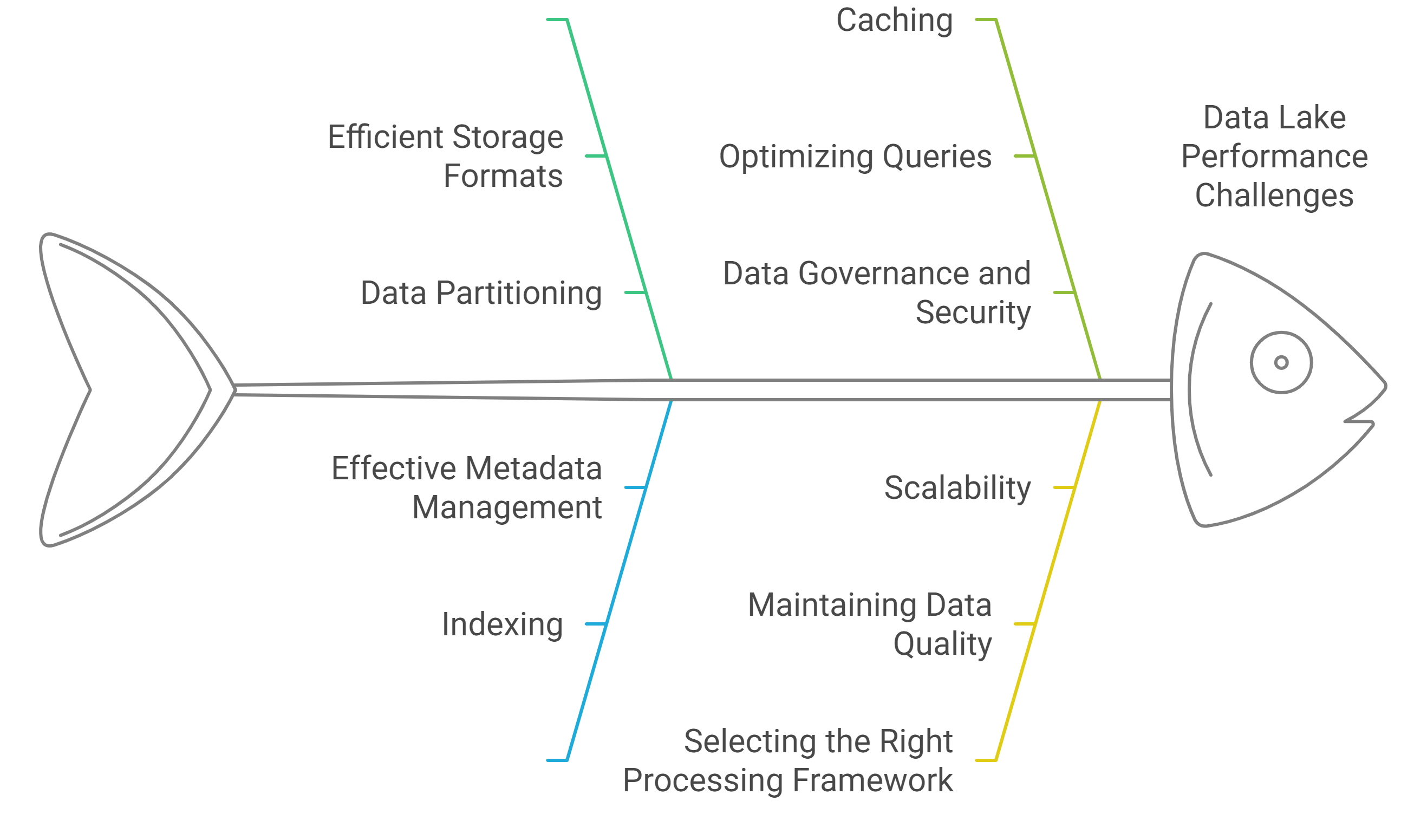
Performance in Data Lake
When discussing performance in a data lake, it refers to the efficiency with which data is stored, retrieved, and processed. To ensure high performance in a data lake, several factors need to be addressed:
- Efficient Storage Formats: Opt for optimized formats like Parquet or ORC, which store data in columns, allowing for better compression and faster retrieval, especially when dealing with large datasets.
- Data Partitioning: Dividing large datasets into smaller, more manageable parts (partitions) is crucial. For example, partitioning data by time, region, or product category ensures that only the relevant portion of data is accessed during queries.
- Indexing: Although data lakes are often schema-less, introducing indexes, when supported, or utilizing frameworks like Apache Hudi or Delta Lake, can accelerate query performance and make data access more efficient.
- Effective Metadata Management: Metadata helps in organizing and tracking the structure of data in a lake. Proper metadata management using tools like Apache Hive, AWS Glue, or Databricks Unity Catalog can greatly speed up data processing and query execution.
- Caching: Frequently accessed data can be stored in cache, which significantly reduces retrieval times for repeated queries. A caching layer can help in making data access more responsive.
- Optimizing Queries: Query engines such as Apache Spark, Presto, or AWS Athena can optimize SQL queries, particularly on large datasets. By leveraging distributed computing, these tools can run queries in parallel, improving overall performance.
- Data Governance and Security: While governance and security don’t directly impact performance, maintaining clear data access policies and ensuring encryption can prevent bottlenecks and help sustain operational efficiency.
- Scalability: One of the major benefits of data lakes is their ability to scale. Cloud storage platforms like AWS S3, Azure Data Lake, or Google Cloud Storage enable you to adjust storage capacity as needed. To maintain performance, it's crucial to ensure that your compute resources scale appropriately with the data.
- Maintaining Data Quality: High-quality, clean data reduces the need for time-consuming transformations or error handling, thus speeding up data processing and improving overall performance.
- Selecting the Right Processing Framework: Choose an appropriate data processing engine based on your needs. Solutions like Apache Spark, Flink, or Databricks are designed for handling large volumes of data, and you may opt for batch processing or real-time stream processing depending on your requirements.
2 min readMore
Build a strong foundation in Data & AI
Follow the Data Foundations learning path (Beginner to Advanced).