Your Organisation Doesn't Have a Data Problem. It Has Too Many Versions of the Truth.
From the book I Am Datapedia!, published here free by the author.
Let me give you a familiar scenario.
The Finance team reports 125,000 customers.
The Sales team reports 138,000.
Marketing has 142,000 in its dashboard.
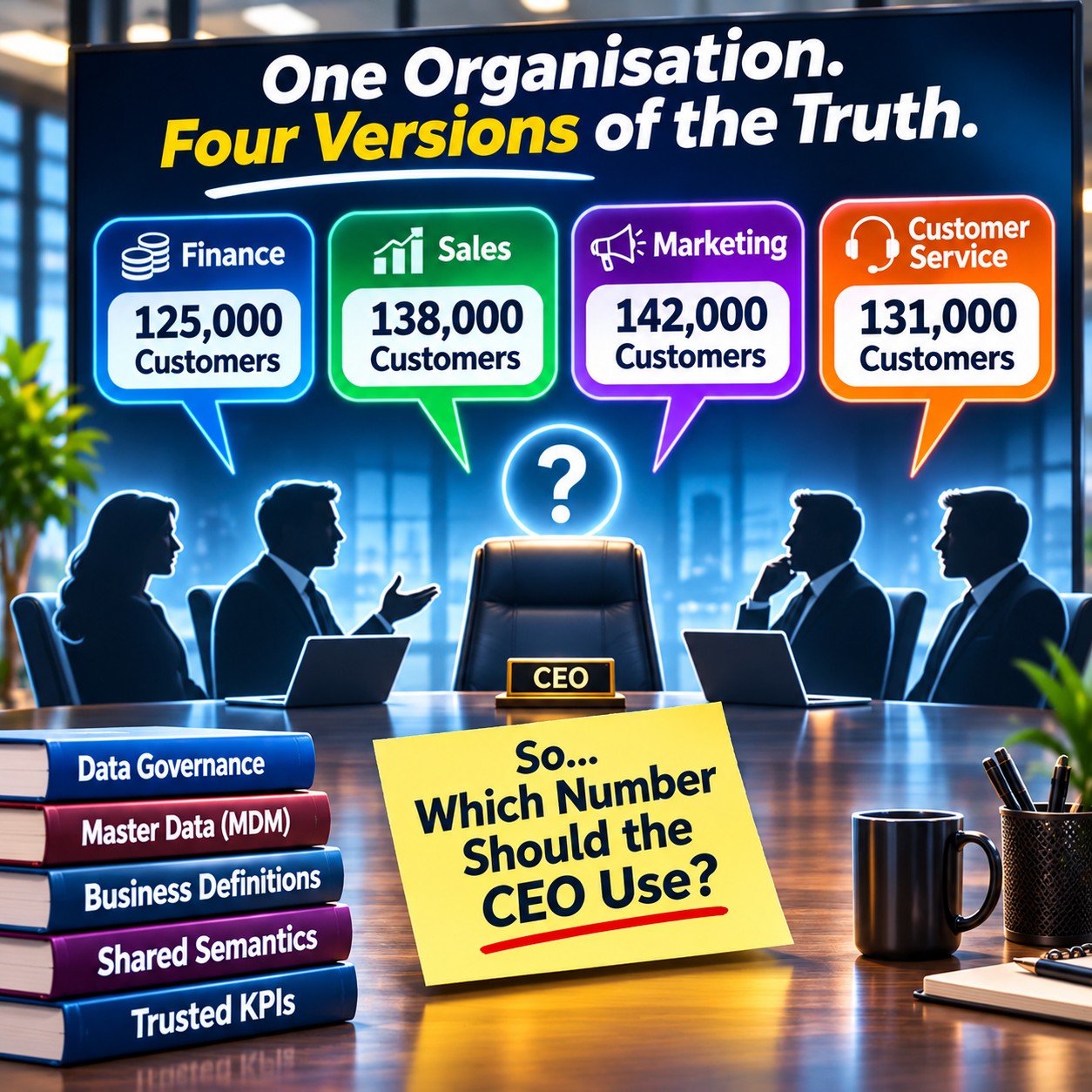
And the Customer Service team has a completely different number.
Everyone is using data. Everyone has a dashboard. Everyone believes their numbers are correct.
So, which number should the CEO use?
This is not necessarily a technology problem. It is often a business definition, ownership, and alignment problem.
What exactly is a customer?
Does a registered user count as a customer? What about someone who has made one transaction? What about inactive customers? What about duplicate records across different business units?
The same challenge exists with revenue, active users, products, suppliers, profitability, customer retention, and almost every important business KPI.
Over the years, organisations have invested heavily in data platforms, warehouses, lakes, integration technologies, BI tools, and now AI.
But we sometimes overlook something fundamental:
Do we actually agree on what our data means?
Now bring AI into the picture.
We are asking AI to analyse business performance, identify opportunities, recommend actions, and increasingly make decisions.
But what happens when different systems provide different definitions of the same business entity?
AI can process all those numbers very efficiently. It can generate impressive reports and convincing explanations.
But processing inconsistent information faster does not make the information consistent.
In fact, we may end up automating our disagreements!
I believe this is one of the important responsibilities of Data Leadership.
We need to establish common business definitions, shared semantics, clear ownership, trusted master data, and consistent KPI calculations across the enterprise.
Not simply to make dashboards look consistent, but to ensure that different parts of the organisation are making decisions based on the same understanding of the business.
And this becomes even more important as we move towards Agentic AI.
Imagine multiple AI agents making decisions for Finance, Sales, Marketing, and Operations, each using a different interpretation of the same business information.
We could end up with perfectly functioning agents delivering conflicting business outcomes.
The next challenge for CDOs may not be getting more data into the organisation. It may be getting the entire organisation to agree on what its data actually means.
My question to Data & AI leaders:
Does your organisation have one agreed definition of its most important business KPIs, or does the answer still depend on which department you ask?
#ChiefDataOfficer #DataLeadership #DataGovernance #DataManagement #EnterpriseAI #BusinessIntelligence #AgenticAI
Nothing about your reading is stored. Your reactions and comments are kept with your account.
Express your reaction
Your Take on This Insight?
Share how this content resonates with you.
3 reactionsSign in to react or comment
Comments (3)
Maarten H.17 Nov 2026
It all revolves around business definitions. If the CEO doesn't clarify which definition s.he wants to be used in reports s.he gets, s.he will get them all, and all are valuable in their own context. Confusion arrises when no decision is made on what the CEO/Corporate definition should be, that is a C-level problem. So one shouldn't blame the messengers.
Mustafa T.17 Nov 2026
@Maarten H. Absolutely. That's an important distinction. Different business definitions can all be valid within their respective contexts. The real issue is the absence of an agreed corporate definition and clear decision-making at the C-suite level. Data teams can provide the facts, highlight inconsistencies, and facilitate alignment, but the business must own the decision. We shouldn't blame the messengers for a decision that leadership hasn't made.
Maarten H.17 Nov 2026
So the people creating the reports should press the C-suite to decide or laugh at them when they don't and keep comming up with different answers on purpose.
Free account
You can read every topic without one. A free account lets you react to this topic, comment under it and search the Knowledge Hub. Reacting and commenting need a confirmed e-mail address.