Are We Using AI Agents to Build Solutions, or to Actually Run Them? There Is a Big Difference.
From the book I Am Datapedia!, published here free by the author.
Are We Using AI Agents to Build Solutions, or to Actually Run Them? There Is a Big Difference.
I have been thinking about two very different ways organisations are approaching Agentic AI.
Option 1: Use AI agents to build solutions.
Give agents a business problem, requirements, architecture guidelines, and the necessary tools. Let them collaborate to analyse, design, develop, test, optimise, and document a solution.
Humans remain responsible for the direction, architecture, validation, and final decisions.
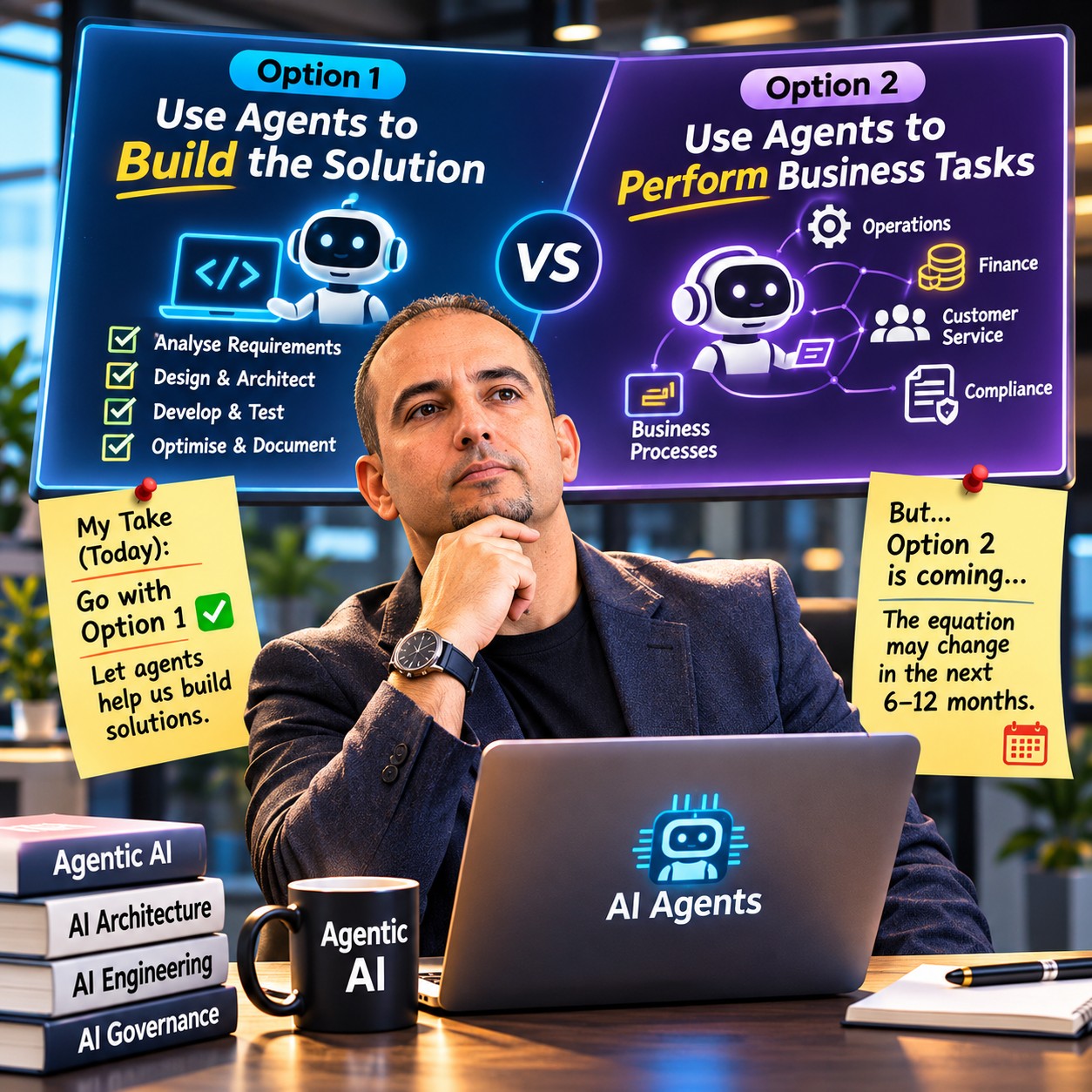
Option 2: Use AI agents to perform business tasks.
Instead of simply helping us build a solution, agents become part of the business operation itself.
They access enterprise systems, retrieve information, make decisions, trigger workflows, communicate with other systems, and execute tasks with varying degrees of autonomy.
Now, both approaches are exciting. But I believe there is a significant difference in the level of trust and maturity required.
With Option 1, we are using AI to accelerate the development process. We can review the code, test the outputs, validate the solution, and retain control before anything reaches production.
With Option 2, we are allowing AI to participate directly in business operations. A wrong decision, incorrect interpretation, or unexpected action can have consequences beyond a piece of code that needs fixing.
Think about financial transactions, customer onboarding, regulatory reporting, supplier payments, credit decisions, or changes to critical enterprise data.
These are not simply coding challenges. They involve business accountability, decision rights, security, governance, and operational risk.
So, where do I stand today?
With the current level of AI maturity, I would lean towards Option 1.
Let agents help us build solutions. Let multiple specialised agents collaborate across development, testing, documentation, architecture, and optimisation.
But when it comes to executing business tasks, I would introduce autonomy progressively, starting with clearly defined responsibilities, controlled permissions, measurable outcomes, and human approval where required.
I am not saying Option 2 is not possible. We are already seeing progress in that direction.
But I believe the balance could look very different in the next 6-12 months. AI capabilities are evolving rapidly, and the boundaries between building, operating, and managing solutions may change considerably.
Perhaps the question is not whether agents can do both.
The real question is: Have we built enough trust, governance, and control to let them do both?
How are you approaching this distinction in your organisation?
#AgenticAI #EnterpriseAI #AIArchitecture #AIStrategy #AIEngineering #DigitalTransformation #DataLeadership
Nothing about your reading is stored. Your reactions and comments are kept with your account.
Express your reaction
Your Take on This Insight?
Share how this content resonates with you.
1 reactionSign in to react or comment
Comments (3)
Maarten H.16 Nov 2026
I would add 'understanding' to: The real question is: Have we built enough trust, governance, and control to let them do both? Or should that be: have we limited the freedoms of the agents enough to be sure they will act within the boudaries we want them in.
Mustafa T.16 Nov 2026
@Maarten H. I like the addition of "understanding". Trust, governance, control, and understanding all matter. I particularly agree with your point about limiting agent autonomy. We need to give agents enough freedom to be effective, but clearly define the boundaries within which they can operate, when they must seek approval, and when they must stop. Autonomy without boundaries can quickly become a liability! 😄
Mustafa T.16 Nov 2026
As this is the first formal post on Data & AI Nexus which I have share with Global Audience. I will take wait and see how many comes and comments on the portal itself. @Bill I.
Free account
You can read every topic without one. A free account lets you react to this topic, comment under it and search the Knowledge Hub. Reacting and commenting need a confirmed e-mail address.