Data & AI Cognitive Architecture - Chapter#1: Structural Failure of Enterprise Data Architecture
From the book I Am Datapedia!, published here free by the author.
Enterprise data architecture is failing. Not because organizations lack investment, or because the problem is inherently too complex, but because the structure required to hold these ecosystems together is either weak or absent. As data landscapes stretch across domains, platforms, and workloads, coherence simply does not sustain itself. Below diagram show the potentiate challenges faced by different persona(s) in an organization.
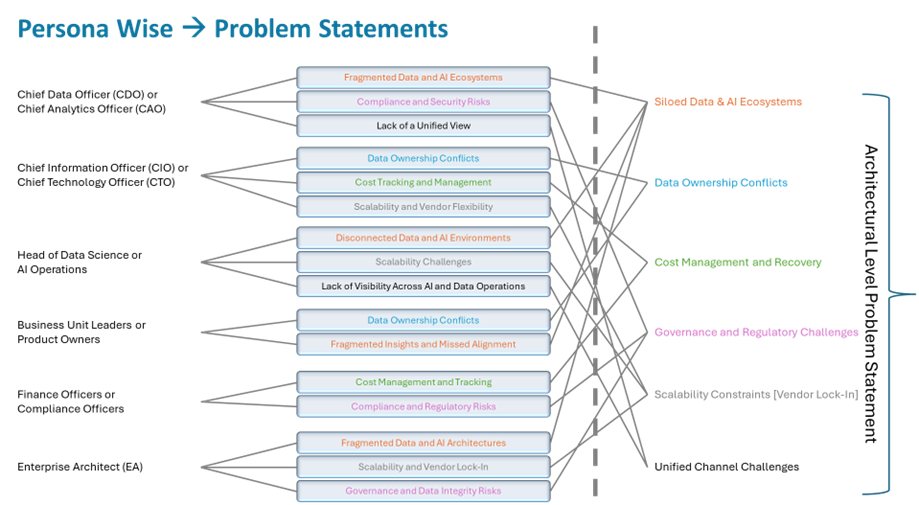
Over the past decade, there has been no shortage of progress. Cloud-native platforms, lakehouse patterns, distributed processing, governance tooling - none of this is immature anymore. And yet the outcomes tell a different story. Environments expand, but alignment erodes. Governance becomes more visible, more documented, more discussed - but less effective in practice. Analytical capability grows, but trust lags behind, sometimes significantly. These are not isolated execution failures. They point to something more fundamental.
Most architectures are built to enable. They focus on access, flexibility, integration. What they don’t do - at least not in any enforceable way - is constrain behavior. How data enters the system varies. How it moves across domains is often negotiated rather than controlled. Consumption evolves based on local needs, not architectural discipline. Once those boundaries are left open, divergence doesn’t creep in - it’s introduced immediately, at the edges, and then carried forward. You end up with a landscape where each environment operates on its own terms. Ingestion patterns differ. Transformation logic reflects local interpretation. Consumption interfaces evolve independently. What looks like a distributed system is, in reality, a collection of loosely related systems.
Data stops behaving like an enterprise asset and starts behaving like a set of localized artifacts. Definitions drift. Lineage breaks down. Governance, at that point, becomes observational - it reports on divergence rather than preventing it.
None of the dominant architectural models have fully resolved this. Centralized approaches maintain control, but at the cost of adaptability. They struggle when distribution becomes a requirement rather than an exception. Decentralized models swing in the opposite direction - ownership is distributed, flexibility increases, but discipline fades and divergence accumulates quickly. Federated models attempt to balance the two, but in practice they depend on alignment and shared standards that are rarely enforced. Without hard boundaries, federation tends to erode over time into decentralization. The pattern underneath all of this is consistent. Architecture defines intent. It does not ensure adherence. Principles, patterns, and policies assume coordination across teams. At small scale, that might hold. At enterprise scale, it doesn’t.
Fragmentation starts early - at ingestion. Multiple pipelines are built to the same source systems, each slightly different. Extraction logic varies. Refresh cycles don’t align. Even interpretation of the same source data begins to diverge. That variation isn’t corrected - it propagates. From there, it compounds. Data is replicated across platforms to serve different workloads. Each environment reshapes it according to its own objectives. Over time, transformation logic drifts. Metadata becomes inconsistent, sometimes incomplete. Lineage exists in fragments, if at all. What you’re left with is not a shared foundation, but a series of parallel interpretations. As the system grows, so does the problem. Every additional pipeline, every replication point, every transformation layer introduces more divergence. There is no natural mechanism that pulls the system back toward alignment.
Capability increases. Structural integrity weakens.
At some point, the symptoms become hard to ignore. Core business entities - customers, products, transactions - start appearing in multiple forms that don’t reconcile cleanly. Alignment is no longer a design property; it becomes an operational burden. Teams coordinate, negotiate, and manually reconcile, often under time pressure. The absence of an authoritative dataset isn’t accidental - it reflects a lack of structural control upstream. Operationally, the impact is immediate. Ingestion inconsistencies lead to different data states across environments. Independent transformations produce outputs that cannot be directly compared. Metadata gaps obscure lineage, making it difficult to understand how data was derived. Reconciliation becomes routine, not exceptional.
Then AI enters the picture and accelerates everything. AI workloads demand rapid iteration, repeated training, and access to data across domains. When the governed paths can’t keep up, teams build around them. Parallel pipelines appear. Data is copied, reshaped, and used outside existing structures. Those parallel paths don’t stay temporary. They harden. Feature engineering happens in isolation. Training pipelines evolve independently. Over time, what was once a single architecture starts to look like multiple ecosystems, each with its own logic, its own data, its own assumptions.
This has direct consequences for decision-making. The same entity is defined differently depending on where you look. Analytical outputs vary because the underlying data and transformations differ. Consistency becomes situational. Trust becomes conditional. Machine learning systems amplify the problem further. Models inherit the assumptions embedded in their training data. Move them to another environment, and those assumptions don’t always hold. Results shift. Reproducibility breaks down. Without consistent lineage and metadata, it’s difficult to even understand why. Governance doesn’t disappear - but it weakens. Data spans multiple systems, each with its own policies, its own gaps. Visibility fragments. Enforcement becomes partial at best. What remains is coordination - manual, ongoing, and increasingly expensive as the system grows. Cost follows the same pattern. Duplicate pipelines, redundant storage, repeated transformations - they accumulate quietly. Multiple teams pay to maintain variations of the same data. Attribution becomes fuzzy because ownership is obscured by duplication.
These effects reinforce each other. Divergence leads to duplication. Duplication increases inconsistency. Inconsistency reduces trust. Reduced trust drives more localized data creation. The system doesn’t stabilize - it drifts further.
And recovery is not straightforward. Aligning datasets means coordinating across teams with entrenched dependencies and differing interpretations. Transformation logic has to be reconciled, often at the expense of existing workflows. The longer divergence persists, the more expensive it becomes to correct. At a certain point, incremental fixes stop working. Restoring coherence requires structural intervention - redefining pipelines, standardizing transformations, consolidating datasets. These are not small changes. They cut across both operational and analytical layers.
The underlying issue is not scale, or distribution, or even the introduction of AI. It’s the absence of control over how data enters, moves, and is consumed. Policies set expectations, but they don’t enforce behavior. In distributed environments, that distinction matters. If coherence is the goal, control cannot remain optional. It has to be built into the architecture itself. Data entry follows defined validation and standardization rules. Movement across domains is governed, not negotiated. Consumption happens through consistent, controlled interfaces. These are not guidelines - they define how the system operates. This is where Data & AI Cognitive (DAC) Architecture comes in. Not as another variation of existing models, but as a structural correction. It defines control points that are not negotiable. Domains retain autonomy, but only within those boundaries. They don’t decide how data enters, how it moves, or how it is exposed. That is defined once - and enforced
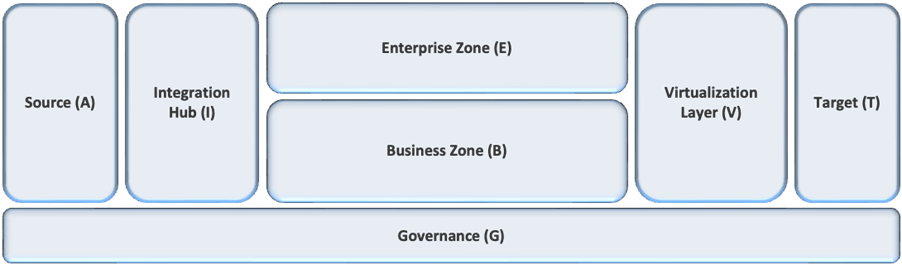
.For a long time, enterprise data architecture has prioritized enablement over control. That trade-off doesn’t hold at scale. Structural control isn’t an enhancement layered on top. It’s the condition required for the architecture to function at all. This didn’t happen overnight. It’s the result of how the industry has responded to scale. Centralized models enforced control but couldn’t keep up with demand. Decentralized approaches restored responsiveness but lost discipline. Federated models tried to bridge the gap, but relied too heavily on coordination. Without hard boundaries, they drifted.
What we see now is the outcome of that progression - capability without constraint. DAC doesn’t introduce a new direction as much as it closes a gap that has been there all along.
Nothing about your reading is stored. Your reactions and comments are kept with your account.
Express your reaction
Your Take on This Insight?
Share how this content resonates with you.
0 reactionsSign in to react or comment
Comments (0)
No comments yet.
Free account
You can read every topic without one. A free account lets you react to this topic, comment under it and search the Knowledge Hub. Reacting and commenting need a confirmed e-mail address.