We Thought We Didn't Need Data People Anymore. Until It Was Time to Put AI-Built Solutions into Production.
From the book I Am Datapedia!, published here free by the author.
Visionaries and business users thought that because they understand their business, know their problems, understand their use cases, and now have Vibe Coding and AI-assisted development at their fingertips, they could build things themselves.
So they began asking:
"Why do we need Data people? We understand the business. We know what we want to build. And AI can help us build it."
And to be fair, the early results look promising.
POCs went well.
Pilots went well.
Applications were built. Dashboards were created. Workflows were automated.
Everyone is excited.
But now comes the interesting part.
Now it's time to bring in the actual enterprise data.
Now it's time for proper user acceptance testing.
Now it's time to fix data quality issues that nobody noticed during the POC.
Now it's time to optimise the code because compute consumption is increasing, cloud costs are approaching budget limits, and the expected ROI is taking a hit.
Now it's time to optimise storage, remove unnecessary data duplication, and manage growing volumes.
Now it's time to integrate with existing enterprise systems, deal with incompatible data structures, and resolve dependencies.
Now it's time to migrate from legacy technologies to newer platforms without disrupting business operations.
Now regulatory bodies are asking questions. We need to produce compliance reports, demonstrate data lineage, maintain audit trails, and prove where the data came from and how it was transformed.
Now business leaders want transparent and trusted KPIs. We need to reconcile different definitions, validate calculations, and ensure everyone is looking at the same numbers.
And that's not all.
Who is responsible for master data when multiple applications create different versions of the same customer, product, or supplier?
Who defines and enforces data access controls, privacy, retention, and protection of sensitive information?
Who ensures that confidential information is not exposed through AI-generated applications?
Who manages API integrations, data contracts, schema changes, and dependencies between systems?
Who establishes data ownership and makes sure business teams take responsibility for the quality of the data they create?
Who monitors data pipelines, failed loads, broken integrations, and unexpected changes in production?
Who ensures that AI models and agents are using trusted, relevant, and up-to-date information?
Who manages metadata, business definitions, and documentation so that the solution remains understandable and maintainable?
Who plans for disaster recovery, business continuity, scalability, and long-term support?
And who takes responsibility when the person who built the original solution leaves the organisation?
Suddenly, the conversation becomes a little different.
"Can we get someone from the Data team to help?"
"Do we have a Data Architect?"
"Who owns our Data Governance?"
"Can we get a CDO involved?"
And then comes the classic conversation:
"What Data team? Who CDO?"
"Okay, can we find someone who can help us with all these things?"
"Well, we don't really have anyone."
"No problem. We have Vibe Coding! Let's ask AI. We can try a few prompts, generate some more code, and use a little hit-and-trial. I'm sure we'll get there."
"Are we sure this is what we actually need?"
Silence.
"Fine. Can we hire a CDO and build a Data team?"
"Yes, we can. But experienced Data & AI professionals are now in high demand. They may cost three times what we expected."
"Three times? That's expensive!"
"Okay, let's not hire them. We'll do it ourselves."
And that's when someone quietly points out:
"Just a thought. We might spend ten times more time figuring out what an experienced Data professional could have helped us solve in a fraction of that time."
Suddenly, hiring doesn't look quite so expensive anymore! 🙂
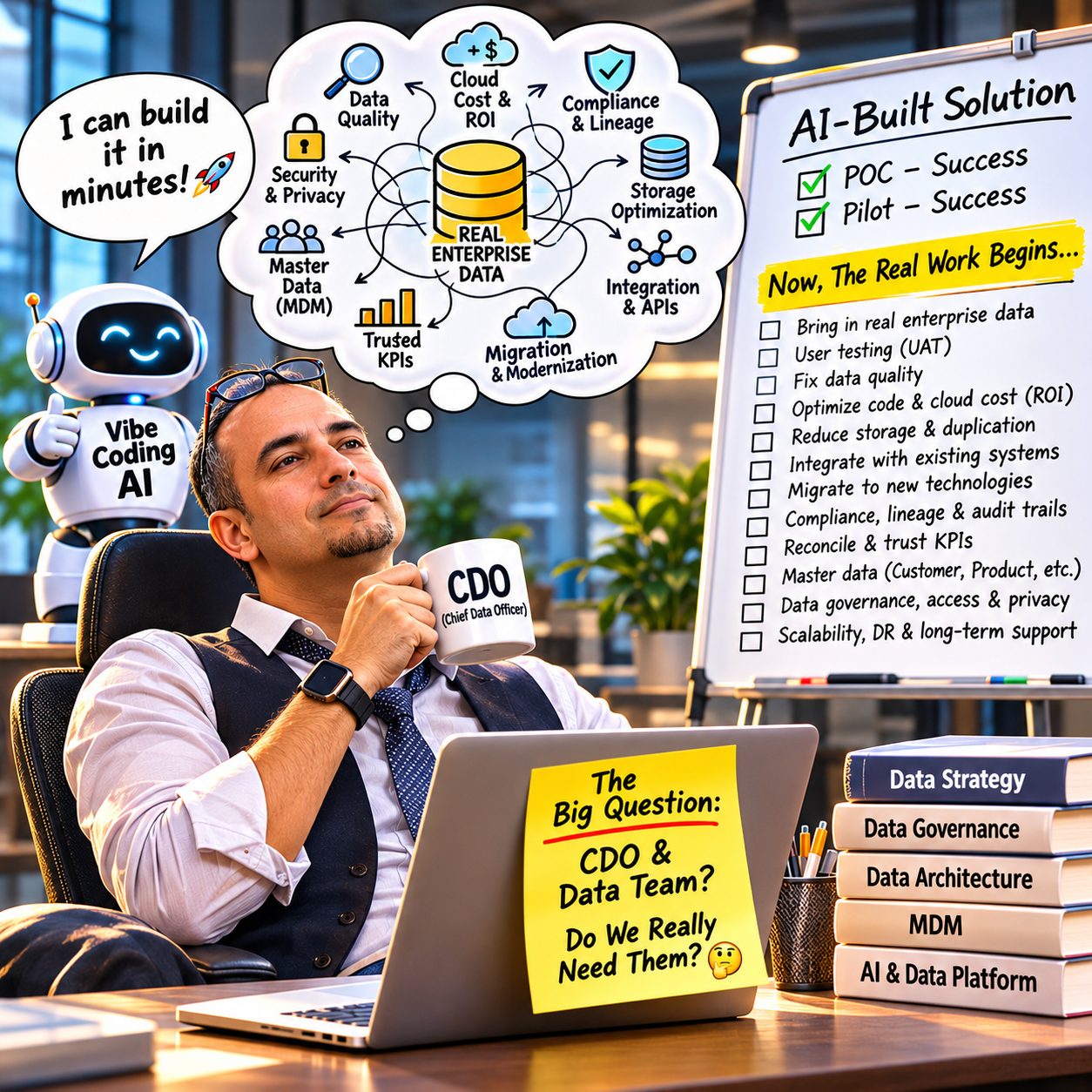
Of course, I'm not suggesting that every business user needs to become a data engineer, or that every organisation needs a large centralised Data team. And I certainly don't want to discourage Vibe Coding. It is an incredible opportunity to accelerate innovation and put more power into the hands of business teams.
But building a working POC is one thing. Making it secure, reliable, compliant, cost-efficient, scalable, and sustainable in an enterprise environment is another.
You can use AI to generate code in minutes. But you cannot generate decades of enterprise Data Management experience simply by writing a better prompt.
Perhaps this is why CDOs and Data teams are not becoming less relevant in the AI era. Their role is becoming even more important.
My question to business leaders and visionaries:
Have we really reached a point where we no longer need Data professionals, or have we simply not reached the stage of our AI journey where we realise how much we still need them?
#ChiefDataOfficer #CDO #DataManagement #VibeCoding #EnterpriseAI #DataLeadership #AITransformation
Nothing about your reading is stored. Your reactions and comments are kept with your account.
Express your reaction
Your Take on This Insight?
Share how this content resonates with you.
3 reactionsSign in to react or comment
Comments (1)
Maarten H.14 Nov 2026
For so long the value of the essence of compute, the data , was put asside. It was process related material. Now only it becomes visible how much value can be drawn there. Well, businesses are about processes, aren't they?
Free account
You can read every topic without one. A free account lets you react to this topic, comment under it and search the Knowledge Hub. Reacting and commenting need a confirmed e-mail address.