Sometimes the Best Technology Decision Is to Switch Something Off.
From the book I Am Datapedia!, published here free by the author.
I have seen organisations invest years building data platforms, introducing new technologies, and expanding their enterprise architecture. Over time, these investments become part of the technology landscape.
Then something interesting happens.
A new platform is introduced, but the old one stays. A new data warehouse is built, but the previous warehouse continues running. A new reporting solution is launched, but business users still depend on the old reports. Another integration layer is added because replacing the existing one is considered too difficult.
Eventually, the organisation is operating multiple generations of technology, often solving similar problems in slightly different ways.
And nobody really wants to switch anything off.
There are understandable reasons. Dependencies are complicated, business users are comfortable with existing systems, migration carries risk, and nobody wants to be responsible for an outage.
But there is a cost to keeping everything.
We pay for infrastructure, licences, support, maintenance, specialist skills, integrations, and operational complexity. More importantly, we spread our investment and attention across capabilities that may no longer justify their existence.
I believe this is an important part of the CDO and CIO agenda that doesn't receive enough attention.
We spend considerable time discussing what to build, what to buy, and what to modernise. But how often do we have an equally serious discussion about what to retire?
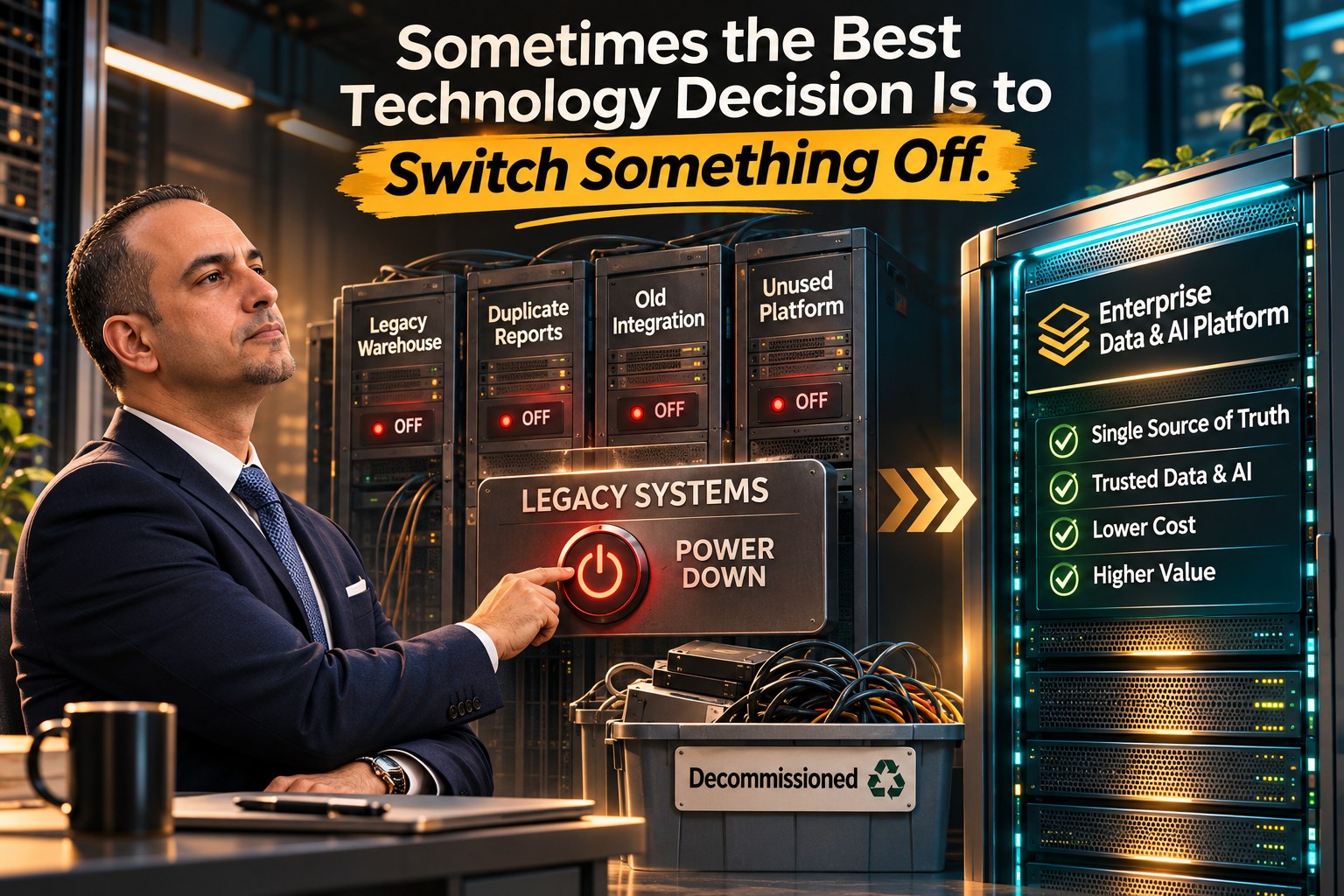
A mature Data & AI strategy should not only define the future-state architecture. It should also define how we get there, including which capabilities will be consolidated, replaced, migrated, or switched off.
And this needs to be treated as a business decision, not just a technical exercise. The business case for retiring a platform should consider its true operating cost, business dependencies, risk, and the opportunity to redirect investment towards more valuable capabilities.
Technology investments should have a purpose, a lifecycle, and eventually, an exit strategy.
A question for fellow CDOs and CIOs:
When was the last time your organisation approved a technology investment specifically to retire an existing platform, rather than introduce another one?
#ChiefDataOfficer #DataStrategy #TechnologyStrategy #EnterpriseArchitecture #DataManagement #DigitalTransformation #ITLeadership
Nothing about your reading is stored. Your reactions and comments are kept with your account.
Express your reaction
Your Take on This Insight?
Share how this content resonates with you.
2 reactionsSign in to react or comment
Comments (2)
Faisal M.12 Nov 2026
Great question, though I think it needs to be directed at CFOs rather than CDOs or CIOs. People often assume we live in a technology-driven world, but in reality, it is a money-driven world led primarily by CFOs. They are the ones holding the purse strings, and the real question is: when was the last time a CIO made retiring legacy systems a discussion point, and how did the CFO respond? I see technology as a wild horse, and CFOs are the ones trying to tame it and keep it under control. While keeping the reins tight on costs is necessary, CFOs too often lose sight of the real potential of this stallion and the true cost of keeping old stables running. When they focus purely on short-term control, they end up funding maintenance over momentum, holding back the very power that could carry the business forward.
Mustafa T.12 Nov 2026
@Faisal M I like the wild horse analogy! 😄 I agree that CFOs have a critical role because every technology decision ultimately competes for financial resources. But I also believe CDOs and CIOs must do a better job of translating technology complexity into business value, including the hidden cost of maintaining legacy environments. The real partnership is when CFOs challenge the investment, and technology leaders demonstrate both the cost of doing nothing and the value of moving forward.
Free account
You can read every topic without one. A free account lets you react to this topic, comment under it and search the Knowledge Hub. Reacting and commenting need a confirmed e-mail address.