Once you sign in, your details will show here.
Knowledge Hub
+ New Topic
Filter (1)
Sort
372 topics · Article · 10 shown
Show allEvery topic is free to read. A free account also lets you search the topics, react to a topic and comment under it.
- I Am Datapedia!
Data Modeling and Design
Event-Driven Data Modelling
Event-Driven Data Modelling structures data around events, discrete occurrences that capture something that has happened, typically with a timestamp and contextual details. Instead of centering the model on static entities such as Customer or Loan, this approach treats events as the primary unit of design. Each event represents a fact in time.
The goal of event-driven modelling is to enable real-time processing, streaming architectures, and event sourcing patterns. By designing systems around events, organizations can react immediately to business activity while maintaining a complete, replayable history of what occurred.
In this model, the focus shifts from storing the current state of entities to recording event streams. Events are immutable and append-only. Once an event is written, it is never updated or deleted. Typical events in a loan approval domain might include LoanApplicationSubmitted, LoanApplicationApproved, or RepaymentMade. Each event contains identifying information, contextual data, and a timestamp.
3 min readMore
- I Am Datapedia!
Data Modeling and Design
Json / Xml Schema Modelling
JSON / XML Schema Modelling is the practice of defining structured schemas for semi-structured data formats such as JSON and XML. These schemas specify the allowed structure, elements, datatypes, and constraints of documents to ensure consistency, validation, and interoperability across systems. Rather than focusing on database storage, this modelling technique focuses on structured data exchange.
The primary goal of JSON / XML Schema Modelling is to provide a clear and enforceable contract for APIs, integration workflows, and document-based systems. When multiple applications exchange data, they must agree not only on the names of fields but also on their structure, required attributes, data types, and validation rules. A schema formalizes these expectations and prevents inconsistent or malformed data from entering the system.
In this approach, schemas define elements, nesting rules, datatypes, required fields, and sometimes value constraints. For example, a Loan schema might define that LoanID is a required string, LoanAmount is a numeric field greater than zero, and Status must be one of a predefined set of values. The schema ensures that every system sending or receiving loan data adheres to the same structural rules.
3 min readMore
- I Am Datapedia!
Data Modeling and Design
API / Service Data Modelling
API / Service Data Modelling is the practice of designing the data contracts and structures that define how information is exchanged between services, applications, and systems. Rather than focusing on how data is stored internally, this approach concentrates on how data is exposed, requested, and consumed across interfaces.
The primary goal of API / Service Data Modelling is to ensure clarity, consistency, and stability in data exchanged across APIs and services. Well-designed API models reduce integration complexity, prevent misunderstandings between systems, and minimize runtime errors. They act as formal contracts between service providers and service consumers.
In this approach, the model defines the structure of inputs and outputs. For example, a Loan Application API may specify required request fields such as CustomerID, LoanAmount, and Term. The response may include fields such as LoanID, ApprovalStatus, and InterestRate. These definitions establish what data must be provided, what data will be returned, and under what rules. The emphasis is not on database tables but on message structures.
4 min readMore
- I Am Datapedia!
Data Modeling and Design
Temporal Data Modelling
Temporal Data Modelling is the practice of structuring data so that changes over time are explicitly captured and preserved. Instead of storing only the current state of information, temporal models record how data has evolved, enabling systems to answer questions about the past, the present, and even planned future states.
The primary goal of Temporal Data Modelling is to enable time-aware queries, regulatory compliance, auditing, and historical analysis. In many industries, especially banking, insurance, healthcare, and government, organizations must demonstrate not only what data looks like today, but what it looked like at a specific point in time.
Temporal modelling distinguishes between different types of time. Valid Time refers to when a fact is true in the real world. For example, an interest rate may be valid from January to March. Transaction Time refers to when the fact was recorded in the system. A correction entered in February about a January event has a different transaction time from its valid time. When both are captured together, the model is called bi-temporal.
3 min readMore
- I Am Datapedia!
Data Modeling and Design
3NF Data Modelling(bill Inmon)
3NF Data Modelling, championed by Bill Inmon, organizes enterprise data in a normalized structure, typically Third Normal Form (3NF), to build a centralized Enterprise Data Warehouse (EDW). The warehouse is subject-oriented, integrated, time-variant, and non-volatile, serving as the authoritative single source of truth for the organization.
The primary goal of a 3NF Data Warehouse is to create a consistent and governed enterprise data foundation. By eliminating redundancy and enforcing referential integrity, the EDW ensures that core entities such as Customer, Loan, Officer, and Product are defined once and integrated across all source systems. This approach prioritizes data quality, traceability, and long-term governance over direct query performance.
In this architecture, data from operational systems is extracted, cleansed, standardized, and loaded into normalized tables. For example, Customer data from a CRM system and Customer data from a Core Banking system are reconciled and integrated under a single enterprise identifier. Loan terms, balances, approval decisions, and officer assignments are stored in separate but related 3NF tables, each with clearly defined primary and foreign keys. Redundancy is minimized, and relationships are explicitly maintained.
4 min readMore
- I Am Datapedia!
Data Modeling and Design
Dimensional Data Modelling
Dimensional Data Modelling is an analytical modelling approach that structures data into facts (quantitative measures) and dimensions (descriptive attributes) to support reporting, dashboards, and business intelligence. It provides a simplified, performance-oriented representation of organizational data, making analytics accessible to both technical and business users.
The primary goal of dimensional modelling is to deliver a business-friendly and performance-optimized structure that enables fast and intuitive access to information. Rather than focusing on eliminating redundancy at all costs, dimensional modelling focuses on making data easy to query, aggregate, and understand.
Dimensional models are organized around business processes. A fact table captures measurable events, such as loan approvals, repayments, or transactions. Surrounding the fact table are dimension tables, which provide context, such as customer attributes, officer details, product types, and dates. Together, they answer two fundamental questions:
3 min readMore
- I Am Datapedia!
Data Warehousing and Business Intelligence
WHAT IS A FACT Table?
A Fact is the central table in dimensional data modelling that stores the measurable outcomes of a business process. These measures are typically numeric and are designed to be aggregated, analysed, and reported across multiple perspectives provided by dimension tables.
The primary goal of a fact table is to capture business events in a structured format that supports performance analysis and decision-making. Facts answer the question: “What happened?” They represent transactions, events, or measurable states that the organization wants to analyse.
A fact table typically contains:
- Numeric measures (e.g., LoanAmount, ApprovalCount, RepaymentAmount)
- Foreign keys to dimension tables (e.g., Customer_ID, Officer_ID, Branch_ID, Time_ID)
- Minimal descriptive attributes of its own
For example, in a loan approval environment, a Fact_LoanApproval table may contain:
- Loan_ID (Primary Key)
- Customer_ID (Foreign Key)
- Officer_ID (Foreign Key)
- Branch_ID (Foreign Key)
- Time_ID (Foreign Key)
- LoanAmount
- InterestRate
- ApprovalFlag
3 min readMore
- I Am Datapedia!
Data Warehousing and Business Intelligence
WHAT IS A DIMENSION Table?
A Dimension is a descriptive table in dimensional modelling that provides context to fact tables. While facts record measurable events, dimensions explain those events by supplying descriptive attributes such as names, categories, locations, and time periods. Dimensions answer questions such as who, what, when, where, and sometimes how.
The primary goal of a dimension is to make numeric measures meaningful and interpretable. Without dimensions, numbers such as LoanAmount or ApprovalCount would lack business relevance. Dimensions provide the language that business users understand.
A dimension table typically contains:
- A primary key (e.g., Customer_ID, Officer_ID, Branch_ID, Time_ID)
- Descriptive attributes (e.g., Name, Segment, Region, ExperienceYears)
- Hierarchies for reporting (e.g., Day → Month → Quarter → Year)
For example, in a loan approval data warehouse:
- Dim_Customer may include CustomerID, Name, AgeGroup, IncomeBand, Segment.
- Dim_Officer may include OfficerID, Name, Branch, ExperienceYears.
- Dim_Branch may include BranchID, City, Region.
- Dim_Date may include DateID, Day, Month, Quarter, Year.
3 min readMore
- I Am Datapedia!
Data Warehousing and Business Intelligence
Star Schema
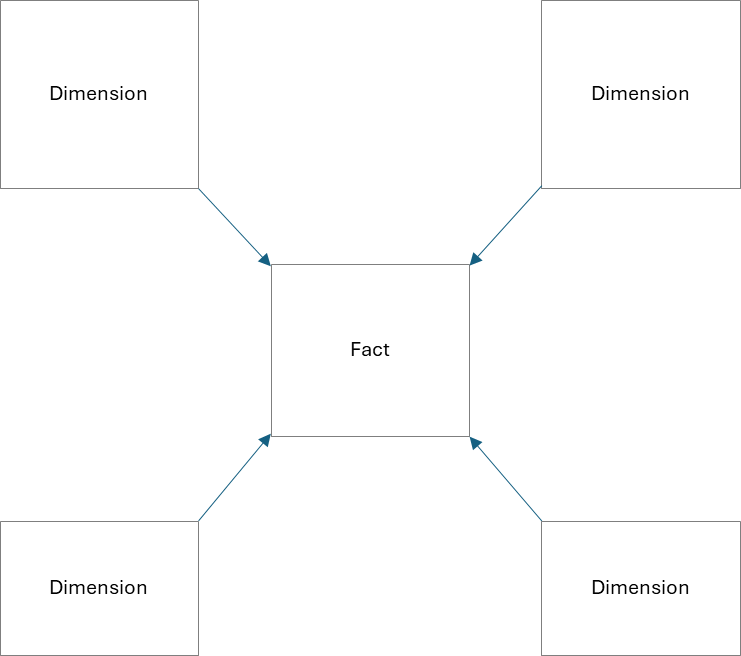
The Star Schema is a dimensional modelling design in which a central fact table connects directly to multiple surrounding dimension tables, forming a star-like structure. The fact table stores quantitative measures of a business process, while the dimension tables provide descriptive context for analysis.
The primary goal of the star schema is to deliver a simple, high-performance, and business-friendly structure for analytics. It is designed specifically for reporting, dashboards, and self-service business intelligence, where clarity and speed are critical.
In a star schema, the fact table captures measurable events such as LoanAmount, InterestRate, ApprovalCount, or RepaymentAmount. Each row represents a clearly defined grain, such as one loan approval or one repayment transaction. The fact table contains foreign keys that link to dimension tables.
The dimension tables contain descriptive attributes used for filtering, grouping, and slicing data. Examples include:
3 min readMore
- I Am Datapedia!
Data Warehousing and Business Intelligence
Snowflake Schema
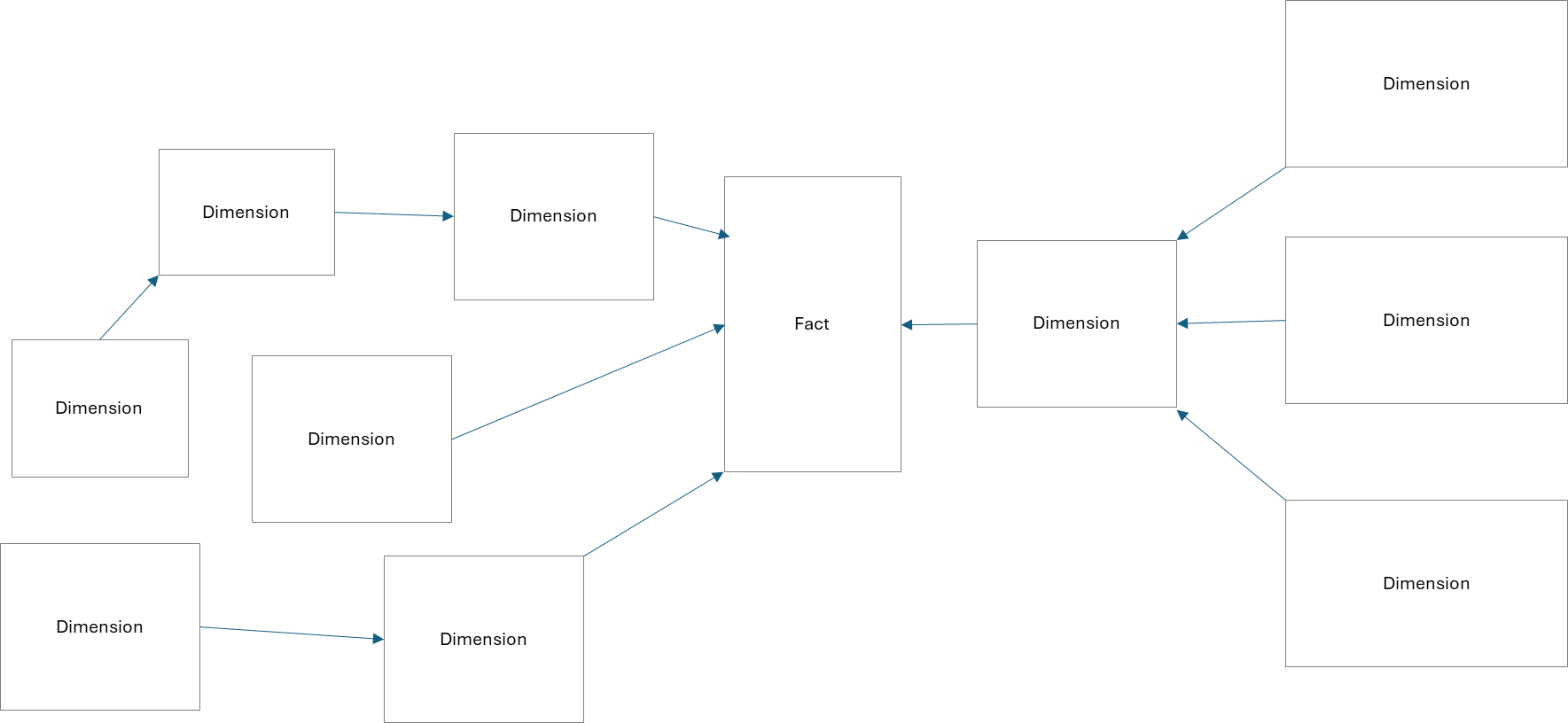
The Snowflake Schema is a dimensional modelling design in which one or more dimension tables are normalized into related sub-dimensions, forming a snowflake-like structure around a central fact table. While the fact table remains the analytical core, dimension tables are decomposed to reduce redundancy and improve governance.
The primary goal of the snowflake schema is to improve data quality, storage efficiency, and reusability, especially for large, shared dimensions, while still preserving dimensional modelling semantics for analytics.
A snowflake schema typically begins as a classic star schema (Fact + Dimensions). Over time, wide dimension tables may be normalized into smaller, related sub-dimensions. For example:
- Dim_Customer may be split into:
- Customer (core identity attributes)
- Demographics (age band, income band)
- Employment (industry, employer category)
- Geography (city, region, country)
3 min readMore
- Dim_Customer may be split into:
Build a strong foundation in Data & AI
Follow the Data Foundations learning path (Beginner to Advanced).