Once you sign in, your details will show here.
Knowledge Hub
+ New Topic
Filter (1)
Sort
372 topics · Article · 10 shown
Show allEvery topic is free to read. A free account also lets you search the topics, react to a topic and comment under it.
- I Am Datapedia!
Data Integration and Interoperability
Semantic Interoperability
Semantics are different for everyone. In an organization, each department has its own semantics, to view data. Same data can have different meanings for one department as compared to others.
Salary for HR department is to know who is getting what and when they hire new candidate, they can refer to what others are getting based on role, JD, skill set etc.. But Salary for Finance department can be, to calculate annual expense for the company.
Semantic Layer in Decision Support Systems are based on business requirements, in their language, using their own key words, their codes etc.
Interoperability on the other hand is about exchanging something across systems so others don’t need to regenerate it again and again.
Semantic Interoperability is about exchanging semantic information across systems or across departments or across organizations. But this comes with a challenge whether the receiving party can understand the keywords, symbols, terminologies etc., from the sending party.
2 min readMore
- I Am Datapedia!
Others
POC
POC stands for Proof of Concept. POC normally follows Sales Context of the product.
In POC, output is most important, not technology. In POC, the implementers make sure output is fulfilling customer requirements and at the same time convince business that this is the solution to go with.
The Goal of POC is to make sure whether Idea is Feasible or not.
‘POC is built and run for Business Users.’
1 min readMore
- I Am Datapedia!
Others
Prototype
Protype is the next stage of POC. In POC, one has test that yes Idea is Feasible, and it will benefit business agenda.
Now, in Prototyping, tools and technologies comes into picture where one starts converting Ideas in Reality, where it will show how the end-result will look like. It will show, how product will look like. It will show the real end solution.
Prototype is not built considering that business users will jump in and start using it. Prototypes are normally for technical folks to evaluate the end results with dumpy but relevant data.
’Prototype is built and run for Technical Users.’
1 min readMore
- I Am Datapedia!
Others
Pilot or MVP
New name of Pilot is MVP 😊. MVP is the next stage of Prototyping where Tools and Technologies are tested, and end solution is tested by technical folks. Now in MVP, subset of actual requirements is considered, subset of real data is used, subset of hardware and infrastructure is used, subset of software is used, and limited number of features are implemented.
Once MVP is ready, it’s released to actual users to start using it. This gives business users a taste of the actual solution. The biggest advantage of this approach is, with small implementation, with small investment, business can taste the blood and take a decision to go to the next stage or drop the solution.
Now a days, many organizations divide complete solution into multiple MVP(s) i.e., by implementing solutions in chunks, this is also supported by Agile approach where product gets ready in shorter timeframes and then keeps maturing with time. In MVP, just like actual implementation, three environments are spin i.e., DEV, UAT and PROD, along with all the steps like DevOps, CI/CD, Metadata Management, Data Quality, Data Governance, Data Lineage, Master and Reference Data Management, and many other steps which are required to go to Production.
2 min readMore
- I Am Datapedia!
Data Storage and Operations
CRUD and CRAP
CRUD and CRAP functions are our daily used processes for data folks, but surely by name most are not aware of these words 😊.
Let’s decode these…..
As we have been using structured data for the last few decades, we know how to create, read, update, and delete. These basic functions which we use in any database are called CRUD data.
Now, the new era, the current era, surfaced where data started to flow-in with high velocity from web logs, social streams, CCTV, sensor data, videos, Facebook, or Tweeter data, mobile, geo-spatial, and so on. All this data has nothing to do with transactional data, so we used to call it CRAP data 😊. But now these have become one of the most valuable assets of any organization. The speed this data is coming, it’s normally not possible to update or delete it so it’s been created, replicate, appended, and process only.
CRUD stands for Create, Read, Update, and Delete
1 min readMore
- I Am Datapedia!
Data Security
Accessibility and Visibility
Accessibility and Visibility are often used interchangeably, especially in simple terms. However, in the world of data solutions, it's crucial to distinguish between them.
Let’s decide it…..
Accessibility pertains to your ability to connect to and utilize data for decision-making purposes.
On the other hand, Visibility involves having a comprehensive understanding of what's happening behind the scenes with your data.
For instance, if you request your Data Warehousing or Data Lakehouse datastore owners to extract data from source systems and transform it into the desired format for decision-making, two key concepts come into play:
Accessibility: This is achieved when your database administrator or datastore owner grants you privileges within the database, allowing you to read, write, or update your data.
Visibility: This extends beyond mere access. It encompasses a deep understanding of various aspects of your data, such as what was sourced, the business rules used for transformations, the presence of business, technical, or operational metadata, the formula for golden records, data quality assurance methods, data loading approaches (e.g., CDC, batch, real-time), SLAs, and lineage information, among other things. All of these elements collectively provide you with comprehensive Visibility into your data.
2 min readMore
- I Am Datapedia!
AI and Machine Learning
Generative AI
Generative Artificial Intelligence (AI) has become a prominent trend in recent times, particularly emphasized by our enthusiastic Sales folks 😊. But let's pause for a moment, are you familiar with the concept of Synthetic Data? Surely, it's not new to you 😊. And for those with a tech-savvy mindset, the term "Generative AI" likely triggers thoughts of Generative Models or Statistical Models, perhaps with a knowing smile.
Indeed, the application of generative and statistical models has been around for decades. In fact, the idea of Generative AI isn’t new at all, it dates back to as early as 1950, when Alan Turing proposed machines that could exhibit intelligent behavior.
Today, however, we're witnessing a resurgence of interest, largely due to the accessibility and power of tools like OpenAI’s ChatGPT, Google Gemini, Anthropic’s Claude, Meta's LLaMA, and Stability AI's Stable Diffusion. These tools represent a leap forward in putting generative capabilities into the hands of everyday users, generating text, images, audio, and even code with natural ease.
3 min readMore
- I Am Datapedia!
Data Integration and Interoperability
ETLT
ETLT is a way of talking about how we handle information. Think of it like this: first, we take out the data we need. Then, we change it to make sure it's clean and ready to use. After that, we put it where we want it to be. Lastly, we might make some more changes to the data to make it even better for understanding. ETLT is like a helpful addition to the usual process (ETL) that makes our data even more useful and organized.
ETLT stands for "Extract, Transform, Load, and Transform" in the context of data integration and processing. Please don’t worry about where this ETLT has come from. ETLT just includes another stage in ETL world to support semantic layers.
Let’s understand each:
- Extract: Involves extracting data from various sources, which could be databases, applications, logs, or other systems.
- Transform (First T): Refers to the process of cleaning, structuring, and enriching the extracted data so that it is suitable for analysis. Transformation may include data cleansing, normalization, aggregation, and other operations.
- Load: Involves loading the transformed data into a target database or data warehouse where it can be used for reporting, analysis, or other purposes.
- Transform (Second T): This additional transformation step might be included in some interpretations of ETLT. It represents further processing or transformation that occurs after the data has been loaded into the target system. This step acknowledges that data transformation can be an ongoing and iterative process.
2 min readMore
- I Am Datapedia!
Data Integration and Interoperability
Synchronization andPropagation
In the world of data, synchronization and propagation are like superheroes that make sure our information stays accurate and consistent, even when it's spread out in different places.
Let's understand these ideas:
Synchronization:
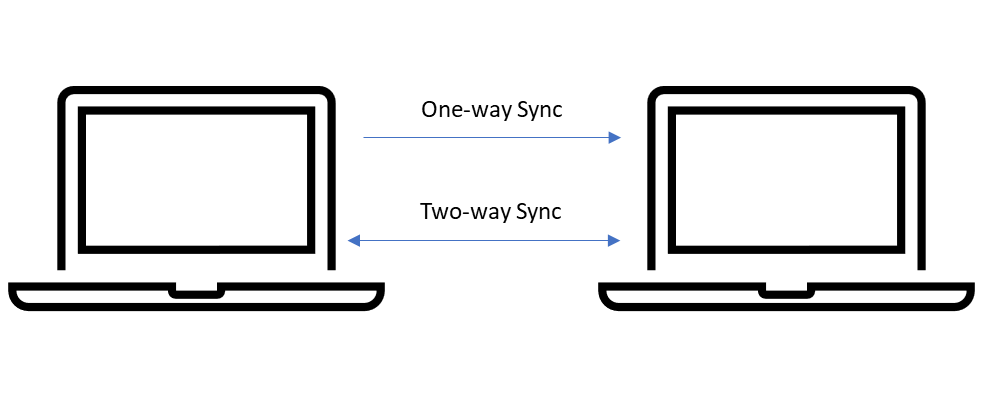
- Synchronization is about keeping data the same and up to date in many different spots or systems.
- The goal is to ensure that if we change something in one place, like updating the inventory in an online store, those changes quickly show up everywhere else, such as on the website and in the physical store's system. This way, everyone using the data gets the latest and correct info.
- For example, imagine you run an online store, and you add new items to your inventory on your computer. Synchronization is like magic that makes sure those new items appear on your website and in your store's computer, so customers and the store both know what's available.
Propagation:
- Propagation is like the spreading of news, but for changes in data. It's about making sure updates in one part of a system travel to other connected parts.
- When something changes, like depositing money at an ATM in a bank, propagation helps that change reach all the places that need to know, such as your online bank account and the main bank database. It's like making sure the news of the deposit goes to all the right places.
- For example, if you put money into an ATM, propagation ensures that the information about your deposit reaches all the important places, like your online bank app and the bank's main computer. It's like making sure everyone in the banking system knows about the deposit.
2 min readMore
- I Am Datapedia!
Data Modeling and Design
Supertype and Subtype
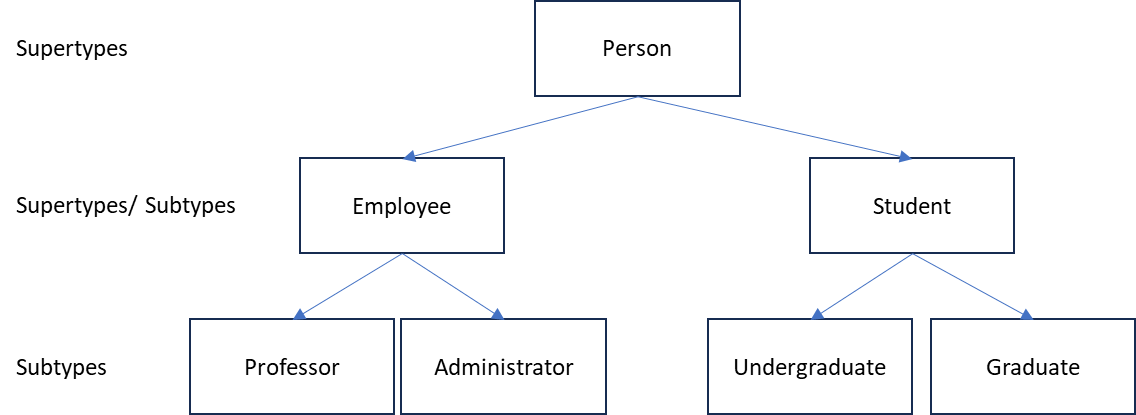
In data modelling, particularly in the context of relational databases, the terms "supertype" and "subtype" are used to describe the relationships between entities.
Let's explore these concepts:
Supertype: A supertype is a generalization that represents a higher-level entity. It encompasses common characteristics shared by multiple lower-level entities.
- It contains attributes common to multiple related entities.
- It represents the generalization of several entities.
- For example, consider a supertype "Vehicle" that includes common attributes like "Manufacturer," "Model," and "Year." Cars, motorcycles, and trucks could be subtypes of this supertype, inheriting these common attributes.
- Subtype: A subtype is a specialization of a supertype, representing a more specific entity with additional attributes or characteristics.
- It inherits attributes from the supertype and may have additional attributes.
- It represents a more specific category within the generalization.
- For example, using the "Vehicle" example, "Car" is a subtype that inherits attributes from the "Vehicle" supertype but may have additional attributes specific to cars, such as "Number of Doors" or "Body Type."
2 min readMore
Build a strong foundation in Data & AI
Follow the Data Foundations learning path (Beginner to Advanced).