Once you sign in, your details will show here.
Knowledge Hub
+ New Topic
Filter (2)
Sort
230 topics · Intermediate · I Am Datapedia! · 10 shown
Show allEvery topic is free to read. A free account also lets you search the topics, react to a topic and comment under it.
- I Am Datapedia!
Data Storage and Operations
Performance in Data Lake
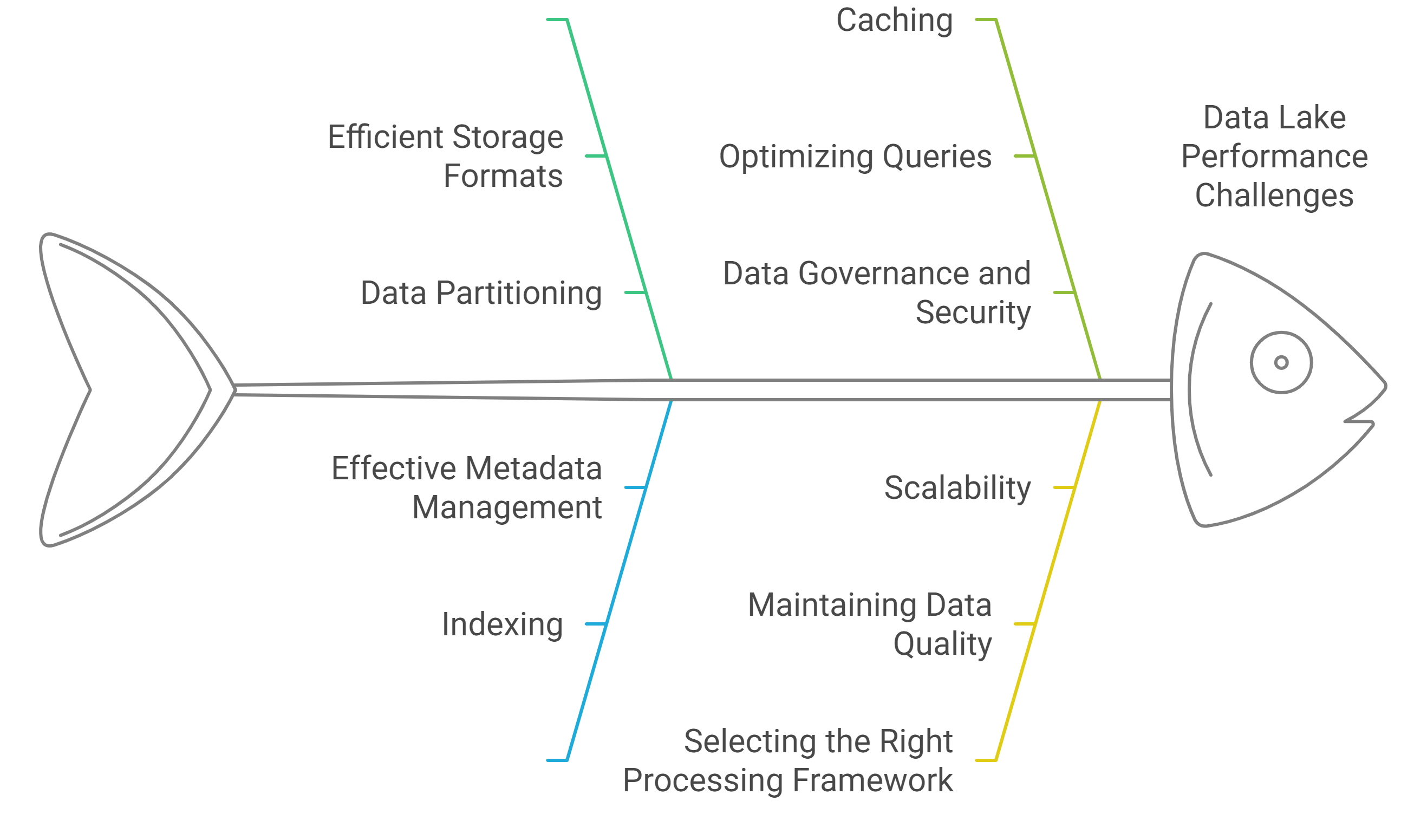
When discussing performance in a data lake, it refers to the efficiency with which data is stored, retrieved, and processed. To ensure high performance in a data lake, several factors need to be addressed:
- Efficient Storage Formats: Opt for optimized formats like Parquet or ORC, which store data in columns, allowing for better compression and faster retrieval, especially when dealing with large datasets.
- Data Partitioning: Dividing large datasets into smaller, more manageable parts (partitions) is crucial. For example, partitioning data by time, region, or product category ensures that only the relevant portion of data is accessed during queries.
- Indexing: Although data lakes are often schema-less, introducing indexes, when supported, or utilizing frameworks like Apache Hudi or Delta Lake, can accelerate query performance and make data access more efficient.
- Effective Metadata Management: Metadata helps in organizing and tracking the structure of data in a lake. Proper metadata management using tools like Apache Hive, AWS Glue, or Databricks Unity Catalog can greatly speed up data processing and query execution.
- Caching: Frequently accessed data can be stored in cache, which significantly reduces retrieval times for repeated queries. A caching layer can help in making data access more responsive.
- Optimizing Queries: Query engines such as Apache Spark, Presto, or AWS Athena can optimize SQL queries, particularly on large datasets. By leveraging distributed computing, these tools can run queries in parallel, improving overall performance.
- Data Governance and Security: While governance and security don’t directly impact performance, maintaining clear data access policies and ensuring encryption can prevent bottlenecks and help sustain operational efficiency.
- Scalability: One of the major benefits of data lakes is their ability to scale. Cloud storage platforms like AWS S3, Azure Data Lake, or Google Cloud Storage enable you to adjust storage capacity as needed. To maintain performance, it's crucial to ensure that your compute resources scale appropriately with the data.
- Maintaining Data Quality: High-quality, clean data reduces the need for time-consuming transformations or error handling, thus speeding up data processing and improving overall performance.
- Selecting the Right Processing Framework: Choose an appropriate data processing engine based on your needs. Solutions like Apache Spark, Flink, or Databricks are designed for handling large volumes of data, and you may opt for batch processing or real-time stream processing depending on your requirements.
2 min readMore
- I Am Datapedia!
Data Quality
Functional andNon-Functional Testing
At its core, functional testing involves validating all the use cases and requirements outlined in the Functional Requirements Document (FRD) or other business requirement specifications to ensure the product operates as intended. In contrast, non-functional testing focuses on evaluating the product's quality attributes, such as performance, compliance with governance standards, security measures, and overall system reliability, ensuring it meets predefined benchmarks beyond functional correctness.
Testing is a critical phase in the software development lifecycle, ensuring that a product meets its requirements and functions as intended. It is broadly divided into two categories: functional testing and non-functional testing. Understanding these categories is essential for developing robust, reliable, and user-friendly software systems. This chapter explores these two testing types, their significance, methodologies, examples, and key differences.
5 min readMore
- I Am Datapedia!
AI and Machine Learning
Agentic AI
Let’s start here: traditional AI predicts. Agentic AI acts.
Instead of just answering your questions or generating text, Agentic AI can pursue goals, make decisions, use tools, and even coordinate with other agents to get things done. It’s not a passive model waiting for instructions. It’s a collaborator, a kind of digital teammate.
That’s what “agentic” means: having agency. The ability to decide, adapt, and operate with autonomy in a live environment.
So, while older AI models were smart calculators, Agentic AI is more like a strategist who:
- Understands your goal (not just your prompt)
- Makes a plan
- Takes action, sometimes with improvisation
- Learns and adjusts along the way
How Does It Work?
Most agentic systems follow a process called the Agent Loop:
- Observe: Take in input from users or systems
- Plan: Break the goal into steps
- Act: Use tools, APIs, or sub-agents to perform tasks
- Reflect: Evaluate what worked (or didn’t)
- Adjust: Update plan or memory and repeat
3 min readMore
- I Am Datapedia!
Data Governance
Data Contract
In the world of modern software development, data contracts serve as the foundation for reliable, scalable, and secure communication between systems. As businesses increasingly adopt microservices architectures, APIs, and distributed systems, defining clear and structured data contracts becomes essential to ensure seamless interoperability.
A data contract is a formal agreement between systems that defines the structure, format, and rules of data exchanged between them. It outlines the expected data fields, data types, constraints, and validation rules that govern the interaction, ensuring that all parties adhere to a consistent standard.
Importance of Data Contracts
Data contracts play a crucial role in software development for several reasons:
- Consistency: They provide a standardized way to define and communicate data structures across systems, reducing ambiguity.
- Interoperability: By adhering to a common contract, different systems, even those built with different technologies, can seamlessly interact.
- Data Integrity: Contracts enforce validation rules that help maintain the integrity and quality of data.
- Security: Clearly defined structures help prevent unintended data exposure and ensure compliance with security standards.
- Scalability: Well-defined contracts enable systems to evolve independently while maintaining compatibility.
- Documentation: They serve as a living document that helps developers understand and integrate with APIs efficiently.
3 min readMore
- I Am Datapedia!
Data Storage and Operations
Lakebase
While “Lakebase” may sound like a new term, its conceptual foundation is rooted in an established class of systems known as HTAP (Hybrid Transactional/Analytical Processing). HTAP systems emerged to break the artificial divide between OLTP and OLAP by enabling both workloads within a single environment. Lakebase carries this ambition forward, but fundamentally rearchitects it for the cloud-native, AI-first era.
Rather than merely merging OLTP and OLAP capabilities, Lakebase introduces a modernized architectural paradigm:
- Decoupled compute and storage
- Metadata-as-control-plane execution
- Branchable workloads and snapshot isolation
- AI-native compatibility and elastic serverless scaling
Lakebase doesn’t reinvent convergence, it modernizes it for distributed ecosystems that demand autonomy, agility, and intelligence.
FROM LEGACY FRAGMENTATION TO UNIFIED INTELLIGENCE
For decades, enterprises were shackled by siloed tooling:
3 min readMore
- I Am Datapedia!
Data Governance
Corporate Data
Corporate Data refers to all the information that belongs to a company and is used to run its business. It includes data created by employees, systems, customers, and partners during daily operations. This data supports decision-making, reporting, planning, and long-term strategy.
In simple terms, corporate data is the complete collection of information that helps a company function and grow.
Corporate data is not limited to one department. It exists across finance, sales, marketing, operations, HR, supply chain, customer service, and IT. Even emails, contracts, reports, dashboards, and system logs are part of corporate data. It may be structured, such as database tables, or unstructured, such as documents and videos.
Types of Corporate Data
Corporate data generally falls into several categories.
- Operational data includes day-to-day transactions such as sales orders, payments, and inventory updates.
- Master data includes core entities like customers, products, employees, and suppliers.
- Financial data includes revenue, expenses, budgets, and accounting records.
- Analytical data includes aggregated and historical information used for reporting and decision-making.
- Unstructured data includes emails, PDFs, contracts, social media comments, and call recordings.
3 min readMore
- I Am Datapedia!
Others
Management By Object (MBO)
Management by Objectives (MBO) is a structured management philosophy in which managers and employees jointly define clear, measurable goals and evaluate performance based on the achievement of those goals. The concept was introduced by Peter Drucker, who emphasized that organizations perform best when objectives are clearly defined and aligned across all levels.
At its core, MBO shifts focus from activity to results. Instead of asking, “Are people busy?”, it asks, “Are we achieving what we set out to achieve?”
The Philosophy Behind MBO
Traditional management often relied on supervision and task control. MBO changed this thinking by introducing goal alignment and accountability. The idea is that when employees understand the organization’s objectives and participate in setting their own goals, they become more responsible and motivated.
MBO is based on a few fundamental principles:
- Clarity of objectives.
- Alignment between individual and organizational goals.
- Participation in goal setting.
- Measurable outcomes.
- Periodic performance review.
4 min readMore
- I Am Datapedia!
Data Governance
KPI vs OKR vs MBO
MBO, OKR, and KPI are closely related concepts in performance management, but they operate at different levels. MBO (Management by Objectives) is a management philosophy introduced by Peter Drucker that focuses on aligning employees and managers around clearly defined objectives, usually on an annual basis. OKR (Objectives and Key Results) is a structured goal-setting framework that defines short-term objectives and measurable results, typically in quarterly cycles. KPI (Key Performance Indicator) is a measurable metric used to track performance and monitor progress over time.
In simple terms, MBO defines the overall management approach, OKR defines how goals are structured and reviewed in shorter cycles, and KPI provides the numerical indicators that measure performance. MBO and OKR focus on goal setting and alignment, while KPIs focus purely on measurement. They are not competing systems but different layers of performance management that can work together.
3 min readMore
- I Am Datapedia!
AI and Machine Learning
Multi-Modal Data
Multi-modal data refers to data that comes in multiple formats or modalities. A modality simply means a type or form of data. In traditional systems, most data was structured text or numbers stored in tables. Today, organizations deal with text, images, audio, video, sensor readings, and more. When different types of data are combined and analyzed together, this is called multi-modal data.
For example, a social media post may include written text, an image, location information, and user reactions. Each of these is a different modality. When analyzed together, they provide richer insights than analyzing just one type alone.
Multi-modal data has become especially important in artificial intelligence and machine learning. Modern AI systems are designed to process text, images, speech, and structured data simultaneously. For instance, a customer service system may analyze a voice recording, convert it to text, examine sentiment, and combine it with customer transaction history. This is a multi-modal approach because it uses more than one type of data to understand the situation.
3 min readMore
- I Am Datapedia!
AI and Machine Learning
Embeddings
Embeddings are numerical representations of data that capture meaning, context, or relationships in a form that machines can understand. Instead of storing words, images, or other data types as raw symbols, embeddings convert them into vectors, which are lists of numbers.
These numbers are not random. They are generated in a way that preserves relationships. If two words or objects are similar in meaning, their embeddings will be mathematically close to each other in vector space.
In simple terms, embeddings translate meaning into numbers.
Why Embeddings Matter
Computers cannot understand language or images the way humans do. They process numbers. Embeddings allow complex data such as text, audio, or images to be transformed into mathematical form while preserving semantic meaning.
For example, the words “king” and “queen” will have embeddings that are close to each other. The words “apple” and “car” will be farther apart. This distance represents similarity.
3 min readMore
Build a strong foundation in Data & AI
Follow the Data Foundations learning path (Beginner to Advanced).