Knowledge Hub
Learn free, at your own pace.
Self-paced learning from the trainer’s own published work, with topic self-checks — alongside, not instead of, our expert-led trainings.
Topics
383 topics · page 37 of 39
361
Data Modellingwith Graph Theory
Graph Theory offers an effective way to structure data as a graph, allowing efficient representation, querying, and analysis of relationships between data en…
362
MetaGraph
A MetaGraph provides information about the structure, schema, and semantics of a knowledge graph within a graph database. It essentially acts as a "graph of…
363
Knowledge Graph (KG)
Just like Row is the physical content in a Relational Database, Knowledge Graph (KG) is the physical content in a Graph Database. Knowledge Graph (KG) integr…
364
DAGs (Directed Acyclic Graphs) orExecuton Graph
An Execution Graph is a visual and logical representation of how tasks, operations, or computations are executed in a system. It shows the order in which act…
365
DOGs (Data Object Graphs)
DOGs, or Data Object Graphs, represent data objects and the relationships between them in the form of a graph. Instead of organizing data only in tables and…
366
Difference BetweenMetaGraph,Ontology andTaxonomy
In simple words, Graph Theory defines the structure i.e., data model, MetaGraph are the metadata, Taxonomies are the classifications, and Ontologies are the…
367
Data Wrapping
Data Wrapping is the practice of augmenting raw data with additional layers of value, such as tools, metadata, and context, to make it easier to use, underst…
368
RAG(Retrieval-Augmented Generation)
The widespread adoption of large language models (LLMs) has led to increased expectations for factual accuracy. However, LLMs often generate incorrect answer…
369
Quantum Computing
Quantum computing is a revolutionary form of computation that leverages the principles of quantum mechanics, a branch of physics that describes how matter an…
370
Performance in Data Lake
When discussing performance in a data lake, it refers to the efficiency with which data is stored, retrieved, and processed. To ensure high performance in a…
Learn free
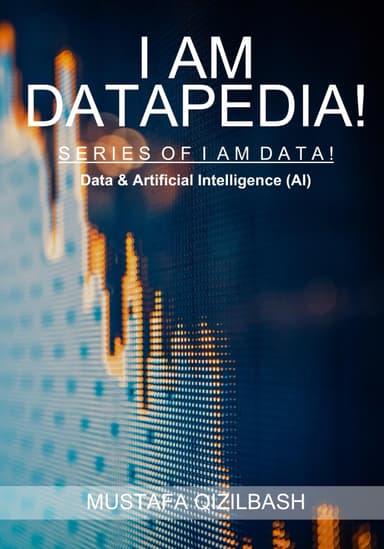
Learn from I Am Datapedia!
Every topic of the book, readable below, with a search box to find the one you need — 383 of them with a self-check at the end.
The source: I Am Datapedia! — Series of ‘I Am Data!’ — co-authored with Bill Inmon & Marco Wobben. By Mustafa Qizilbash.