Once you sign in, your details will show here.
Knowledge Hub
+ New Topic
Filter (1)
Sort
78 topics · Data Storage and Operations · 8 shown
Show allEvery topic is free to read. A free account also lets you search the topics, react to a topic and comment under it.
- I Am Datapedia!
Data Storage and Operations
UDF
UDF stands for User-Defined Function. It is a feature provided by many programming and database languages that allows users to define their own functions to perform specific tasks. UDFs are particularly useful for encapsulating commonly used logic, promoting code reusability, and enhancing the readability of code.
Few examples of UDFs in different programming and database contexts:
1. SQL UDF (User-Defined Function):
In SQL, you can create user-defined functions to perform specific tasks. Here's an example of a simple UDF in SQL that concatenates two strings:
-- SQL UDF Example
CREATE FUNCTION ConcatenateStrings(@str1 NVARCHAR(MAX), @str2 NVARCHAR(MAX))
RETURNS NVARCHAR(MAX)
AS
BEGIN
RETURN @str1 + ' ' + @str2;
END;
You can then use this UDF in SQL queries:
SELECT ConcatenateStrings('Hello', 'World') AS Result;
-- Result: Hello World
2. Python UDF:
In Python, you can define functions to encapsulate logic. Here's a simple example of a Python UDF that calculates the square of a number:
3 min readMore
- I Am Datapedia!
Data Storage and Operations
Materialized View orTemporary Tables in SQL
In typical SQL world (Structured Query Language), usually managing and manipulating data efficiently is very crucial for its performance, database lifecycle or DWH scalability. Temporary tables and materialized views are two powerful constructs (objects) that help in achieving both objectives simultaneously. Even though each serves a unique purpose within data operations and data streams. Let´s look at both little closer.
Temporary Tables
We can define them as typical tables which are created within a database session and are only available during the lifetime of that particular session. Lifetime during session is critical as they are designed to store intermediate results, results of window functions for complex calculations or data processing tasks and massive data manipulations.
Temporary tables are essentially useful in scenarios where data needs to be temporarily held and manipulated without affecting the main database tables. Here comes why it is called “temporary”. After your session ends, the temporary table is automatically discarded - same as you run command DROP TABLE, after query results are taken into another step. This way processing ensures no permanent database storage is consumed. You can imagine storing all 245 steps and their output tables consisting of 6 billion rows and 700 columns each day to have versions of each step.
3 min readMore
- I Am Datapedia!
Data Governance
ILM – InformationLifecycle Management
Let’s start by breaking down each part of this acronym based on the context of its usage.
- Information – In this case the Information is related to the usage of the related data stored in a database or a data platform.
- Lifecycle – The standard definition for life cycle is the different stages of life for a living thing. In this case the living thing is the Data. The Lifecycle for data is classified based on its usage as: - ‘HOT’, ‘WARM’, ‘COLD’ and that also could be extended to ‘DEAD’ for deleted.
- Management – The process to facilitate the movement of the data related to the information over its Lifecycle.
So, using the context above, Information Lifecycle Management (ILM) is the process to optimize data storage by automatically tiering data to different locations based on its age, access frequency, and required read/write speeds. This approach minimizes storage costs by placing frequently accessed data in high-performance tiers and infrequently accessed or archived data in lower-cost tiers. ILM can also simplify data archiving and deletion according to data retention policies.
7 min readMore
- I Am Datapedia!
Data Architecture
Data Platform Gravity
A Unified Approach to Data Ecosystem Management
The concept of Data Platform Gravity revolves around a holistic framework where every aspect of data handling, from ingestion to transformation, analytics, and deployment, is achieved within a single, unified platform. Inspired by the Data Fabric paradigm, it advocates for seamless operations across the entire data lifecycle, reducing complexities, minimizing data silos, and empowering organizations to derive value efficiently and effectively.
Understanding Data Platform Gravity
In a traditional data management ecosystem, disparate tools and technologies often create bottlenecks. A single project might involve different platforms for:
- Extracting and loading data from sources,
- Transforming and enriching data,
- Performing analytics and data science experiments,
- Visualizing results in dashboards or reports, and
- Sharing data insights with external systems or stakeholders.
4 min readMore
- I Am Datapedia!
Data Integration and Interoperability
DAGs (Directed Acyclic Graphs) orExecuton Graph
An Execution Graph is a visual and logical representation of how tasks, operations, or computations are executed in a system. It shows the order in which activities run and how they depend on one another.
In data engineering and distributed computing, an execution graph is often represented as a Directed Acyclic Graph (DAG). “Directed” means tasks move in one direction. “Acyclic” means the graph does not loop back on itself. Once a task finishes, the flow moves forward.
In simple terms, an execution graph answers one important question:
What runs first, what runs next, and what depends on what?
Why Execution Graphs Matter
Modern data systems rarely execute tasks in a straight line. Instead, they perform multiple steps such as reading data, filtering, transforming, aggregating, and storing results. Some steps can run in parallel, while others must wait for previous tasks to complete.
An execution graph helps systems:
3 min readMore
- I Am Datapedia!
Data Storage and Operations
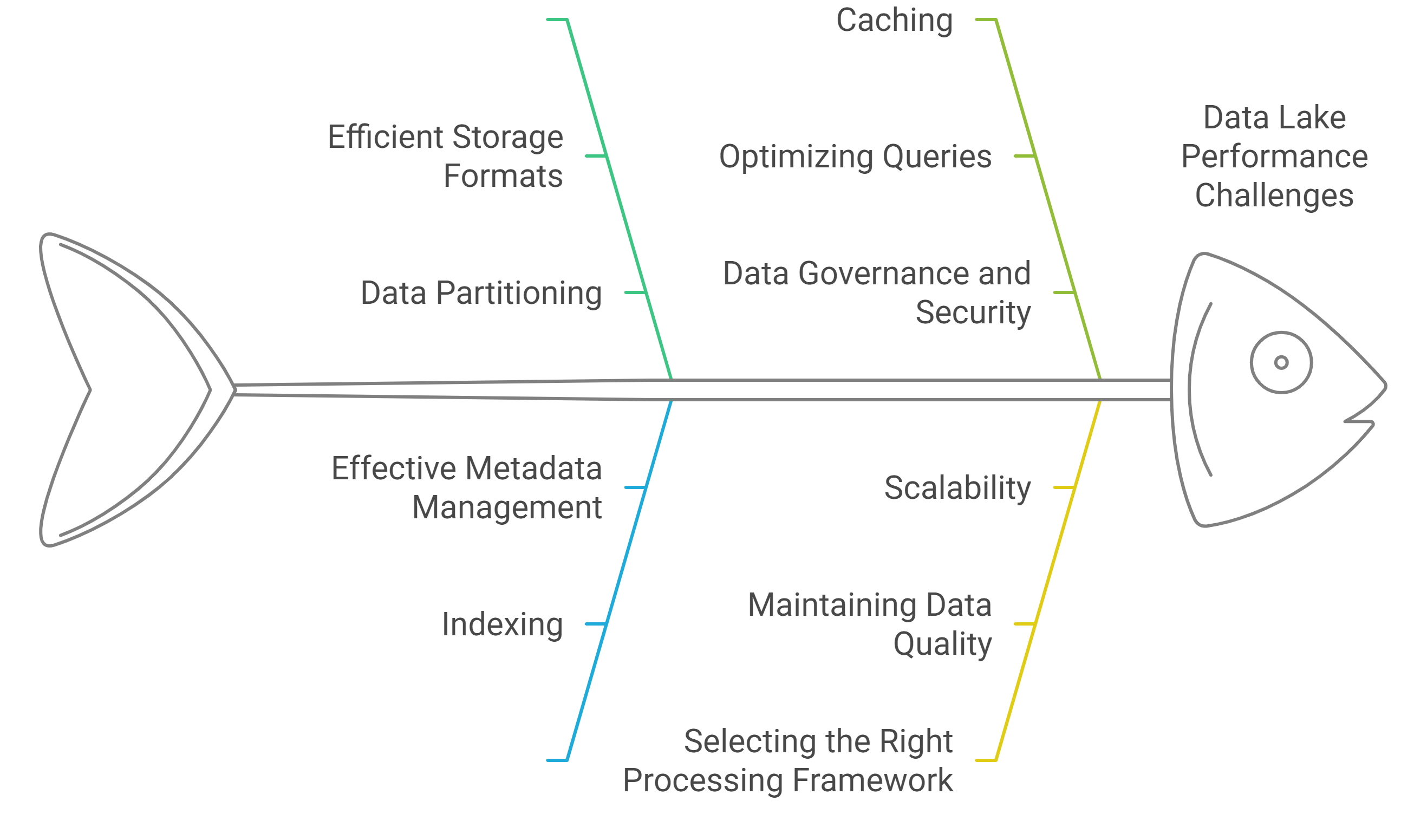
Performance in Data Lake
When discussing performance in a data lake, it refers to the efficiency with which data is stored, retrieved, and processed. To ensure high performance in a data lake, several factors need to be addressed:
- Efficient Storage Formats: Opt for optimized formats like Parquet or ORC, which store data in columns, allowing for better compression and faster retrieval, especially when dealing with large datasets.
- Data Partitioning: Dividing large datasets into smaller, more manageable parts (partitions) is crucial. For example, partitioning data by time, region, or product category ensures that only the relevant portion of data is accessed during queries.
- Indexing: Although data lakes are often schema-less, introducing indexes, when supported, or utilizing frameworks like Apache Hudi or Delta Lake, can accelerate query performance and make data access more efficient.
- Effective Metadata Management: Metadata helps in organizing and tracking the structure of data in a lake. Proper metadata management using tools like Apache Hive, AWS Glue, or Databricks Unity Catalog can greatly speed up data processing and query execution.
- Caching: Frequently accessed data can be stored in cache, which significantly reduces retrieval times for repeated queries. A caching layer can help in making data access more responsive.
- Optimizing Queries: Query engines such as Apache Spark, Presto, or AWS Athena can optimize SQL queries, particularly on large datasets. By leveraging distributed computing, these tools can run queries in parallel, improving overall performance.
- Data Governance and Security: While governance and security don’t directly impact performance, maintaining clear data access policies and ensuring encryption can prevent bottlenecks and help sustain operational efficiency.
- Scalability: One of the major benefits of data lakes is their ability to scale. Cloud storage platforms like AWS S3, Azure Data Lake, or Google Cloud Storage enable you to adjust storage capacity as needed. To maintain performance, it's crucial to ensure that your compute resources scale appropriately with the data.
- Maintaining Data Quality: High-quality, clean data reduces the need for time-consuming transformations or error handling, thus speeding up data processing and improving overall performance.
- Selecting the Right Processing Framework: Choose an appropriate data processing engine based on your needs. Solutions like Apache Spark, Flink, or Databricks are designed for handling large volumes of data, and you may opt for batch processing or real-time stream processing depending on your requirements.
2 min readMore
- I Am Datapedia!
Data Quality
Functional andNon-Functional Testing
At its core, functional testing involves validating all the use cases and requirements outlined in the Functional Requirements Document (FRD) or other business requirement specifications to ensure the product operates as intended. In contrast, non-functional testing focuses on evaluating the product's quality attributes, such as performance, compliance with governance standards, security measures, and overall system reliability, ensuring it meets predefined benchmarks beyond functional correctness.
Testing is a critical phase in the software development lifecycle, ensuring that a product meets its requirements and functions as intended. It is broadly divided into two categories: functional testing and non-functional testing. Understanding these categories is essential for developing robust, reliable, and user-friendly software systems. This chapter explores these two testing types, their significance, methodologies, examples, and key differences.
5 min readMore
- I Am Datapedia!
Data Storage and Operations
Lakebase
While “Lakebase” may sound like a new term, its conceptual foundation is rooted in an established class of systems known as HTAP (Hybrid Transactional/Analytical Processing). HTAP systems emerged to break the artificial divide between OLTP and OLAP by enabling both workloads within a single environment. Lakebase carries this ambition forward, but fundamentally rearchitects it for the cloud-native, AI-first era.
Rather than merely merging OLTP and OLAP capabilities, Lakebase introduces a modernized architectural paradigm:
- Decoupled compute and storage
- Metadata-as-control-plane execution
- Branchable workloads and snapshot isolation
- AI-native compatibility and elastic serverless scaling
Lakebase doesn’t reinvent convergence, it modernizes it for distributed ecosystems that demand autonomy, agility, and intelligence.
FROM LEGACY FRAGMENTATION TO UNIFIED INTELLIGENCE
For decades, enterprises were shackled by siloed tooling:
3 min readMore
Build a strong foundation in Data & AI
Follow the Data Foundations learning path (Beginner to Advanced).